
Quick Take
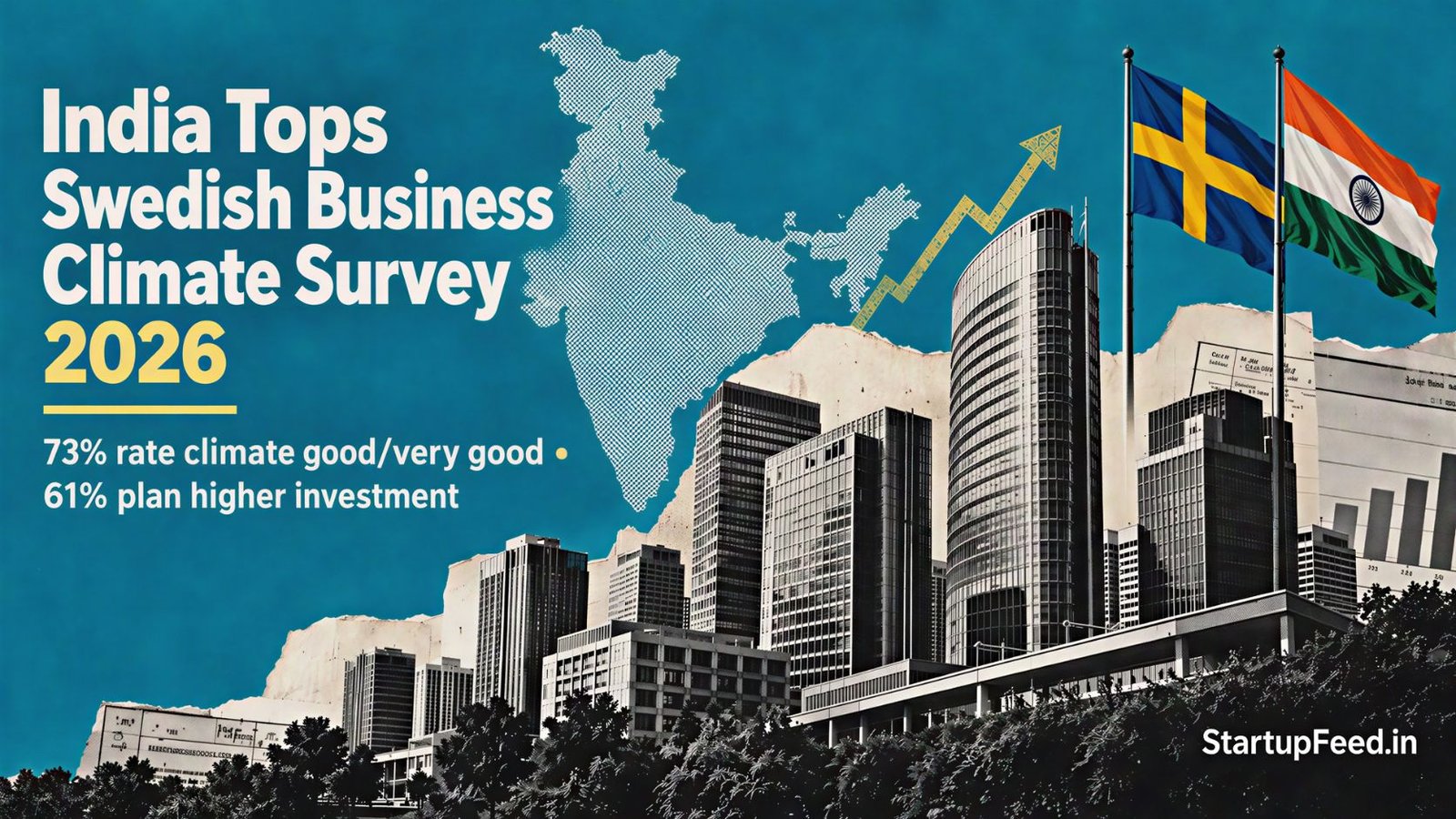
- India ranked first for business climate among 41 markets in the Global Business Climate Survey 2026.
- 73% of surveyed Swedish firms rated India’s climate good or very good. 61% plan to raise investment within 12 months.
- The survey polled 2,250-plus senior decision-makers. India has held a global top-three spot for four years running.
India ranked first for business climate among 41 global markets in the Global Business Climate Survey 2026. The Swedish Chamber of Commerce in India, known as SCCI, ran the study. Commerce and Industry Minister Piyush Goyal shared the result on September 18, 2026.
Goyal posted the finding on the social media platform X. He wrote that India is “the world’s favourite destination to do business” and called its climate a “gold standard” for stability and growth. His post also said India has stayed in the global top three for four years straight.
The survey rests on a wide sample. It drew on more than 2,250 senior decision-makers at Swedish companies. It covered 41 markets where those firms operate. Business Sweden, Swedish Chambers International and Sweden’s foreign ministry ran it together.
Two India-specific numbers matter most for founders. First, 73% of surveyed firms rated India’s current business climate good or very good. Second, 61% said they plan to increase investment over the next 12 months. Both figures come from Goyal’s summary of the SCCI data.
What did the survey actually measure?
The Global Business Climate Survey measures how Swedish firms view the markets they work in. It tracks economic performance, business outlook and operating conditions over time. The aim is a fact-based view of key Swedish export markets.

The study is not a red-tape ranking. It does not score legal steps or filing times, the way the old World Bank index did. It captures sentiment and plans from companies already on the ground. That is a different signal, and for a founder raising foreign money, often a more useful one.
The 2026 edition also flags a real limit. Business Sweden collected the data around the onset of a Middle East war on February 28, 2026. About 75% of responses came in before that date. The remaining 25% came after. The report says war-related effects may only be partly captured, so the results should be read with care.
How does India compare with other markets?
Asia-Pacific was the most optimistic region in the survey. India and Vietnam sat among the highest-rated markets there. The Philippines and India ranked among the top markets for planned investment.
Other regions told a mixed story. The report noted a more cautious mood across the Middle East and Africa. In Saudi Arabia, the share of firms with a positive outlook fell from 90% in 2025 to 44% in 2026. The Americas and Europe looked somewhat better than in 2025, with Ireland entering the top tier.
Growth projections were highest in a small set of markets. India, the Philippines and Poland led on market-level growth expectations, according to the survey. Across all 41 markets, 64% of Swedish firms reported profitability.
| Market or region | Survey signal, 2026 |
|---|---|
| India | Ranked first for business climate; top for growth and investment intent |
| Vietnam | Among highest-rated markets in Asia-Pacific |
| Philippines | Among top markets for planned investment |
| Saudi Arabia | Positive outlook fell from 90% (2025) to 44% (2026) |
| Ireland | Entered the top tier in Europe |
Why does this matter for Indian startups?
Foreign investor sentiment shapes startup funding. When Swedish firms say they will raise India investment, that money often flows through joint ventures, supplier deals and direct stakes. A first-place climate ranking is a talking point a founder can use in a pitch.
The sector detail is the useful part. In the earlier 2025-26 SCCI round, Goyal named the strongest turnover expectations in construction and building, aerospace and defence, IT and electronics, and business services. Founders in those sectors have a clearer case when courting European partners.


The signal has limits too. This is one chamber, tracking one country’s firms. It is not a broad measure of all foreign capital, and it is not startup-specific. Treat it as one input, not a verdict on the whole funding market.
Is this the same as the World Bank ranking?
No. This is the Swedish Chamber of Commerce in India’s survey of Swedish firms. It is not the World Bank’s old Ease of Doing Business index, which the Bank retired and is relaunching as “Business Ready.” The two measure different things and should not be mixed up.
The World Bank index scored regulation, such as the steps to start a firm or pay taxes. The SCCI survey scores how real companies feel and what they plan to do. One is a rulebook audit. The other is a mood and money reading.
StartupFeed Insight
The headline is “India first,” but the honest number is 61%. That is the share of surveyed Swedish firms planning to raise India investment inside a year. Sentiment rankings shift; committed capital does not. Watch that 61% figure in the next edition, due around mid-2027. If it holds above 60% even after the Middle East war fully feeds into the data, the India confidence is real and not a pre-war afterglow. Founders in aerospace, defence, IT and business services should court European partners now, while the ranking is fresh and quotable. A first-place climate line works in a pitch deck. The war caveat means the next reading is the one that truly tests the trend.
— Avinash Mishra, Business Correspondent
What this means for you: If you raise or partner with European capital, cite the first-place 2026 ranking now, but lead your pitch with the 61% investment-intent figure, which is the number that signals real money.
Frequently Asked Questions
Have a tip? Write to us at editorial@startupfeed.in.
Liked this story? Follow StartupFeed on Google so our reporting reaches you first.