
Quick Take
- India marks the 12th National Handloom Day on August 7, 2026, at Rashtrapati Bhavan, New Delhi.
- The sector supports 35.22 lakh weavers and allied workers, with women forming over 72% of them.
- President Droupadi Murmu confers 22 awards as handloom exports touch Rs 1,330.96 Cr in 2025-26.
In This Article
National Handloom Day 2026 is observed on August 7, 2026, as India honours its 35.22 lakh handloom weavers and allied workers at a national function at the Rashtrapati Bhavan Cultural Centre in New Delhi.
President Droupadi Murmu attends the 12th edition as Chief Guest, according to the Ministry of Textiles backgrounder. Union Textiles Minister Giriraj Singh, Minister of State Pabitra Margherita, Secretary (Textiles) Neelam Shami Rao and Development Commissioner (Handlooms) Dr M. Beena join the event. The day commemorates the 1905 Swadeshi Movement and recognises weavers across every state.
StartupFeed Insight
The real story of National Handloom Day 2026 is a quiet digital shift. When 1.50 lakh weavers list on GeM and 4,186 join the Indiahandmade platform, handloom stops being only a heritage cause and becomes a live e-commerce and D2C opportunity. Founders in fashion-tech, GI-tag authentication and rural logistics should watch the Indiahandmade and India Handloom Brand systems closely, because verified origin is the moat. Expect at least two well-funded handloom-first D2C or marketplace startups to raise external rounds by mid-2027 as authenticity infrastructure matures. By Soumya Verma.
National Handloom Day 2026: Key Facts
National Handloom Day 2026 is the 12th edition of an observance first held on August 7, 2015. The Ministry of Textiles hosts the 2026 function at the Rashtrapati Bhavan Cultural Centre in New Delhi. A total of 22 awards, comprising 3 Sant Kabir Handloom Awards and 19 National Handloom Awards for 2025, are conferred on outstanding weavers (Ministry of Textiles). The occasion also sees the release of four commemorative postage stamps and two publications, “Earth. Root. Thread” and the Handloom Awards Book 2025.
| Detail | Fact | Notes |
|---|---|---|
| Date | August 7, 2026 | 12th edition |
| Chief Guest | President Droupadi Murmu | Rashtrapati Bhavan, New Delhi |
| Weavers and allied workers | 35.22 lakh | Fourth Handloom Census, 2019-20 |
| Women in workforce | 25.46 lakh (over 72%) | Women-led sector |
| Awards conferred | 22 (3 Sant Kabir, 19 National) | For the year 2025 |
| Origin year | 2015 | First held at Chennai |
The census also recorded 28.20 lakh looms nationwide, with nearly nine out of every ten located in rural India (Ministry of Textiles). This rural weight is why weaver welfare sits at the heart of every handloom scheme.
About National Handloom Day
National Handloom Day is an annual Indian observance held on August 7 since 2015 to honour handloom weavers and promote handwoven textiles. It was instituted by the Government of India through the Ministry of Textiles, with the first celebration held in Chennai. The day marks the 1905 Swadeshi Movement, recognises the socio-economic role of weaving households, and drives the “Vocal for Local” push. Key vehicles include the India Handloom Brand, the Handloom Mark and GI (Geographical Indication) tags.


Why is National Handloom Day on August 7?
National Handloom Day falls on August 7 to commemorate the Swadeshi Movement launched on that date in 1905. The movement began at Calcutta Town Hall to boycott foreign goods and revive indigenous industries, including handloom. Prime Minister Narendra Modi announced the day in 2015, and the first edition was held in Chennai. This year, Modi urged citizens to buy handloom products and share “Get Ready With Me” videos using #NationalHandloomDay (Ministry of Textiles).
Our Government will keep supporting the handloom sector, which is a key pillar of rural empowerment and women-led development, PM Narendra Modi said on National Handloom Day.
The choice of date links a modern celebration to a historic act of economic self-reliance. It frames handloom not as nostalgia but as an early symbol of Atmanirbhar Bharat. That framing shapes how the government designs support for weavers today.
Which schemes support handloom weavers?
Handloom weavers are supported mainly through the National Handloom Development Programme (NHDP) and the Raw Material Supply Scheme (RMSS). For 2026-27, these carry budget allocations of Rs 205 Cr and Rs 200 Cr respectively (Ministry of Textiles). NHDP funds small clusters with up to Rs 2 Cr each, while mega clusters can draw central assistance of up to Rs 30 Cr over five years. During 2025-26, Rs 94 Cr was released for worksheds, looms and electronic jacquards.
The impact shows in earnings. Electronic jacquards lifted average monthly income from Rs 9,600 to Rs 15,000, and 96% of beneficiaries reported productivity gains (Ministry of Textiles). The Weaver MUDRA Scheme offers loans at a concessional 6% interest rate, and the Union Budget 2026-27 added a National Fibre Scheme plus a National Handloom and Handicraft Programme. GST on 36 handicraft items was also cut from 12% to 5%.
How strong are India’s handloom exports?
India’s handloom exports stood at about Rs 1,330.96 Cr ($152 Mn) in 2025-26, with the UAE, United States, France, United Kingdom and Spain as the top destinations (Ministry of Textiles). USD conversion uses the live rate of Rs 87.6 to $1 as sourced from Trading Economics on August 7, 2026. Distinctive designs, small-batch output and eco-friendly processes drive this global demand.
| Metric | Value |
|---|---|
| Handloom exports (2025-26) | Rs 1,330.96 Cr ($152 Mn) |
| Handloom Mark registrations | 29,402 (as of June 30, 2026) |
| Weavers on GeM | Around 1.50 lakh |
| GI-registered handloom products | 106 (as of August 2026) |
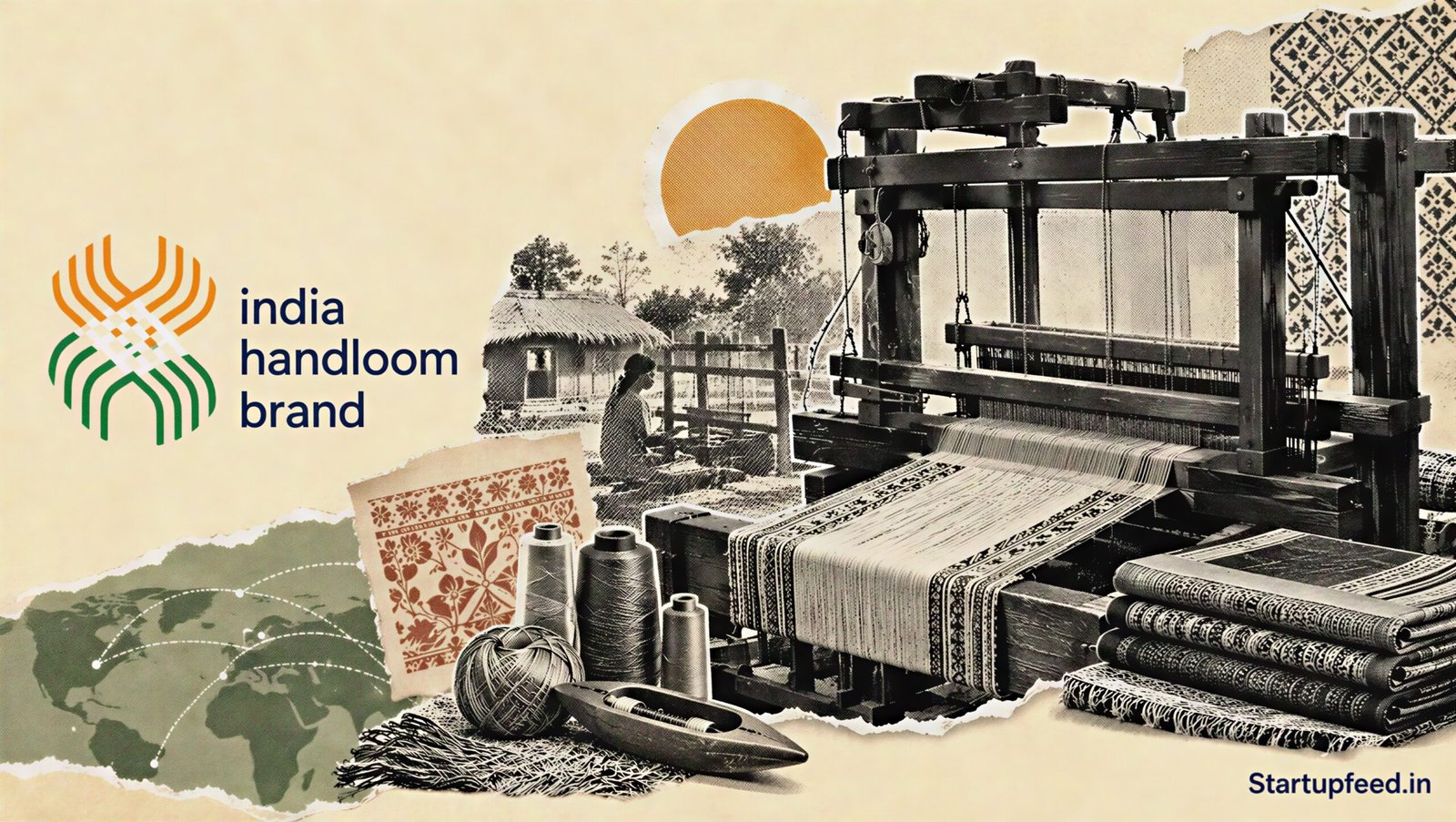
Authenticity systems back this trade. The India Handloom Brand, launched on the first National Handloom Day in 2015, now covers 2,305 registrations across 184 categories (Ministry of Textiles). What sets Indian handloom apart is verified origin at scale, a rare edge in a world of mass-produced textiles.
What’s Next
The Handloom Hackathon 2026, themed “Weaving Innovation,” invites students, weavers and startups to solve for design, market access and productivity. Winners gain a pathway to one-year incubation support, signalling a startup-style future for the craft. The National Handloom and Handicraft Programme is expected to consolidate schemes through 2026-27. Will India’s next big D2C brand story be woven on a handloom?
Frequently Asked Questions
Have a tip? Write to us at editorial@startupfeed.in.
Liked this story? Follow StartupFeed on Google so our reporting reaches you first.