

Quick Take
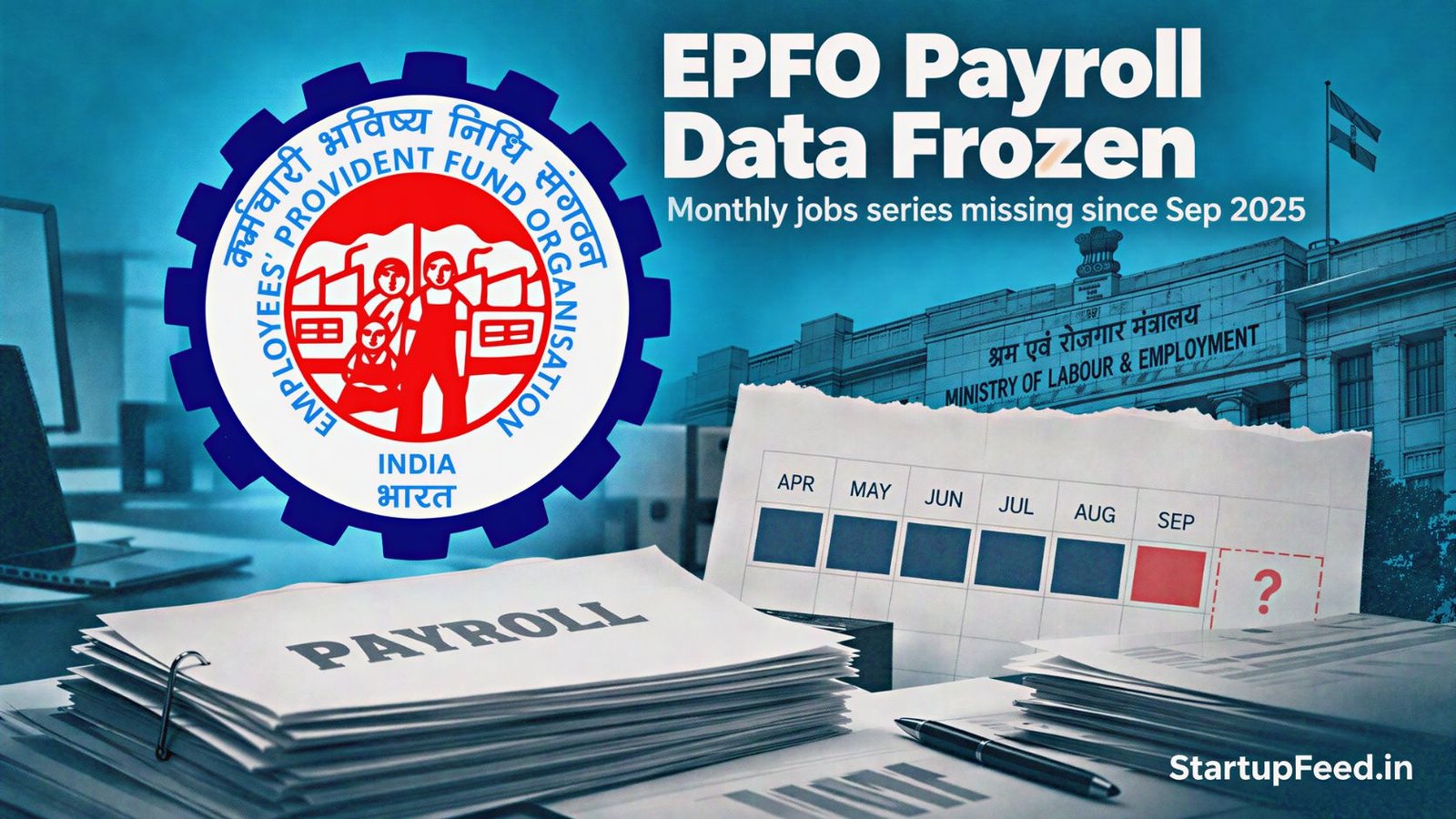
- EPFO’s monthly payroll estimate has not been published since September 2025 data, a run of 58 straight months from December 2020.
- The last press release was on September 23, 2025, for July 2025 data, which showed 21.04 lakh net additions.
- The same figures now appear as PM-VBRY scheme results and, per one report, a real-time dashboard for state governments.
India’s only monthly number for formal job creation has gone quiet. The Employees’ Provident Fund Organisation, or EPFO, has not published its provisional monthly payroll estimate since September 2025 data.
There was no notice. No delay was announced. The series simply stopped.
This is the figure every story about Indian formal employment quotes. It ran for 58 straight months, from December 2020 to September 2025, with no gap. Then it ended.
The EPFO data page tells the story plainly. It holds 58 monthly entries. The newest is the “Provisional Monthly Estimate of Payroll” for September 2025. There is no October 2025 file, no November, and nothing from 2026.
The page is free and needs no login. Anyone can open it and count the entries. That is what makes this checkable.

What actually stopped, and when
The publicity channel died first. The last payroll press release from the Press Information Bureau went out on September 23, 2025, and it covered July 2025 data.
That July release reported a net addition of 21.04 lakh members. A month earlier, the June 2025 figure was 21.89 lakh, the highest since this tracking began in April 2018.
August and September 2025 data went up on the EPFO website with no press release. No outlet covered them. Then the website uploads stopped too.
One correction is worth making before anyone quotes the youth share. The 18 to 25 age group made up 60.22% of new subscribers in June 2025 and 61.06% in July 2025. That is a share of new subscribers, not of net additions. Mixing those two denominators is the standard error in coverage of this series.
Was the data stopped, or substituted?
The sharper reading is that the number was not killed. It was moved. The data still exists, but it now travels in two new shapes, and neither is a public monthly statistic.
The first shape is scheme publicity. PM-VBRY is a Rs 99,446 crore employment scheme launched in August 2025. The Labour Ministry runs it through EPFO, and it is computed off the same Electronic Challan cum Return data that fed the payroll series.
Those same numbers now surface as scheme results. The government has cited 62.56 lakh first-time employees in the scheme’s first year, about 32.6% of its target. It has also cited Rs 744.58 crore disbursed to 13.18 lakh people.


The second shape is a private feed. Business Standard reported on August 21, 2026, that EPFO may give state governments access to real-time data on the scheme’s progress.
Put the two together and the change is clear. A universal monthly statistic became selective scheme publicity and a dashboard for state governments. Nobody announced the switch.
Proof that EPFO is not simply dormant
One easy objection is that EPFO went quiet everywhere. It did not. The organisation is generating news constantly. The payroll series just is not in it.
The government’s own broadcaster ran eight EPFO stories between May and August 2026. They covered the 8.25% interest rate, the VISHWAS scheme, an amnesty scheme, an enrolment drive, Onam pensions, WhatsApp outreach and a CBI arrest.
Not one of those eight was about payroll data. The broadcaster’s last payroll story ran on August 21, 2025. Before that, it had covered the series almost every month.
So this is not a dormant body. It is an active one that has dropped a single, specific, universal number.
One companion case, not a pattern
The tempting line is that India’s statistical system is going dark. That claim does not hold, and it is worth resisting.
The Reserve Bank of India’s forward-looking survey suite is current. Its consumer confidence, industrial outlook, inflation expectations, bank lending and forecaster rounds all ran, and the September 2026 round launched on September 8, 2026.
The quarterly Periodic Labour Force Survey is current too, with Q1 FY27 results released on August 10, 2026. Two frozen series are two cases, not a trend.
There is one genuine companion, and it points the same way. The RBI Digital Payments Index, or DPI, has itself gone stale. RBI publishes it twice a year, for the March and September positions, with a lag of about four months.
The last reading RBI has published is 493.22, for March 2025, put out on July 28, 2025. On RBI’s own series table, that is where the index stops.
| Period | RBI Digital Payments Index |
|---|---|
| March 2023 | 395.57 |
| September 2023 | 418.77 |
| March 2024 | 445.50 |
| September 2024 | 465.33 |
| March 2025 | 493.22 |
| September 2025 | Not published |
The September 2024 reading was published on January 29, 2025. By that cadence, the September 2025 figure was due around late January or early February 2026. It has not appeared, and there is no revision or rebasing notice.
Use the DPI as a second example of the same habit. Do not build a system-wide claim on two data points.
One honest gap remains in the reporting. The EPFO page carries no upload dates, so the exact day the last file appeared cannot be pinned down. That is a question for EPFO directly, and RBI’s press office can be asked the same about the DPI.
What this means for you: If your deck, pitch or board note cites a recent EPFO monthly jobs figure, check the date. Anything past July 2025 is not a published monthly estimate, and you should source formal-employment claims from PLFS or the scheme figures instead.
StartupFeed Insight
The quiet part is the method. A monthly public number was not defended and then removed. It was left to lapse while the same underlying data got re-released as scheme wins and, per Business Standard, a private feed to states. A statistic anyone could audit became one only the government frames. Watch the September 2025 DPI reading. If it is still missing by December 2026, the case that this is a habit, not a coincidence, gets much harder to argue against.
— Avinash Mishra, Business Correspondent
Have a tip? Write to us at editorial@startupfeed.in.