Quick Take
- Medicine baskets run Rs 800 to Rs 1,200, against a grocery basket of Rs 300 to Rs 450. Repeat orders sit near 50% a month.
- Zepto still lost about Rs 79 on every order in FY26, down from Rs 136 in FY25, per its updated DRHP filed on June 8, 2026.
- Over 8 lakh chemists struck on May 20, 2026, and India still has no final e-pharmacy law seven years after the 2018 draft.
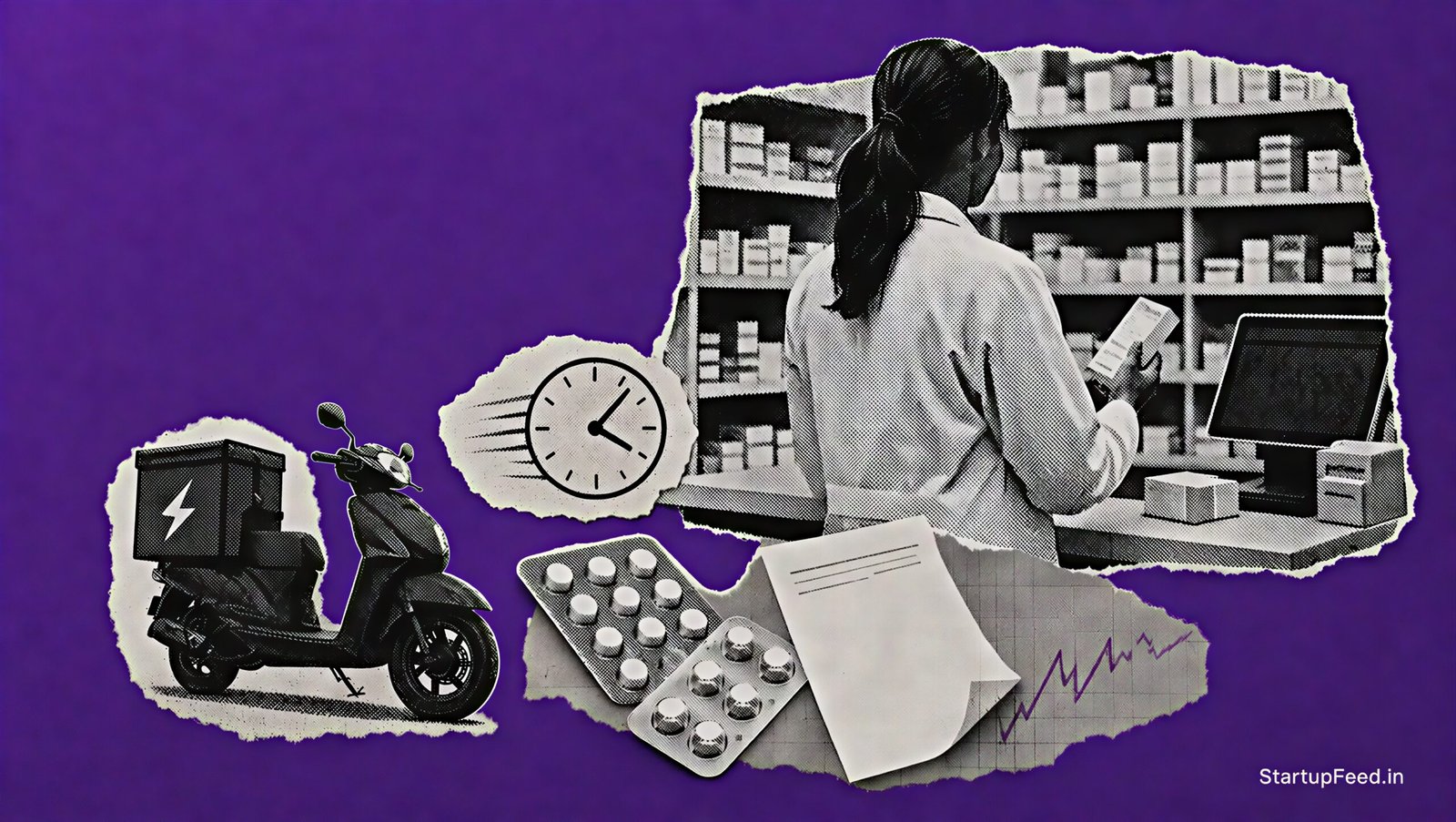
Quick commerce apps in India now deliver medicines in 10 minutes. The pitch is a bigger, more loyal basket. The unit economics are harder than that pitch sounds.
Zepto launched Zepto Pharmacy on August 7, 2025, across Mumbai, Bengaluru, Delhi NCR and Hyderabad. Aadit Palicha, co-founder and chief executive of Zepto, announced it after a 12-month pilot. He said the plan is to grow it slowly.
The category also carries a legal cloud. The All India Organisation of Chemists and Druggists (AIOCD) wants prescription drug delivery in minutes banned outright. Over 8 lakh of its members struck work on May 20, 2026.
What Makes 10-Minute Medicine Delivery Look Attractive?
Medicine is a high-frequency, high-value category, and that is the whole appeal. A patient on a long-term prescription reorders every month. That is exactly the repeat behaviour these apps need.
The average medicine order runs Rs 800 to Rs 1,200, Outlook Business reported. That is two to three times a grocery basket. Repeat rates sit near 50% a month, far above impulse grocery buys.

Delivery cost per medicine order can also be lower. A hub-and-spoke pharmacy model pools stock in fewer, larger stores. That spreads the fixed cost of each store across more orders.
The timing matters for Zepto. The company crossed Rs 22,624 crore in revenue in FY26, up 103% year-on-year, per its updated draft prospectus. In FY25 the figure was Rs 11,110 crore.
A fresh, higher-margin category helps an IPO story.
The field is already crowded. Zepto Pharmacy competes with Tata 1mg, PharmEasy, Apollo 24/7, Flipkart Health+ and Blinkit. PharmEasy runs its fast service through Swiggy Instamart.
A Rs 64,000 crore quick commerce market pulls all of them toward the same shelf.
Is 10-Minute Medicine Delivery Actually Profitable?
Not yet, and the numbers are blunt about it. Zepto lost about Rs 79 on every order it fulfilled in FY26. That is the whole company, not just pharmacy, per its June 2026 prospectus.
The loss did shrink. It was about Rs 136 an order in FY25. So the trend is the right way.

But part of that gain was bought, not earned. Zepto cut digital marketing spend by about 87% before the filing. That lever is hard to pull twice, especially as Amazon and Flipkart push into the category.
A higher medicine basket helps, yet the core problem stays. The cost of one fast delivery is roughly fixed. It changes little whether the basket is Rs 350 or Rs 1,000.
Grocery quick commerce runs on a basket of Rs 300 to Rs 450. Delivery, picking and packing cost Rs 40 to Rs 80 an order. On a small basket that is 11% to 23% of the order value.
Medicine adds costs groceries never carry. Every prescription order needs a licensed pharmacist to verify it.
Many drugs need careful storage and handling. These checks add time and cost to a model built on speed.
Scale is the other hurdle. A dark store breaks even near 1,250 to 1,400 orders a day at an AOV of about Rs 600. Below that, rent and staff eat the revenue.
Zepto has told investors it targets a 12% contribution margin and a 7% EBITDA margin. EBITDA means earnings before interest, taxes, depreciation and amortisation.
| Metric | Grocery order | Medicine order |
|---|---|---|
| Average order value | Rs 300 to Rs 450 | Rs 800 to Rs 1,200 |
| Monthly repeat rate | Weekly top-ups | About 50% |
| Cost per delivery | Rs 40 to Rs 80 | Rs 40 to Rs 80 plus handling |
| Prescription check | Not needed | Mandatory for Schedule H/H1/X |
Why Are Chemists Fighting 10-Minute Medicine Delivery?
India’s chemists say fast medicine delivery breaks the law and puts patients at risk. The AIOCD wrote to Union Home Minister Amit Shah in August 2025. It asked for a ban on 10-minute delivery of Schedule H, H1 and X drugs.
These are prescription-only categories, including habit-forming medicines. The chemists’ body flagged the problem of “ghost prescriptions”. These are approvals given without a real doctor check, sometimes at midnight for distant patients.
The AIOCD also claimed a 55% rise in drug abuse and pointed to easy access to drugs like Pregabalin. That figure is the chemists’ own claim, not a government count.
AIOCD President J. S. Shinde and General Secretary Rajiv Singhal signed the appeal.
The protest grew into a national strike. On May 20, 2026, over 8 lakh chemists shut shops for a day. Their demand was to withdraw two notifications, the 2018 draft rule known as GSR 817(E) and a later one, GSR 220(E).
The strike was not total. Major chains, hospital pharmacies and Jan Aushadhi Kendras stayed open. Retail associations from 12 states said they would not join.
That split shows the trade itself is divided on how hard to fight.
Should Medicines Be Delivered in 10 Minutes in 2026?
Two clear cases sit on opposite sides, and the access case is real. Many patients value speed far more for medicine than for a grocery top-up. For an elderly patient or a night emergency, 10 minutes can matter.
The safety case is also real. Schedule H1 and X drugs are controlled for a reason. Speed pressure and weak prescription checks are a dangerous mix for habit-forming drugs.
The legal base is genuinely unsettled. The Drugs and Cosmetics Act of 1940 predates online sales. The Draft E-Pharmacy Rules of 2018 are still not final, seven years on.
A Delhi High Court injunction against unlicensed online sales still stands.
Change may be coming through a bigger law. The Drugs, Medical Devices and Cosmetics Bill, 2025 would replace the 1940 Act. It would make a licence compulsory for online drug sales.
The Drugs Controller General presented it to the Health Ministry in October 2025, but it has no firm timeline.
So the real question is not speed. It is control. Fast delivery of an over-the-counter (OTC) painkiller is low risk.
Fast, unchecked delivery of a Schedule X drug is not.
What this means for you: If you run a health-tech or quick commerce startup, build for prescription compliance first. India’s coming e-pharmacy rules will land on verification, not convenience.
StartupFeed Insight
A Rs 79 loss per order is the number that frames this whole debate. Ten-minute medicine delivery will survive, but not in its current shape. The economics work for a narrow slice: OTC products, wellness items and clean monthly refills. That is where margin and safety agree. Prescription-only and habit-forming drugs are a different business, and today’s free-for-all invites the ban the chemists want. The Drugs, Medical Devices and Cosmetics Bill, 2025 is the one to watch, because it makes a licence compulsory for online sales. Expect a split into two lanes, fast OTC and verified prescription, most likely before mid-2027. The apps that build that split now will keep the category. Speed is not the product here. Trust is.
— Harshvardhan Kothari, Technology and Policy Correspondent
Frequently Asked Questions
Have a tip? Write to us at editorial@startupfeed.in.
Liked this story? Follow StartupFeed on Google so our reporting reaches you first.