Quick Take
- Quick commerce India hit Rs 64,000 Cr in gross order value during FY25, growing over 2x year on year.
- Blinkit leads with 50%+ market share; Zepto’s FY25 revenue touched Rs 11,110 Cr.
- These platforms earn through four streams: product margins, delivery fees, advertising, and subscriptions.
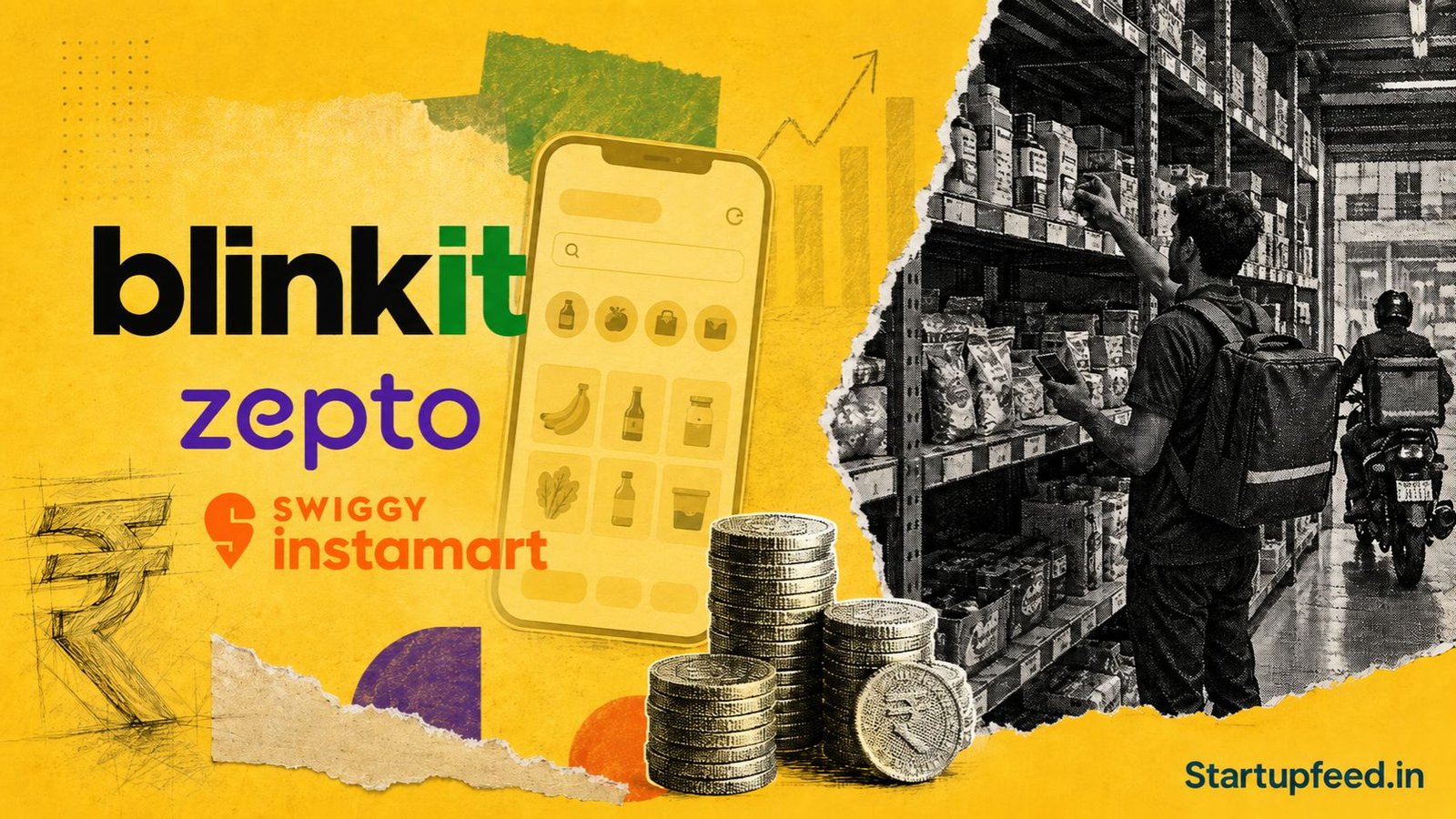
Quick commerce India is a Rs 64,000 Cr ($7.6 Bn) market where Blinkit, Zepto, and Swiggy Instamart deliver everyday items to your door in under 10 minutes from small warehouses called dark stores.These three platforms together control roughly 95% of India’s instant-delivery market. Most people have never stopped to ask how they actually make money when deliveries cost Rs 40 to 55 each to execute. The answer is a four-part revenue model that gets more interesting the deeper you look.
StartupFeed Insight
Most people assume quick commerce platforms earn the same way an e-commerce site does: sell things at a markup. That is true, but only partly. The real money machine is advertising. Blinkit and Zepto each crossed Rs 1,000 Cr in ad revenue by FY25, and the three platforms combined pulled in Rs 3,000 to 3,500 Cr in ads. For any FMCG (Fast Moving Consumer Goods) brand in India, quick commerce is now a media channel, not just a logistics one. Brands that skip advertising risk being invisible at the exact moment a buyer is ready to purchase. Expect combined ad revenues from the Big Three to cross Rs 7,000 Cr by FY27 as D2C brands treat q-commerce shelf space like television prime time, StartupFeed Desk.
How Big Is Quick Commerce India Today?
Quick commerce (also called q-commerce) is the delivery of everyday goods in 10 to 30 minutes. The products come from dark stores, small rented warehouses tucked inside residential areas. Each dark store stocks between 8,000 and 45,000 SKUs (Stock Keeping Units, individual product variants). It serves only the surrounding 2 to 3 km radius.India’s quick commerce sector reached a combined GOV (Gross Order Value, the total value of all orders placed) of roughly Rs 64,000 Cr ($7.6 Bn) in FY25. That is more than double the FY24 figure. According to a 2026 Research and Markets report, the sector grew at a CAGR (Compound Annual Growth Rate, the smoothed annual pace of growth) of 71.2% between 2020 and 2024, and is projected to reach $12.97 Bn by 2029.
| Metric | Figure | Period / Source |
|---|---|---|
| India quick commerce GOV | Rs 64,000 Cr ($7.6 Bn) | FY25, industry estimates |
| YoY GOV growth | +100%+ | FY24 to FY25 |
| Blinkit market share | 50%+ | September 2025 |
| Zepto market share | ~29% | Mid-2025 |
| Instamart market share | ~23% | Mid-2025 |
| Dark stores nationally | 6,000+ | April 2026 |
| Projected market size by 2029 | $12.97 Bn | Research and Markets, 2026 |
Newer entrants like Flipkart Minutes (800+ dark stores) and Amazon Fresh are present but remain much smaller. Together, Blinkit, Zepto, and Instamart control roughly 95% of all quick commerce orders in India.
About Blinkit, Zepto, and Swiggy Instamart
Blinkit was founded in 2013 as Grofers by Albinder Dhindsa and Saurabh Kumar, and acquired by Zomato (now listed as Eternal Ltd on NSE) in August 2022 for $568 Mn (Rs 4,447 Cr) in an all-stock deal. Goldman Sachs valued Blinkit at $13 Bn in 2025. Zepto was founded in 2021 by Stanford dropouts Aadit Palicha and Kaivalya Vohra, both from Mumbai. It confidentially filed its DRHP (Draft Red Herring Prospectus, the pre-IPO document filed with SEBI) in December 2025 to raise Rs 11,000 Cr ($1.22 Bn). Swiggy Instamart launched in 2020 as the quick-delivery arm of publicly listed Swiggy Ltd (NSE: SWIGGY) and now operates across 124 cities with 1,100 to 1,200 dark stores.
What Are the Four Ways Quick Commerce India Platforms Make Money?
The business model rests on four revenue pillars. Each one is thin individually. Together, they are formidable.
1. Product Margins and CommissionsEvery purchase earns the platform a margin on the product. Blinkit shifted from a commission-based marketplace model to a first-party inventory model from September 2025. Under the old model, it charged brands a commission ranging from 2% on items priced below Rs 500 to 18% on items above Rs 1,200. Under the new model, Blinkit buys goods directly from brands and marks them up, keeping the full retail margin. By Q3 FY26, roughly 90% of Blinkit’s orders ran through this first-party model. Zepto operates a vendor model: brands sell stock to Zepto at a wholesale price, and Zepto sets the retail price for consumers.
2. Delivery Fees and Platform ChargesEvery order carries a delivery fee. Platforms also add a “platform fee,” “handling fee,” and sometimes a “small cart fee” for baskets below a minimum size. These fees together account for roughly 3% of GOV industry-wide, according to public statements by Zepto’s founders. They do not drive most of the revenue, but they contribute directly to covering last-mile rider costs, which run Rs 40 to 55 per delivery.
3. Retail Media (Advertising)This is the most important revenue stream, and the one that changes how you should think about these businesses. Quick commerce platforms are, at their core, media companies that also deliver groceries. A brand pays to appear at the top of search results inside the Blinkit or Zepto app. Blinkit’s listing fee alone is Rs 25,000 per SKU (Stock Keeping Unit) per state. That is before any advertising spend.Zepto’s CEO Aadit Palicha has said the platform’s ad ARR (Annual Recurring Revenue, total predictable yearly revenue) surged five times in one year to Rs 1,670 Cr ($200 Mn). Blinkit crossed Rs 1,000 Cr in annual ad revenue by FY25. All three platforms combined earned Rs 3,000 to 3,500 Cr in advertising in that period.Brands prefer quick commerce advertising because the conversion window is uniquely tight. A consumer who sees a sponsored listing on Blinkit typically buys in the same session, inside the same 10-minute delivery flow. Industry data shows ROAS (Return on Ad Spend, revenue earned per rupee spent on ads) of 1.5 to 2 times on q-commerce apps in the first weeks of a campaign, compared to 1 to 1.5 times on Meta or Google. Zepto even offers an ad format called Swap and Save, which shows a competing brand’s product to a consumer at the exact moment they add a rival item to their cart.
4. Subscriptions and Private LabelsZepto Pass and Blinkit Plus offer free deliveries and discounts for a monthly or annual fee. These subscriptions raise AOV (Average Order Value, the typical basket size per order) and reduce churn. Blinkit Plus memberships contribute an estimated 10% of total revenue.Private labels are a newer and faster-growing lever. Both Zepto and Instamart have launched their own grocery and meat brands. A private-label product typically carries 30 to 40% higher gross margin than a branded equivalent, making each order more profitable without adding any delivery cost.
How Does the Dark Store Model Keep Delivery Viable?
A dark store looks nothing like a supermarket. There are no checkout counters and no customers walking in. Workers called pickers move through narrow aisles, pull items off shelves, and hand them to a waiting rider at the back door. The entire process from order to dispatch takes under 3 minutes.Profitability at the store level depends on order density. Industry benchmarks put the dark store breakeven at roughly 1,250 to 1,400 orders per day, at an AOV of around Rs 600. Below that, fixed costs (rent, staff, refrigeration) exceed revenue. This is why quick commerce works in dense metro areas and struggles in smaller cities where demand is thinner.As of April 2026, India has over 6,000 active dark stores. Blinkit operates 2,100+, with a stated target of 3,000 by March 2027. Zepto and Instamart each run approximately 1,100 to 1,200.
Is Quick Commerce India Profitable Yet?
Not fully, but the direction has shifted. Blinkit achieved EBITDA (Earnings Before Interest, Taxes, Depreciation, and Amortization, a measure of operating profitability) positivity in March 2024, the first of the three to do so. Its parent Eternal Ltd reported a consolidated net income of Rs 527 Cr in FY25.Zepto is still in the red. Losses widened to Rs 3,368 Cr in FY25, up from Rs 1,215 Cr the year before. But revenue grew from Rs 4,454 Cr in FY24 to Rs 11,110 Cr in FY25, a 149% jump, according to the company’s disclosures. Instamart’s contribution margin (revenue minus variable costs) improved to roughly -4.6% in Q1 FY26 after heavy dark store expansion pushed it to -5.6% in Q4 FY25.The core challenge is simple arithmetic. Delivering a Rs 60 packet of milk for a Rs 20 delivery fee costs the platform more than it earns on that item. The path to profit runs through higher basket sizes. Blinkit now actively sells electronics and appliances. Zepto is entering pharmacy. Both want consumers to add a laptop charger or a face wash to their grocery order, because each extra item costs nothing more to deliver and a great deal more to earn from.
How Do Blinkit, Zepto, and Instamart Compare?
| Metric | Blinkit | Zepto | Swiggy Instamart |
|---|---|---|---|
| Parent | Eternal Ltd (Zomato) | Independent | Swiggy Ltd |
| Market share (mid-2025) | 50%+ | ~29% | ~23% |
| Dark stores (Apr 2026) | 2,100+ | ~1,100-1,200 | ~1,100-1,200 |
| AOV (2026 analyst estimate) | Rs 709 | Rs 550 | Rs 619 |
| FY25 revenue (latest available) | Rs 1,709 Cr (Q4 FY25 alone) | Rs 11,110 Cr (full year) | Not disclosed separately |
| Profitability status | EBITDA positive (Mar 2024) | Loss-making, narrowing | Contribution margin improving |
| Key structural advantage | Zomato user base, highest AOV | Speed, Gen-Z audience, IPO runway | Swiggy cross-sell, 124 cities |
Blinkit’s biggest structural advantage is its parent. Zomato’s existing food-delivery user base reduces Blinkit’s CAC (Customer Acquisition Cost, the amount spent to win each new customer) by an estimated 40%, according to industry analysis. That means Blinkit grows faster for less money than Zepto, which must pay to acquire every user through its own marketing.

What’s Next
The next battle in quick commerce will move from speed to margin. Watch for Zepto’s IPO process to advance through 2026, Blinkit’s push toward Rs 1,000+ AOV baskets through electronics, and Instamart’s contribution margin turning positive within two to three quarters. The company that proves sustained profitability first will likely define how the sector is valued on public markets. Which platform do you think gets there first?
Frequently Asked Questions
How do Zepto, Blinkit, and Instamart make money?
These quick commerce platforms earn from four streams: product margins or commissions (2% to 18% per order depending on item price), delivery and platform fees, in-app advertising revenue (Rs 1,000 Cr+ each for Blinkit and Zepto in FY25), and subscription services like Zepto Pass and Blinkit Plus. Advertising has become the fastest-growing revenue stream for all three platforms. Private labels are an emerging fifth lever, offering 30 to 40% higher gross margins than branded products.
What is a dark store and how does it work?
A dark store is a small warehouse placed inside a residential area, stocking 8,000 to 45,000 individual products. Shoppers cannot walk in. Workers called pickers pull items off shelves in under 3 minutes and hand them to a delivery rider. Each store needs roughly 1,250 to 1,400 orders per day at an AOV of Rs 600 to break even on its fixed costs of rent, staff, and refrigeration.
Is quick commerce profitable in India?
Blinkit reached EBITDA positivity in March 2024 and its parent Eternal Ltd posted net income of Rs 527 Cr in FY25. Zepto reported a Rs 3,368 Cr loss in FY25, but revenue grew by 149% to Rs 11,110 Cr in the same year. Instamart’s contribution margin is improving quarter on quarter. Full sector-wide profitability depends on raising average basket sizes through higher-value categories like electronics and pharmacy.
Have a tip? Write to us at editorial@startupfeed.in.
Liked this story? Follow StartupFeed on Google so our reporting reaches you first.