
Quick Take
- PM Modi’s WFH advisory amid the West Asia conflict has triggered debate across India’s startup ecosystem.
- Over a dozen founders across major cities told Inc42 they will not go fully remote.
- Common reasons cited: lost momentum, team output dips after 2 weeks, and office lease obligations.
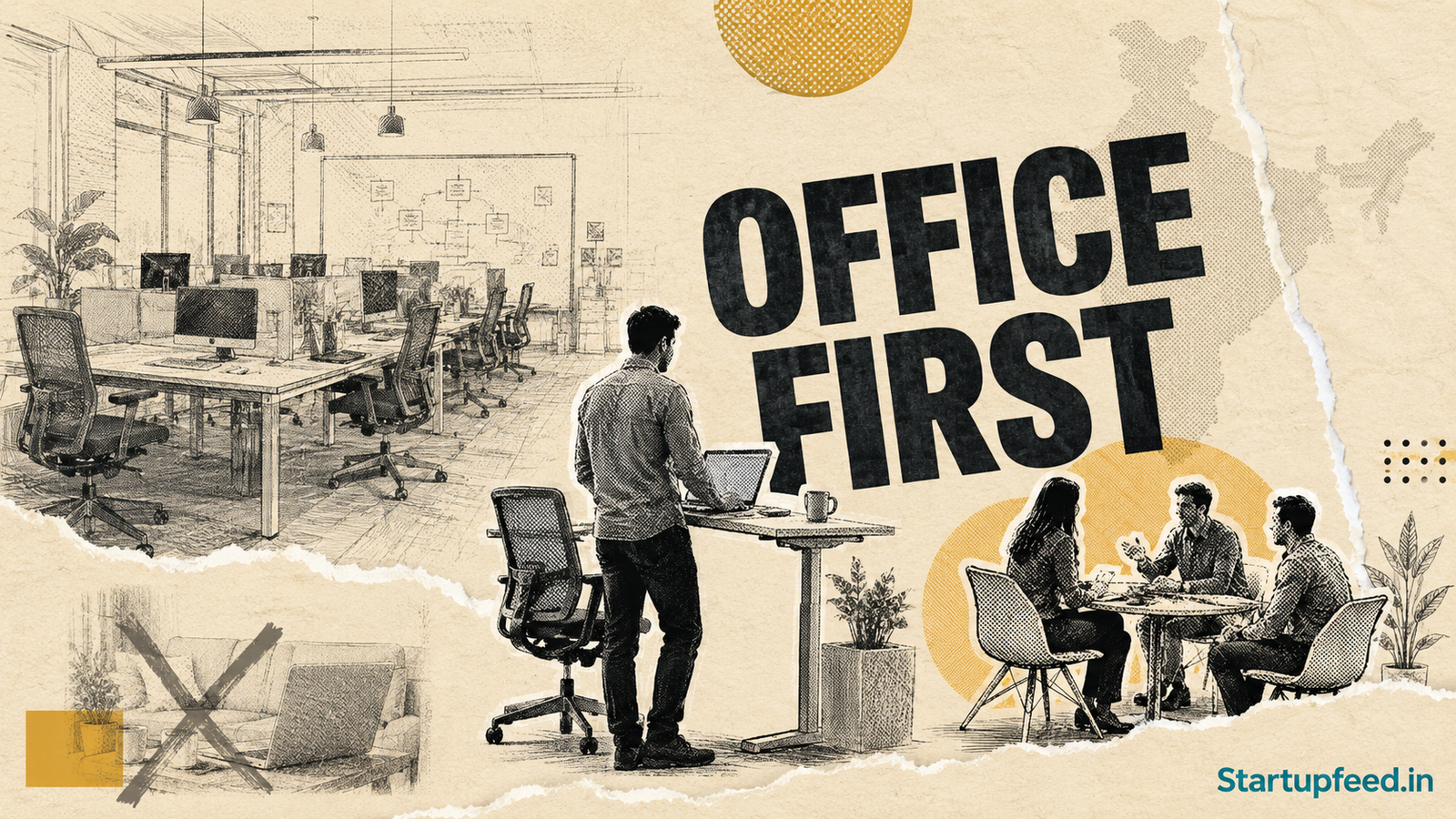
The Indian startups WFH policy debate has arrived — and most founders are answering it with a firm no. PM Narendra Modi’s recent advisory urging companies to adopt work from home amid the ongoing West Asia conflict has pushed corporate India to take a position on remote work for the first time since the pandemic. Large IT companies are evaluating the directive. But conversations with more than a dozen startup founders across Bengaluru, Delhi NCR, and Mumbai reveal a very different response from the startup ecosystem: the office-first culture they spent years rebuilding is not going anywhere.
Zoho is one of the few prominent startups to have actively embraced remote work. Beyond that exception, the picture is clear.
StartupFeed Insight
The founders resisting WFH are not primarily making a productivity argument — they are making a culture argument. A startup’s decision-making velocity, team trust, and energy are built through daily physical proximity. These took years to rebuild after the 2020-21 WFH period. The Verloop.io and Zoho exceptions are instructive: both have mature documented workflows and remote-collaboration tooling built over years, which means they can absorb the transition cost. Most Indian startups — especially those founded post-2021 — have never operated remotely at scale. They genuinely do not know whether their company works in WFH mode. Founders resisting the advisory are right to be cautious.
What Is Driving the Indian Startups WFH Policy Debate?
The immediate trigger is PM Modi’s advisory, issued in the context of the ongoing West Asia conflict. Unlike large IT companies — where processes are documented, delivery is offshore, and remote work is structurally feasible — startups operate differently. Their competitive advantage depends on speed: fast decisions, quick pivots, and real-time collaboration. Those are hard to replicate in a Slack-and-video-call environment.
| Stance | Who | Reason |
|---|---|---|
| Firmly office-first | Most SaaS, agritech, marketplace startups (anonymous) | Lost momentum in 2020-21; output dips significantly after 2 weeks of WFH |
| Monitoring / contingency planning | Mumbai-based founder; others across cities | Decision on WFH policy deferred by 2 weeks; not ruling out WFH if tensions escalate |
| Hybrid if forced | Bengaluru SaaS founder (anonymous) | Prefers hybrid over full remote; critical in-person days maintained |
| Going fully remote | Verloop.io | Operational continuity + employee safety; flexibility over rigid format |
| Already remote-friendly | Zoho | Long-standing remote work culture; mature documentation and tooling |
The common thread in the refusals is a specific memory: the productivity decline that set in after the first few weeks of pandemic-era WFH. Founders are not citing theory — they are citing their own experience.
The Productivity Argument: What Founders Experienced in 2020-21
The pandemic forced Indian startups into remote operations for the better part of two years. For many founders, that period produced a consistent pattern: the first few weeks of WFH felt functional, and then output dropped.
“I don’t think we should advocate WFH. We lost all momentum when WFH happened earlier. Startups work on energy, momentum and collaboration.” — SaaS founder, requesting anonymity
The same founder said that if remote work became unavoidable, a hybrid setup would be preferred over a fully remote arrangement, specifically to preserve the in-person momentum that drives execution.
An agritech founder in Bengaluru was equally direct:


“We suffered from poor output during the pandemic. WFH works well for a couple of weeks and then the overall team output starts dipping significantly. That’s been our experience. We cannot compromise business output.” — Agritech startup founder
For execution-heavy startups — those running on-ground operations, field sales, or physical fulfilment — the decline in coordination during WFH was not abstract. Tracking productivity became harder. Response times on critical decisions stretched. The cost of miscommunication rose.
The Culture Battle: Getting Employees Back Once Took Years
A second argument against WFH is almost more concerning to founders than productivity: the fear that even a temporary return to remote work will reopen a culture battle they only recently won.
Restoring office attendance after 2021 was not a notification and a date. For most startups, it was a months-long negotiation with employees who had restructured their lives around flexible schedules, removed commutes, and, in many cases, relocated to lower-cost cities. Reversing those expectations — gradually, without losing people — took sustained effort.
“Startups are famous for making quick decisions. Someone heard in the meeting room, and things got executed. Now when people do WFH, the whole efficiency goes away. Startups are on a scale journey, a WFH will have a severe impact, unlike in big IT companies, where processes are already set.” — Business leader, marketplace startup
This is not an abstract concern. Several startups have made significant investments in office infrastructure over the past two years — better collaboration spaces, breakout areas, and in-office tools — specifically to make the office more appealing than home. A WFH policy, even temporary, risks undermining that investment and rekindling employee expectations of flexibility that founders spent years managing.
The Financial Cost: Office Leases and Remote Work Expenses
There is a third, less discussed dimension to the WFH resistance: money. Many startups are locked into multi-year office leases signed after the pandemic. Choosing WFH does not reduce that cost — it doubles the expense, because companies must then reimburse employees for desks, chairs, internet upgrades, and other remote-work infrastructure.
A venture studio founder added a different financial calculation: talent retention. Noting that some of his portfolio companies are offering location flexibility to avoid losing people during the tense period, he said: “Ultimately, talent is the real fuel. We should save it at all costs.”
Who Is Going Remote? The Exceptions Worth Watching
Verloop.io stands out as the clearest example of a startup actively choosing WFH during this period. CFO Ankit Sarawagi said the decision was primarily about employee safety and operational continuity, not productivity preference.
“We are looking to completely move to the WFH setup. The larger priority right now is maintaining operational continuity while ensuring employees have the flexibility to work in a manner that feels safe and practical. Like many new-age organisations, the focus is less on rigid formats and more on adapting responsibly to evolving circumstances.” — Ankit Sarawagi, CFO, Verloop.io
Zoho’s remote work culture predates the current crisis. It is structurally different from most startups: decades-old documentation systems, asynchronous communication norms, and a distributed team model that does not depend on a central office. These are capabilities that take years to build, which is precisely why most founders say they cannot replicate the Zoho model on short notice.
What’s Next
The Indian startups WFH policy question will be answered by what happens geopolitically in the next two to four weeks. Most founders have said they are watching the situation and will revisit their stance only if tensions escalate significantly. A Mumbai-based founder noted that all non-critical travel has been paused, and a firm policy decision is two weeks away.
Watch for any major startup publicly announcing a permanent or extended WFH policy — that would signal a broader sentiment shift. Until then, the office-first consensus among Indian startups appears firm.
Will the next escalation finally break the office-first consensus that Indian startup founders rebuilt so painstakingly after the pandemic?



Frequently Asked Questions
What is the Indian startups WFH policy debate about?
The Indian startups WFH policy debate was triggered by PM Narendra Modi’s advisory urging companies to adopt work from home amid the ongoing West Asia conflict in May 2026. While large IT companies began evaluating the directive, most startup founders across Bengaluru, Delhi NCR, and Mumbai told they are not considering a company-wide WFH policy.
Why are Indian startup founders resisting the WFH advisory?
Founders cite three main reasons. First, they experienced significant output declines during the 2020-21 WFH period — with team productivity beginning to fall after roughly two weeks of remote work. Second, they spent years after the pandemic rebuilding in-office culture and fear that even a temporary WFH shift will reopen employee expectations around flexibility. Third, many startups are locked into long-term office leases and would face additional costs providing remote-work reimbursements while still paying rent on unused office space.
Which Indian startups are choosing to go remote during the current situation?
Verloop.io has announced a full shift to WFH, with CFO Ankit Sarawagi citing employee safety and operational continuity as the priorities. Zoho, which has a long-established remote work culture, is also continuing its flexible model. Both companies have built the documentation, tooling, and asynchronous communication norms over years that allow them to absorb a WFH transition — a capability most younger startups do not yet have at scale.
Liked this story? Follow StartupFeed on Google so our reporting reaches you first.