Quick Take
- Kissht IPO lists at Rs 191 on BSE, an 11.7% premium over the issue price of Rs 171 per share.
- The Rs 926 Cr issue closed 9.5X oversubscribed overall, with the QIB category subscribing 26X.
- Market cap touched Rs 3,300 Cr at listing; fresh issue proceeds will strengthen NBFC arm Si Creva Capital.
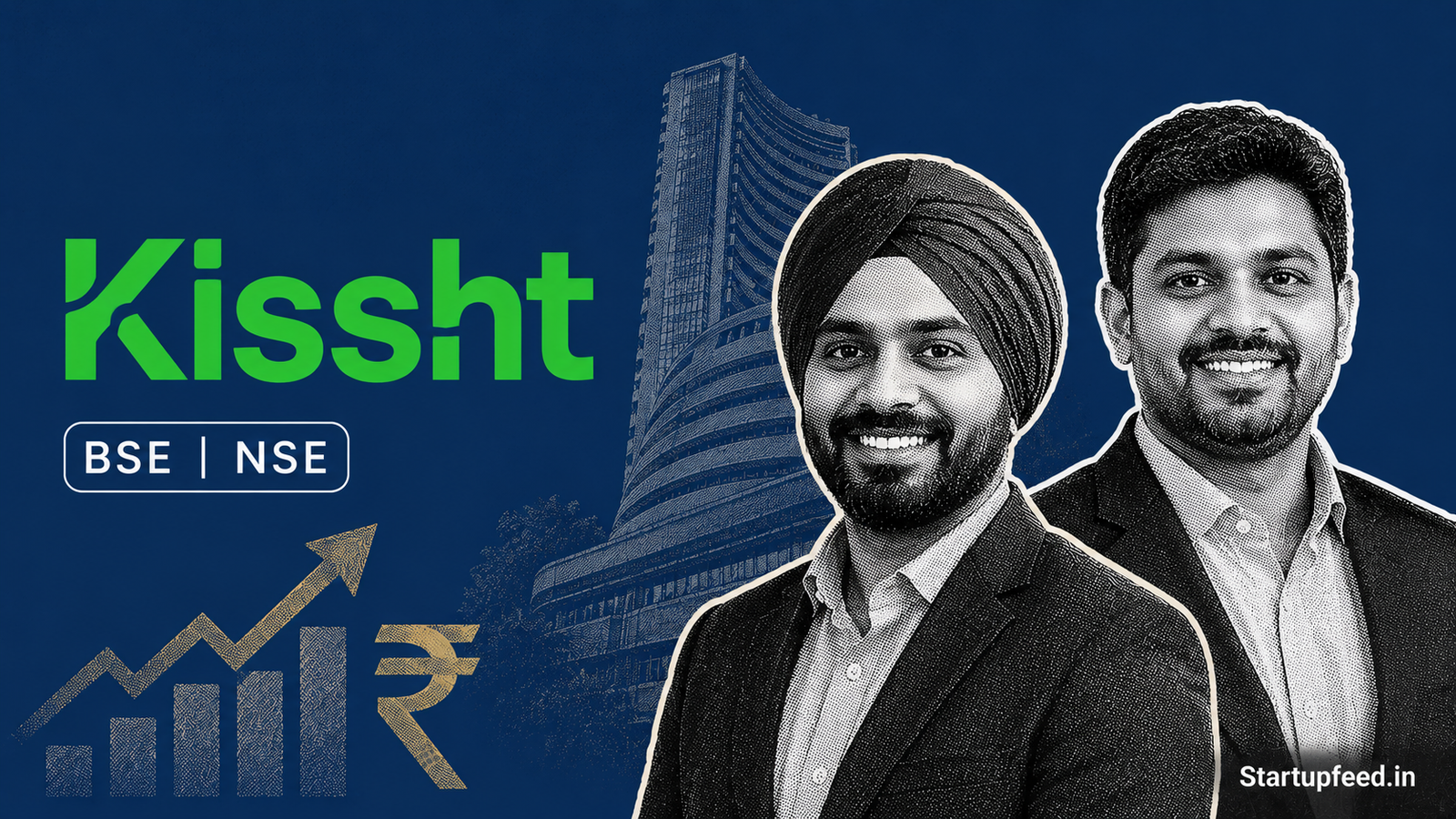
Kissht IPO lists at Rs 191 on BSE and Rs 190 on NSE on May 8, 2026, giving allottees a listing-day gain of Rs 1,740 per lot at the opening price — a clean 11.7% premium over the issue price of Rs 171. OnEMI Technology Solutions Limited, the Mumbai-based parent of the Kissht digital lending platform, becomes India’s sixth new-age tech company to go public in 2026 with a market capitalisation of approximately Rs 3,300 Cr at listing.
The stock pushed higher after the opening bell and was trading at Rs 196.20 on BSE by 10:05 IST, nearly 15% above the issue price. The IPO had opened from April 30 to May 5, 2026, with a price band of Rs 162–171 per share and a lot size of 87 shares, and raised Rs 926 Cr in total — comprising a fresh issue of Rs 850 Cr and an OFS of 44.4 Lakh shares worth Rs 75.9 Cr. Ahead of the public issue, the company had raised Rs 277.8 Cr from anchor investors including HDFC Mutual Fund, ICICI Prudential, Goldman Sachs, BNP Paribas, and Citigroup.
StartupFeed Insight
The number most analysts missed: Kissht IPO’s P/E at the issue price of Rs 171 was just 10.84x — roughly half that of HDB Financial Services (~24.7x) and one-third of Bajaj Finance (34x+). Yet the issue closed 9.5X oversubscribed. That gap explains the listing pop. But here is the real signal for investors: in just the first nine months of FY26, Kissht already earned Rs 199.3 Cr in PAT, beating all of FY25’s Rs 160.6 Cr.
The FY25 profit dip was not structural — it was the result of RBI’s tightening on unsecured consumer lending. With 94% of Kissht’s book being unsecured, any further RBI tightening is the single biggest risk to watch before adding to the position post-listing. Expect Kissht to target an AUM of Rs 10,000 Cr within 18 months, driven by the capital infusion into Si Creva Capital. — StartupFeed Desk
Kissht IPO Lists at 12%: Key Metrics and Deal Breakdown
| Metric | Detail | Notes |
|---|---|---|
| Listing Price (BSE) | Rs 191 per share | +11.7% premium over issue price of Rs 171 |
| Listing Price (NSE) | Rs 190 per share | +11.1% premium over issue price |
| Market Cap at Listing | ~Rs 3,300 Cr | At BSE listing price of Rs 191 |
| Total Issue Size | Rs 925.92 Cr | Fresh issue Rs 850 Cr + OFS Rs 75.9 Cr |
| Overall Subscription | 9.5X | QIB 26X, NII 6.91X, Retail 2.13X |
| Anchor Investors | Rs 277.8 Cr raised | HDFC MF, Goldman Sachs, Citigroup, BNP Paribas |
| Valuation at Issue | P/E 10.84x; P/ABV 1.6x | Based on upper price band of Rs 171 |
| OFS Sellers | Vertex Venture, Ventureast, AION, Endiya | Promoters did NOT participate in OFS |
The standout detail from the table: promoters chose not to sell a single share in the OFS. Every selling shareholder was an early institutional backer exiting partially. That distinction signals founder confidence in where the stock goes from here.
About OnEMI Technology Solutions (Kissht)
OnEMI Technology Solutions Limited is a Mumbai-based digital lending NBFC incorporated in 2016 by Ranvir Singh and Krishnan Vishwanathan. It operates under two brand names: Kissht, a digital lending app offering personal loans, loans against property, and MSME loans up to Rs 5 Lakh; and Ring, a consumer payments app. The company’s NBFC partner, Si Creva Capital Services, handles loan disbursement, KYC, and EMI collections. As of December 31, 2025, Kissht had 63.73 Mn registered users, 11.17 Mn active borrowers, an AUM of Rs 5,956 Cr, and operations across 17,000+ pin codes nationally.
How Does the Kissht Valuation Compare to Listed Peers?
At the issue price of Rs 171, Kissht was priced at a P/E of 10.84x — notably cheaper than most listed consumer lending NBFCs at the time of its filing.
| Company | P/E (approx.) | AUM | Model |
|---|---|---|---|
| Kissht (OnEMI) | 10.84x | Rs 5,956 Cr | Digital lending, small-ticket personal loans |
| HDB Financial Services | ~24.7x | Large-cap NBFC | Diversified retail and SME lending |
| Bajaj Finance | 34x+ | Rs 4.8 Lakh Cr | Diversified consumer and SME financing |
The valuation discount at issue is a double-edged signal. It made Kissht attractive to institutional bidders — hence the 26X QIB subscription — but it also reflects the risk that 94% of Kissht’s book is unsecured. A regulatory tightening cycle could compress margins faster than at larger, more diversified lenders.
What Drove the 9.5X Subscription?
Three things worked in Kissht’s favour. First, the numbers: 9M FY26 PAT of Rs 199.3 Cr had already beaten full FY25 PAT of Rs 160.6 Cr — a clean recovery signal after a ~18% profit decline in FY25. Net NPA was just 0.4% as of December 2025, and net interest margins expanded to 23.8% in FY25. Second, the valuation at 10.84x P/E left room on the table relative to peers. Third, institutional anchors with household names — HDFC Mutual Fund, Goldman Sachs, and Citigroup — validated the book quality before retail participation even began. The QIB book, which hit 26X subscription, was the tide that lifted the overall figure.
Brokerage firms cited the company’s CAGR of 140.9% in net profit between FY23 and FY25 as the headline growth metric. SBICAP Securities noted the P/ABV of 1.6x as reasonable for the growth trajectory, while flagging the concentration in unsecured loans as the primary risk.
Who Sold Shares and How Much Did They Make?
The OFS component saw several early venture capital backers partially exit. Ammar Sdn Bhd offloaded 11.56 Lakh shares and realised Rs 19.8 Cr at the top end of the price band. Vertex Venture and Ventureast both sold shares held across multiple funds. AION Advisory Services and Endiya Partners also participated in the OFS. All four are institutional investors, not promoters — the founding team of Ranvir Singh and Krishnan Vishwanathan did not sell any shares.
Ventureast, according to earlier reporting, booked a 10.9X return on its holding at exit price.
What’s Next
Watch two things over the next 12 months. First, how Kissht deploys the Rs 850 Cr of fresh capital into Si Creva Capital — AUM growth from the current Rs 5,956 Cr will be the key performance indicator. The company has stated targets for geographic deepening (currently 17,000+ pin codes) and product expansion into mutual funds and life insurance. Second, monitor RBI policy on unsecured lending — any fresh circular tightening risk weights or exposure norms for unsecured consumer NBFCs would directly affect Kissht’s cost of capital and net interest margins. Can Kissht reach a Rs 10,000 Cr AUM milestone before a potential adverse regulatory move?
Frequently Asked Questions
At what price did the Kissht IPO list and what was the premium?
Kissht IPO listed at Rs 191 on BSE on May 8, 2026, a premium of 11.7% over the issue price of Rs 171. It listed at Rs 190 on NSE, an 11.1% premium. The stock rose further to Rs 196.20 on BSE within the first hour of trading, giving allottees a gain of approximately Rs 1,740 per lot at the opening price, based on the lot size of 87 shares.
What does Kissht do and who are its founders?
Kissht is a digital lending platform operated by OnEMI Technology Solutions, a Mumbai-based NBFC incorporated in 2016 by Ranvir Singh and Krishnan Vishwanathan. The platform offers personal loans, loans against property, and MSME loans primarily through a mobile app with minimal documentation. As of December 2025, it had 63.73 Mn registered users and an AUM of Rs 5,956 Cr. It also operates Ring, a consumer payments app.

What will Kissht use the IPO proceeds for?
The Rs 850 Cr fresh issue will primarily be used to strengthen the capital base of Si Creva Capital Services, Kissht’s NBFC subsidiary that handles loan disbursements, KYC, and EMI collections. A stronger capital base will allow Si Creva to grow its on-book loan portfolio and expand into new geographies and product categories including secured loans and insurance distribution.
Disclaimer: This article is for informational purposes only and does not constitute investment advice. StartupFeed and its authors are not SEBI-registered investment advisors.
The analysis above is based on publicly available information and should not be the sole basis for any investment decision. Please consult a SEBI-registered financial advisor before making investment decisions.
Written by Harshvardhan jain. Published: May 8, 2026. Updated: May 8, 2026. Have a tip? Write to us at editorial@startupfeed.in.
Liked this story? Follow StartupFeed on Google so our reporting reaches you first.