Quick Take
- Skyroot Aerospace raises $60 Mn (Rs 504 Cr), co-led by Sherpalo Ventures and GIC, at a $1.1 Bn valuation.
- The round doubles Skyroot’s 2023 valuation of $550 Mn and takes total funding past $160 Mn (Rs 1,344 Cr).
- Capital will fund Vikram-1 launch cadence targeting June 2026, plus next-generation Vikram-2 rocket development.
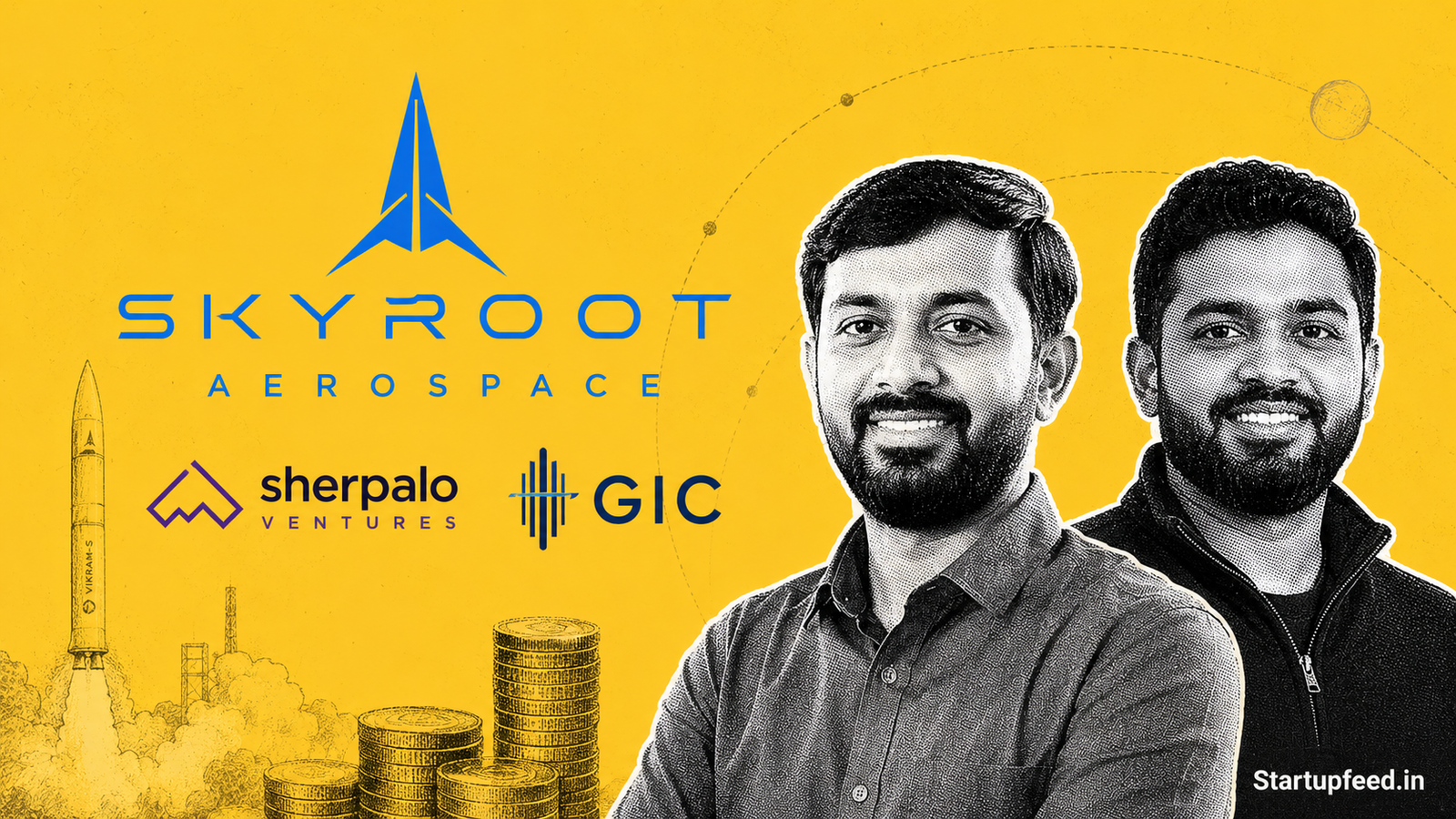
Skyroot Aerospace raises $60 Mn (Rs 504 Cr) in a growth round co-led by Sherpalo Ventures and Singapore’s sovereign wealth fund GIC, reaching a valuation of $1.1 Bn (Rs 9,240 Cr) and becoming India’s 129th unicorn and its first private spacetech company to hit the billion-dollar mark.
The round, announced on May 7, 2026, arrives weeks before Skyroot attempts the maiden orbital launch of Vikram-1 — India’s first privately developed orbital-class rocket — from the Sriharikota spaceport. The company is targeting a June 2026 launch window. Beyond Sherpalo and GIC, the round drew participation from funds managed by BlackRock, Arkam Ventures, Greenko Group founders, Playbook Partners, and Shanghvi Family Office. Playbook Partners and Shanghvi Family Office are new investors; the rest are existing backers.
StartupFeed Insight
Most coverage has missed the round’s internal structure: roughly $50 Mn is primary equity while $10 Mn is structured debt managed by BlackRock-affiliated funds. That split limits dilution before Skyroot generates launch revenue while providing the near-term capital needed to ramp manufacturing and meet launch costs. Two audiences need to track this closely — Indian satellite makers who still depend on SpaceX or ISRO for orbital access, and global small-satellite operators in Southeast Asia and Japan that Skyroot is actively courting.
With a June 2026 Vikram-1 launch on track and a stated goal of four to six launches this financial year, expect Skyroot to announce its first signed anchor commercial contract with a named customer within six months of a successful orbital debut. — StartupFeed Desk
Skyroot Aerospace Raises $60 Mn: Deal Breakdown
| Metric | Detail | Notes |
|---|---|---|
| Total Raise | $60 Mn (Rs 504 Cr) | ~$50 Mn equity + ~$10 Mn structured debt |
| Lead Investors | Sherpalo Ventures, GIC | Both are existing investors; Ram Shriram joins the board |
| Round Type | Growth round | Not formally labelled Series C by the company |
| Valuation (pre-money) | $1.1 Bn (Rs 9,240 Cr) | Up from ~$550 Mn in 2023 — valuation more than doubled |
| Previous Round | $51 Mn Series B (2022, led by GIC) | Included Sherpalo, Greenko founders, Arkam Ventures |
| Cumulative Raised | $160 Mn+ (Rs 1,344 Cr+) | Since founding in 2018 |
| Announcement Date | May 7, 2026 | Ahead of planned June 2026 Vikram-1 orbital launch |
The most consequential detail in this table: Skyroot’s $1.1 Bn valuation arrived on a pre-money basis, meaning the post-money figure is even higher. That sets a firm marker for what a Series C or IPO conversation might look like once Vikram-1 delivers its first payload to orbit.
About Skyroot Aerospace
Skyroot Aerospace is a Hyderabad-based private space launch company founded in 2018 by Pawan Kumar Chandana (CEO) and Naga Bharath Daka (CTO), both former engineers at the Indian Space Research Organisation (ISRO). The company builds small-lift orbital launch vehicles under the Vikram family, targeting the fast-growing small satellite market. In November 2022, Skyroot became the first Indian private company to launch a rocket into space with its suborbital Vikram-S mission. Key backers include Sherpalo Ventures, GIC, BlackRock, Arkam Ventures, and Greenko Group founders.
Why Did Sherpalo and GIC Back Skyroot Again?
Both lead investors have backed Skyroot through multiple rounds and deepened their conviction with each cheque. Ram Shriram, founder of Sherpalo Ventures and an early investor in Google, will now join Skyroot’s board — a signal of hands-on commitment rather than passive capital.

“I’ve believed in the Skyroot team since the early days, and that conviction has only deepened as the team marches forward to the launchpad with Vikram-1, India’s first private orbital-class rocket. Access to space is one of the key challenges of our time.” — Ram Shriram, Managing Partner, Sherpalo Ventures
GIC’s continued participation matters just as much. The Singapore sovereign wealth fund has a long-dated investment horizon and typically re-invests only in portfolio companies it views as infrastructure-grade assets. Its repeat backing positions Skyroot as exactly that — not a startup bet, but a foundational node in the emerging commercial space supply chain. Skyroot says roughly a third of expected launch demand will come from Indian customers, with the remaining two-thirds from international operators in Southeast Asia, Japan, Europe, and the US.
How Does Skyroot Compare to Indian Space Rivals?
India’s private space sector has produced a handful of launch-focused startups since reforms opened the sector in 2020. Skyroot is now the most capitalised and the only one with unicorn status.
| Company | Total Raised | Rocket | Status |
|---|---|---|---|
| Skyroot Aerospace | $160 Mn+ | Vikram-1 (orbital) | Launch June 2026, unicorn status |
| Agnikul Cosmos | ~$95 Mn (est.) | Agnibaan (orbital) | Sub-orbital test completed 2024; orbital pending |
| Bellatrix Aerospace | Undisclosed (smaller) | N/A (in-space propulsion) | Satellite propulsion; different market |
What separates Skyroot from peers: it is the only Indian private company that has completed a funded orbital-class rocket, shipped it to a launch site, and secured international institutional investors — GIC and BlackRock — willing to put structured capital on the table. Agnikul Cosmos is a credible second mover, but is at least one flight cycle behind.
What’s Next
Vikram-1’s June 2026 orbital launch attempt is the single most important milestone to watch. A successful mission would make Skyroot the first Indian private company to place a payload into orbit and immediately activate its commercial backlog. The company is targeting four to six launches in FY27. If Vikram-1 succeeds, watch for a Series C or pre-IPO growth round within 18 months as Skyroot begins to generate contracted revenue. Will India’s policy environment keep pace with the private launch cadence Skyroot is building?
Frequently Asked Questions
How much did Skyroot Aerospace raise in its latest funding round?
Skyroot Aerospace raised $60 Mn (Rs 504 Cr) in a growth round co-led by Sherpalo Ventures and Singapore’s GIC. The round also included BlackRock-affiliated funds via structured debt, along with Arkam Ventures, Playbook Partners, Shanghvi Family Office, and Greenko Group founders. The raise values Skyroot at $1.1 Bn on a pre-money basis, making it India’s first spacetech unicorn and its 129th unicorn overall.
What does Skyroot Aerospace do?

Skyroot Aerospace builds small-lift orbital launch vehicles for the commercial satellite market. Founded in 2018 by former ISRO engineers Pawan Kumar Chandana and Naga Bharath Daka, the Hyderabad-based company offers on-demand, cost-competitive launch services. Its Vikram family of rockets targets small satellite operators globally. Skyroot launched India’s first private rocket, the suborbital Vikram-S, in November 2022, and is preparing the orbital Vikram-1 for launch in June 2026.
How will Skyroot use the $60 Mn funding?
Skyroot will use the capital across three priorities: establishing a high-frequency Vikram-1 launch cadence (targeting four to six launches in FY27), scaling its 2 lakh square foot manufacturing facility in Hyderabad, and accelerating development of Vikram-2 — a next-generation rocket featuring an advanced cryogenic upper stage capable of lifting heavier payloads into orbit.
Written by Harshvardhan jian . Published: May 8, 2026. Updated: May 8, 2026. Have a tip? Write to us at editorial@startupfeed.in.
Liked this story? Follow StartupFeed on Google so our reporting reaches you first.