Quick Take
- Gujarat tops India’s DPIIT Startup Ranking for the fifth year in a row in 2026.
- Karnataka’s Rs 518 Cr startup policy is the largest single-state corpus in India today.
- UP joins the top five for the first time, now home to 17,000 active startups.
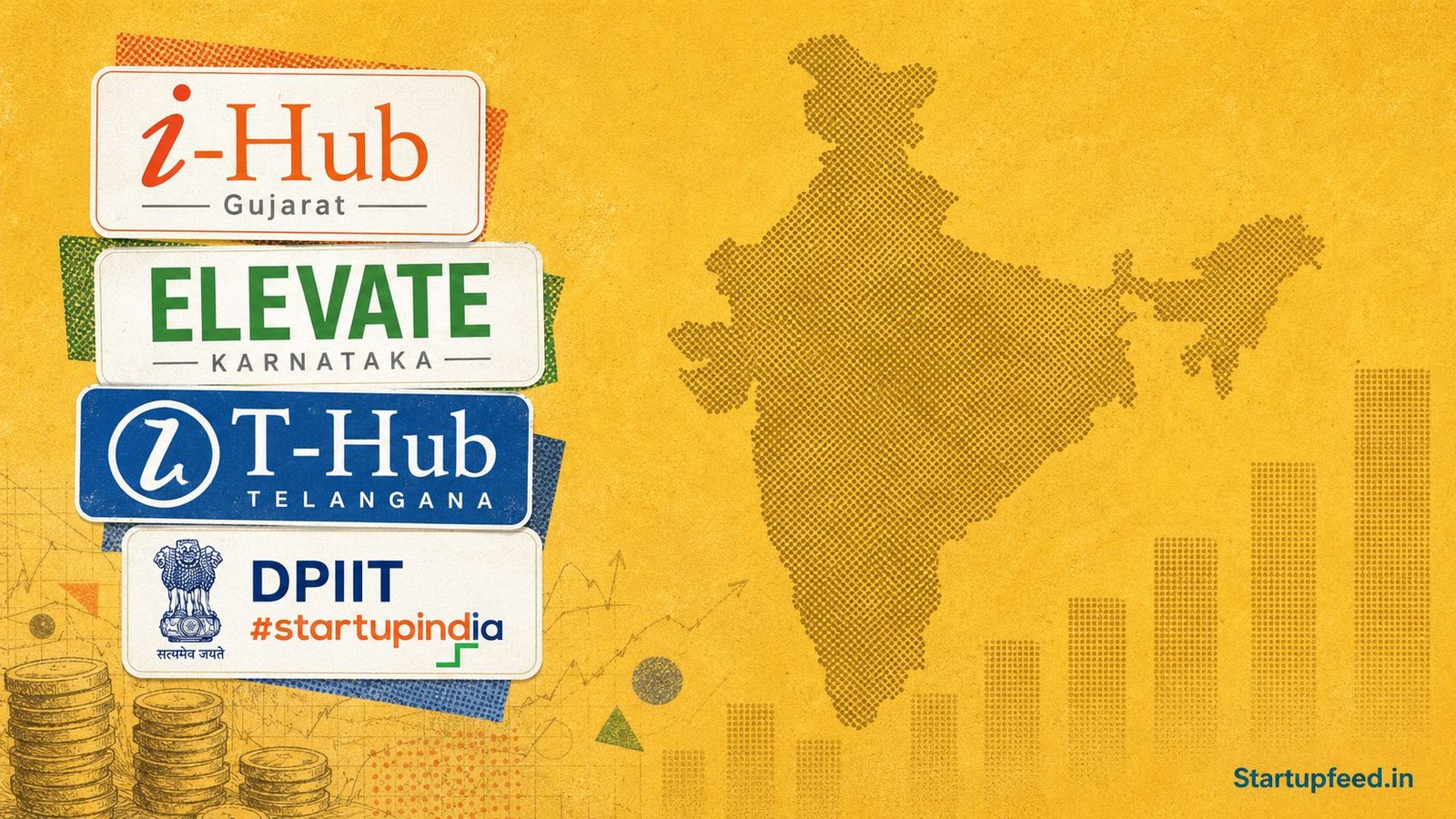
India’s top 10 state startup policies, as ranked by DPIIT (Department for Promotion of Industry and Internal Trade, the central government body that governs India’s startup framework) performance data, confirm Gujarat at the top for a fifth consecutive year in 2026. The Rankings are based on the fifth edition of DPIIT’s States’ Startup Ranking Framework, or SRF, released on January 16, 2026 at an event in New Delhi attended by Prime Minister Narendra Modi.The SRF 5.0 covered the period from January 2023 to November 2024 and evaluated 34 states and union territories on six reform areas: institutional support, infrastructure, funding, market access, ecosystem capacity building, and innovation. It produced five tiers: Best Performer, Top Performer, Leader, Aspiring Leader, and Emerging Startup Ecosystem. India now has over 1,97,692 DPIIT-recognised startups as of October 2025.
StartupFeed Insight
The most underreported story in India’s startup ecosystem ranking this cycle is not Gujarat’s fifth title. It is Uttar Pradesh’s tier jump. UP moved from “Leader” in SRF 4.0 to “Top Performer” in SRF 5.0, the only large-population state to jump a full tier in a single cycle. This signals genuine startup activity in Noida, Lucknow, and Kanpur, not just DPIIT registrations. At the same time, both Karnataka and Kerala dropped one tier each compared to SRF 4.0. That drop is not a failure. It reflects the bar rising nationally. Seed-stage investors focused on non-metro India should track UP, Rajasthan, and Tamil Nadu closely for the next crop of breakout deals. Expect at least two new unicorns from UP-based startups by Q4 FY27, StartupFeed Desk.
How Do India’s Top 10 State Startup Policies Compare?
The table below summarises all 10 states on their DPIIT SRF 5.0 tier, their flagship program or hub, their policy corpus (where disclosed), and one standout benefit.
| Rank | State | Flagship Hub or Program | DPIIT SRF 5.0 Tier | Policy Corpus | Standout Benefit |
|---|---|---|---|---|---|
| 1 | Gujarat | i-Hub (SSIP 2.0), WEStart | Best Performer | Rs 300 Cr (SSIP 2.0) | Grants up to Rs 10 Lakh per student team |
| 2 | Karnataka | Startup Policy 2025-2030, ELEVATE | Top Performer | Rs 518 Cr | ELEVATE NxT grants up to Rs 1 Cr for deep tech |
| 3 | Tamil Nadu | TN Innovation Policy, Co-creating Fund | Top Performer | Rs 100 Cr (Co-creating Fund) | 36% CAGR in startup registrations, 2020-2025 |
| 4 | Uttar Pradesh | Innovation Hub at AKTU (StartinUP) | Top Performer | Not disclosed | 63 incubators across 23 districts; 8 unicorns |
| 5 | Telangana | T-Hub, T-Fund, Rs 1,000 Cr Startup Fund | Leader | Rs 1,000 Cr (fund-of-funds) | World’s largest startup incubation centre (T-Hub) |
| 6 | Maharashtra | CM MahaFund (MSINS) | Leader | Rs 500 Cr | 100% stamp duty exemption; IPR subsidy up to Rs 10 Lakh |
| 7 | Kerala | Kerala Startup Mission (KSUM) | Leader | Rs 90 Cr (2024 budget) | $665 Mn in funding facilitated; India’s only Super Fab Lab |
| 8 | Rajasthan | iStart Portal | Leader | Not disclosed | 7,100+ startups on portal; multi-district incubators |
| 9 | Haryana | H-HUB (Gurugram), GCC Policy 2025 | Leader | Not disclosed | Plug-and-play labs; MNC incentives via GCC Policy |
| 10 | Delhi | Draft Startup Policy 2025 | Lowest in Cat A | Rs 200 Cr (proposed VC fund) | 15 unicorns; monthly grants up to Rs 2 Lakh (proposed) |
DPIIT SRF 5.0 evaluation period: January 2023 to November 2024. Results announced January 16, 2026.
1. Gujarat: i-Hub and SSIP 2.0
Gujarat tops the India startup ecosystem ranking for a fifth straight year. The state runs the Student Startup and Innovation Policy, or SSIP 2.0, with a Rs 300 Cr corpus spread across five years. The i-Hub (Innovation Hub) in Ahmedabad spans 1.5 million square feet and can house 500 startups at once. It has already incubated 840+ startups. Grants range from Rs 2.5 Lakh to Rs 10 Lakh per student team. WEStart, its women-focused arm, has backed 1,543 startups with financial help over four years. Gujarat now counts 16,700 total startups and 12,500+ DPIIT-recognised ventures.
2. Karnataka: Startup Policy 2025-2030 and ELEVATE
Karnataka approved the Startup Policy 2025-2030 in November 2025 with a Rs 518 Cr outlay, the largest state-level startup budget in India. The policy targets 25,000 new startups in five years, with 10,000 of those outside Bengaluru, in cities like Mysuru, Mangaluru, Hubballi-Dharwad, and Kalaburagi. ELEVATE, the state’s flagship idea-to-proof-of-concept grant, gives up to Rs 50 Lakh per startup. ELEVATE NxT scales that to Rs 1 Cr for deep tech ventures. Private incubators receive one-time capital grants of up to Rs 50 Lakh. Karnataka hosts over 50 unicorns, more than any other Indian state. Bengaluru ranks 14th globally in the Global Startup Ecosystem Rankings.
3. Tamil Nadu: Co-creating Fund and 36% CAGR
Tamil Nadu registered a 36% CAGR (Compound Annual Growth Rate, the year-on-year pace of startup additions) in startup numbers between 2020 and 2025. The state now counts 12,000+ startups, with half of them led by women. Chief Minister M.K. Stalin announced a Rs 100 Cr Co-creating Fund to invest in VC (Venture Capital, professional investor groups that fund startups in exchange for equity) funds backing Tamil Nadu companies. The state focuses on manufacturing tech, SaaS (Software as a Service), and CleanTech, with hubs in Chennai and Coimbatore.
4. Uttar Pradesh: Innovation Hub at AKTU
UP (Uttar Pradesh) became the biggest story in SRF 5.0 by jumping a full DPIIT tier. The state’s Innovation Hub at AKTU (Dr. A.P.J. Abdul Kalam Technical University) runs on a Hub and Spoke model, connecting 63 approved incubators across 23 districts. UP has 17,000 active startups and 8 unicorns. Three CoEs (Centres of Excellence) already operate in AI and ML, Drones, and MedTech. Four more are approved in Blockchain, 5G and 6G Telecom, and Additive Manufacturing. The StartinUP portal acts as a single window for all state startup services.
5. Telangana: T-Hub and Rs 1,000 Cr Startup Fund
T-Hub in Hyderabad is the world’s largest startup incubation centre at 5,72,000 square feet, housing 2,000+ startups. In December 2025, Telangana announced a Rs 1,000 Cr Startup Fund structured as a fund-of-funds, meaning it invests in VC funds that then deploy capital into startups. T-Fund, the state’s direct co-investment program, provides Rs 25 Lakh to Rs 1 Cr per early-stage startup. Telangana also hosts India’s first Google for Startups Hub and a dedicated Telangana AI Innovation Hub.
6. Maharashtra: MahaFund and Stamp Duty Zero
Maharashtra’s Startup, Entrepreneurship and Innovation Policy 2025 sets the most ambitious raw target in India: 50,000 startups by 2030. The CM MahaFund, managed by MSINS (Maharashtra State Innovation Society, the state’s nodal startup agency), deploys Rs 500 Cr in startup support. Registered startups get 100% stamp duty exemption. Winners of the Startup Week challenge receive government work orders up to Rs 15 Lakh. IPR (Intellectual Property Rights) subsidies cover up to Rs 2 Lakh for domestic patents and Rs 10 Lakh for international patents. Maharashtra leads on raw tech startup count with 5,801 ventures.
7. Kerala: KSUM and India’s Only Super Fab Lab
Kerala Startup Mission (KSUM) is the oldest state startup agency still actively operating, founded in 2006. It has supported 6,400+ startups, set up 67 incubators, and facilitated $665 Mn (approximately Rs 5,500 Cr) in funding across the ecosystem. Kerala runs India’s only Super Fab Lab, a 10,000 sqft hardware prototyping lab in Kochi built in partnership with MIT (Massachusetts Institute of Technology). The state’s ecosystem value surged +147% in 2025, the highest growth rate among established startup states. Kerala’s annual KSUM budget was Rs 90 Cr in the 2024 fiscal year.
8. Rajasthan: iStart and District-Level Reach
Rajasthan’s iStart portal has over 7,100 registered startups, making it the best-performing tier-2 state on raw enrollment. The state scores well on reach: iStart runs incubators across multiple districts rather than concentrating activity in Jaipur alone. Rajasthan’s strength is in CleanTech, AgriTech, and handicraft-linked tech ventures that draw on local industry.
9. Haryana: H-HUB and the GCC Play
Haryana launched the H-HUB startup incubator in Gurugram in September 2025. It offers plug-and-play workspaces, innovation labs, and prototyping centres for early-stage founders in the NCR (National Capital Region). The state also released GCC Policy 2025, designed to attract MNCs (Multinational Companies) with financial incentives and streamlined approvals, creating a potential enterprise customer base for B2B startups. Haryana has 9,500+ DPIIT-recognised startups and benefits from its proximity to Delhi’s talent pool.

10. Delhi: Draft Startup Policy 2025
Delhi ranks last in Category A of SRF 5.0 on DPIIT’s own scorecard, despite hosting 15 unicorns and 3,150 tech startups. The city’s fragmented governance, split across the Delhi government and the central government, has held back a unified policy for years. The Draft Startup Policy 2025 proposes a Rs 200 Cr Delhi Startup Venture Capital Fund and monthly operational grants of up to Rs 2 Lakh per startup. It targets 5,000 startups by 2035 across 18 sectors, including AI, SaaS, and digital health. The policy is still in consultation and has not been formally enacted.
Why Does the DPIIT Startup Ranking Actually Matter?
The ranking is not just a trophy. It determines which states receive central government attention, capacity-building support, and recognition in investor reports. States ranked “Best Performer” or “Top Performer” attract more founder migration and VC scouting trips. For founders, the ranking signals which governments actually follow through on their startup policies, not just announce them. DPIIT uses six reform areas for scoring: institutional support, infrastructure, funding, market access, ecosystem capacity building, and innovation plus sustainability. The 34 participating states submit documents (weighted at 75%), startup feedback surveys (15%), and private ecosystem mapping data (10%).
Which State Should You Set Up Your Startup In?
| Startup Stage | Best State | Reason |
|---|---|---|
| Student or pre-revenue idea | Gujarat | i-Hub grants up to Rs 10 Lakh with no equity dilution |
| Deep tech or hardware | Karnataka | ELEVATE NxT gives up to Rs 1 Cr; Bengaluru has the densest engineering talent |
| Hardware prototyping | Kerala | Only Super Fab Lab in India outside the US, backed by MIT |
| B2B SaaS or enterprise tech | Telangana | T-Hub’s corporate network and Google for Startups Hub access |
| Manufacturing or fintech | Maharashtra | 100% stamp duty exemption; Mumbai’s financial market access |
| AgriTech or tier-2 market | Uttar Pradesh | 63 incubators in 23 districts; direct rural consumer access |
About the DPIIT States’ Startup Ranking Framework
The States’ Startup Ranking Framework (SRF) is an annual exercise launched in 2018 by DPIIT under the Ministry of Commerce and Industry. It evaluates all Indian states and union territories on their efforts to build startup-friendly ecosystems. The fifth edition, SRF 5.0, is the most comprehensive to date, covering the period January 2023 to November 2024, with results announced on January 16, 2026. States are classified into five tiers, from Best Performer to Emerging Startup Ecosystem, across two population-based categories. Industry bodies FICCI, NASSCOM, CII, Google, and Zerodha’s Rainmatter fund all participated in the evaluation panel for SRF 5.0.
What’s Next
Watch for two key milestones in the next 12 months. First, Delhi’s Draft Startup Policy 2025 is expected to be finalised and enacted. If the Rs 200 Cr VC fund clears, Delhi could jump at least two tiers in SRF 6.0. Second, Karnataka’s ELEVATE NxT deep tech grant program opens new cohorts in late 2026, which could produce the next set of Indian deep tech startups in semiconductors and quantum computing. Which of the 10 states do you think offers the best deal for early-stage founders right now?
Frequently Asked Questions
What are India’s top 10 state startup policies in 2026?India’s top 10 state startup policies in 2026 are led by Gujarat (i-Hub, SSIP 2.0), followed by Karnataka (Startup Policy 2025-2030), Tamil Nadu, Uttar Pradesh, Telangana (T-Hub), Maharashtra (MahaFund), Kerala (KSUM), Rajasthan (iStart), Haryana (H-HUB), and Delhi (Draft Policy 2025). Rankings are based on DPIIT’s SRF 5.0 data released in January 2026. Gujarat has held the top position for five consecutive years.
How does DPIIT rank India’s state startup ecosystems?DPIIT ranks states through its annual States’ Startup Ranking Framework (SRF). States are scored on six reform areas: institutional support, infrastructure, funding opportunities, market access, ecosystem capacity building, and innovation. Documents submitted by states carry 75% of the weight, with startup feedback surveys at 15% and private ecosystem mapping at 10%. States are placed into five tiers: Best Performer, Top Performer, Leader, Aspiring Leader, and Emerging Startup Ecosystem.
Which Indian state gives the most money to startups?Karnataka gives the highest grant per startup. Its ELEVATE NxT program offers up to Rs 1 Cr per deep tech startup with no equity dilution. At the corpus level, Telangana announced the largest single fund at Rs 1,000 Cr in December 2025, structured as a fund-of-funds. Maharashtra’s CM MahaFund at Rs 500 Cr is the second-largest direct state corpus. Gujarat’s SSIP 2.0 at Rs 300 Cr focuses specifically on student-stage founders.
Have a tip? Write to us at editorial@startupfeed.in.
Liked this story? Follow StartupFeed on Google so our reporting reaches you first.