

Quick Take
- Groww shares slide 7% to Rs 180.15 on block deal and post-IPO lock-in expiry news.
- Peak XV, YC, Sequoia, and Ribbit plan to offload Rs 4,750 Cr in shares on May 12, 2026.
- Despite the sell-off pressure, Groww’s Q4 FY26 profit jumped 122% YoY to Rs 686 Cr.
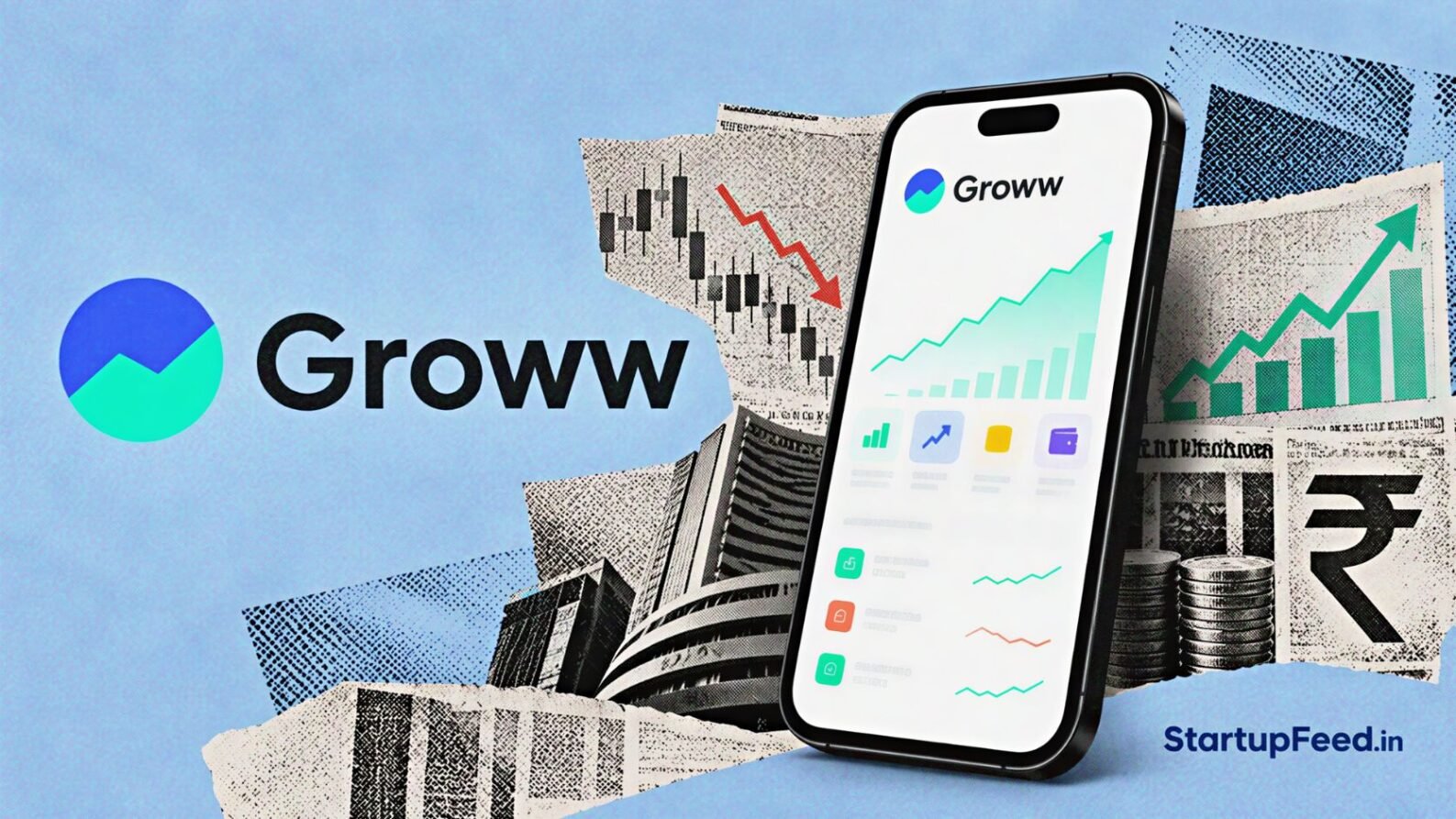
Groww shares slide as much as 7% on May 12, 2026, hitting an intraday low of Rs 180.15 after reports emerged that early investors were planning to offload up to Rs 4,750 Cr worth of stock through block deals — the same day Groww’s six-month post-IPO shareholder lock-in expired, unlocking 418.2 Cr shares for open market trading. The stock recovered some ground and was trading 3.98% lower at Rs 186 at 12:00 IST, giving the company a market capitalisation of Rs 1.16 Lakh Cr (approximately $12.1 Bn).
The timing caught markets off guard. Groww had just reported one of the strongest quarters in its listed history — a 122% YoY jump in Q4 FY26 profit — yet early investors chose the first day of lock-in expiry to announce an exit plan. The divergence between strong fundamentals and a falling stock price captures exactly why lock-in expiry days are routinely among the most volatile in a post-IPO stock’s life.
StartupFeed Insight
The 7% intraday drop in Groww shares does not reflect a fundamental deterioration. Groww’s Q4 FY26 numbers — PAT up 122%, EBITDA up 142%, PAT margin at 45% — are among the cleanest posted by any Indian fintech in recent memory. What the market is pricing is short-term float expansion: 418.2 Cr newly eligible shares represent significant supply shock for a stock that was closely held through the lock-in window. The block deal structure, with buyers typically pre-arranged at a floor price, means the actual selling is often more orderly than the headline decline suggests. Retail investors tempted to exit should note that the overhang tends to clear within two to three trading sessions.
Why Did Groww Shares Slide 7% Today?
Two events converged on May 12, 2026. First, Groww’s six-month post-IPO lock-in period expired, making 418.2 Cr shares eligible for trading for the first time since the November 2025 IPO. Second, reports surfaced that four of Groww’s largest early investors had arranged a block deal to sell up to 26.84 Cr shares — roughly a 4.3% stake — worth as much as Rs 4,750 Cr.
| Metric | Value | Context |
|---|---|---|
| Intraday Low (May 12) | Rs 180.15 | -7% from previous close |
| Price at 12:00 IST | Rs 186 | -3.98% after partial recovery |
| Market Cap (at Rs 186) | Rs 1.16 Lakh Cr (~$12.1 Bn) | Nearly double the IPO valuation |
| Block Deal Size | Up to Rs 4,750 Cr | Up to 26.84 Cr shares (4.3% stake) |
| Sellers | Peak XV, YC, Sequoia, Ribbit Capital | Four original VC investors |
| Shares Unlocked Today | 418.2 Cr shares | Six-month post-IPO lock-in expired |
| IPO Price | Rs 100 | Listed November 2025 at +14% premium |
| Q4 FY26 PAT | Rs 686.4 Cr | +122% YoY, +25% QoQ |
| Q4 FY26 Operating Revenue | Rs 1,505.4 Cr | +88% YoY, +24% QoQ |
| Q4 FY26 EBITDA | Rs 938.7 Cr | +142% YoY, +30% QoQ |
| PAT Margin | 45% | +8.3 percentage points YoY |
| Broader Market | Sensex -1.1%, Nifty -1% | Weak macro backdrop added pressure |
Peak XV Partners holds the largest pre-deal stake at 16.88%, followed by YC Holdings at 10.08% and Ribbit Capital at 6.9%. The block deal, if fully executed, would reduce combined early-investor concentration and increase the free float available to institutional and retail buyers.
About Groww
Groww, operated by Billionbrains Garage Ventures, is India’s largest retail stock broking platform by active client count. Founded in 2016 by Lalit Keshre, Harsh Jain, Neeraj Singh, and Ishan Bansal, and headquartered in Bengaluru, the company offers equity trading, mutual fund investments, IPO applications, and digital gold. Groww went public in November 2025 at an IPO price of Rs 100, listing at a 14% premium. In Q4 FY26, the company posted operating revenue of Rs 1,505.4 Cr (+88% YoY) and a profit after tax of Rs 686.4 Cr (+122% YoY), with a PAT margin of 45%. Its market cap has roughly doubled from the IPO valuation of approximately Rs 62,000 Cr.
Is Groww Profitable Despite the Share Price Fall?
The stock decline obscures a strong earnings picture. Groww’s Q4 FY26 operating revenue of Rs 1,505.4 Cr grew 88% year on year and 24% sequentially. Total income for the quarter reached Rs 1,535.5 Cr. EBITDA surged 142% YoY and 30% QoQ to Rs 938.7 Cr, while the PAT margin expanded 8.3 percentage points year on year to 45% — a level few Indian new-age fintechs have reached at this scale.
The PAT margin expansion signals operating leverage kicking in: revenue growth outpaced fixed costs, meaning each incremental rupee of revenue is dropping to the bottom line more efficiently than before. This is the structural metric long-term investors in the stock should track, not the intraday price move triggered by a one-time supply event.
How Does Groww Compare to Angel One and Zerodha?
India’s retail broking market is a three-way contest between Groww (listed), Angel One (listed), and Zerodha (private).
| Broker | Status | Q4 FY26 Revenue* | Differentiator |
|---|---|---|---|
| Groww | NSE/BSE listed (Nov 2025) | Rs 1,505 Cr (+88% YoY) | Largest active client base, mobile-first UX |
| Angel One | NSE/BSE listed | Not used for comparison | Advisory + wealth management focus |
| Zerodha | Private (bootstrapped) | Undisclosed (FY25 PAT ~Rs 4,700 Cr) | No-frills, fee-based, high margin model |
*Groww figure verified from Q4 FY26 earnings; Angel One Q4 FY26 figure not included as a direct comparison is not available in this context. Verify before publishing.
Groww’s 45% PAT margin in Q4 FY26 is competitive with Zerodha’s historically high margins, and suggests the company has crossed the point where scale drives profitability rather than diluting it. That makes the lock-in expiry sell-off a technical event rather than a verdict on business quality.
What’s Next
Watch for the Groww block deal execution on the next trading session — block deals typically clear at market open at a pre-negotiated floor price. Once the deal completes and the overhang lifts, the stock’s direction will depend on whether institutional buyers absorb the supply at a discount or demand a steeper entry. The Q4 FY26 investor call, expected this week, will set the FY27 revenue guidance tone that determines medium-term sentiment.
Will the block deal create a buying opportunity — or signal that early investors see limited upside ahead?
Frequently Asked Questions
Why did Groww shares slide 7% on May 12, 2026?
Groww shares slide 7% intraday on May 12, 2026 because of two simultaneous events: the expiry of the company’s six-month post-IPO lock-in period, which made 418.2 Cr shares eligible for open market trading, and reports that early investors — Peak XV, Sequoia Capital, Y Combinator, and Ribbit Capital — were planning to sell up to 26.84 Cr shares worth Rs 4,750 Cr through block deals. Broader market weakness, with Sensex down 1.1% and Nifty down 1%, added to the selling pressure.
What is Groww’s financial performance in Q4 FY26?
Groww reported a consolidated profit after tax of Rs 686.4 Cr in Q4 FY26, a jump of 122% year on year from Rs 309.1 Cr and up 25% from the prior quarter. Operating revenue grew 88% YoY and 24% sequentially to Rs 1,505.4 Cr. EBITDA surged 142% YoY to Rs 938.7 Cr, while the PAT margin expanded 8.3 percentage points year on year to reach 45%, supported by operating leverage as revenue growth outpaced fixed costs.

Who is selling Groww shares in the block deal?
According to reports, four early investors are looking to sell shares in Groww through block deals on May 12, 2026: Peak XV Partners (Groww’s largest shareholder with a 16.88% stake), YC Holdings (10.08% stake), Sequoia Capital, and Ribbit Capital (6.9% stake). Together they plan to offload up to 26.84 Cr shares, or approximately 4.3% of the company’s total equity, worth up to Rs 4,750 Cr.
Disclaimer: This article is for informational purposes only and does not constitute investment advice. StartupFeed and its authors are not SEBI-registered investment advisors. The analysis above is based on publicly available information and should not be the sole basis for any investment decision. Please consult a SEBI-registered financial advisor before making investment decisions.
Liked this story? Follow StartupFeed on Google so our reporting reaches you first.