
Quick Take
- OpenAI DeployCo launches with $4 Bn and 150 engineers to embed AI directly inside businesses.
- The model mimics Palantir’s embedded-engineer approach, competing directly with TCS, Infosys, and Wipro.
- Anthropic’s $1.5 Bn parallel JV means India’s IT firms now face a two-front AI services war.
OpenAI DeployCo—the OpenAI Deployment Company—launched on May 11, 2026, with more than $4 Bn in initial investment from 19 global partners and a mandate to do what Indian IT companies have done for three decades: go inside corporations and make technology work. The difference is that DeployCo brings AI models, embedded engineers, and a $10 Bn pre-money valuation to a market that TCS, Infosys, and Wipro have built their combined $150 Bn+ in annual revenues on. For India’s IT sector, this is the most direct structural challenge since cloud computing arrived in the mid-2000s and forced the same companies to reinvent their delivery models.
StartupFeed Insight
The most important detail about OpenAI DeployCo is not that it threatens Indian IT — it is who invested. Bain & Company, Capgemini, and McKinsey funded a company that will directly compete for the same enterprise budgets those firms depend on. This is OpenAI achieving something remarkable: convincing incumbents to pay for their own disintermediation. Indian IT has seen this playbook before. In 2008, Amazon Web Services began commoditising the infrastructure management that TCS and Infosys built entire practices around.
The firms that partnered early — and built cloud-native capabilities — survived and grew. Those that treated cloud as a threat to manage lost a decade of growth. The same fork in the road is here again, and the window to choose the right path is roughly 18 months. Expect at least one major Indian IT company to announce a strategic AI deployment JV or acquire a domestic AI engineering firm before the end of FY27. — StartupFeed Desk
What Is OpenAI DeployCo and How Does It Work?
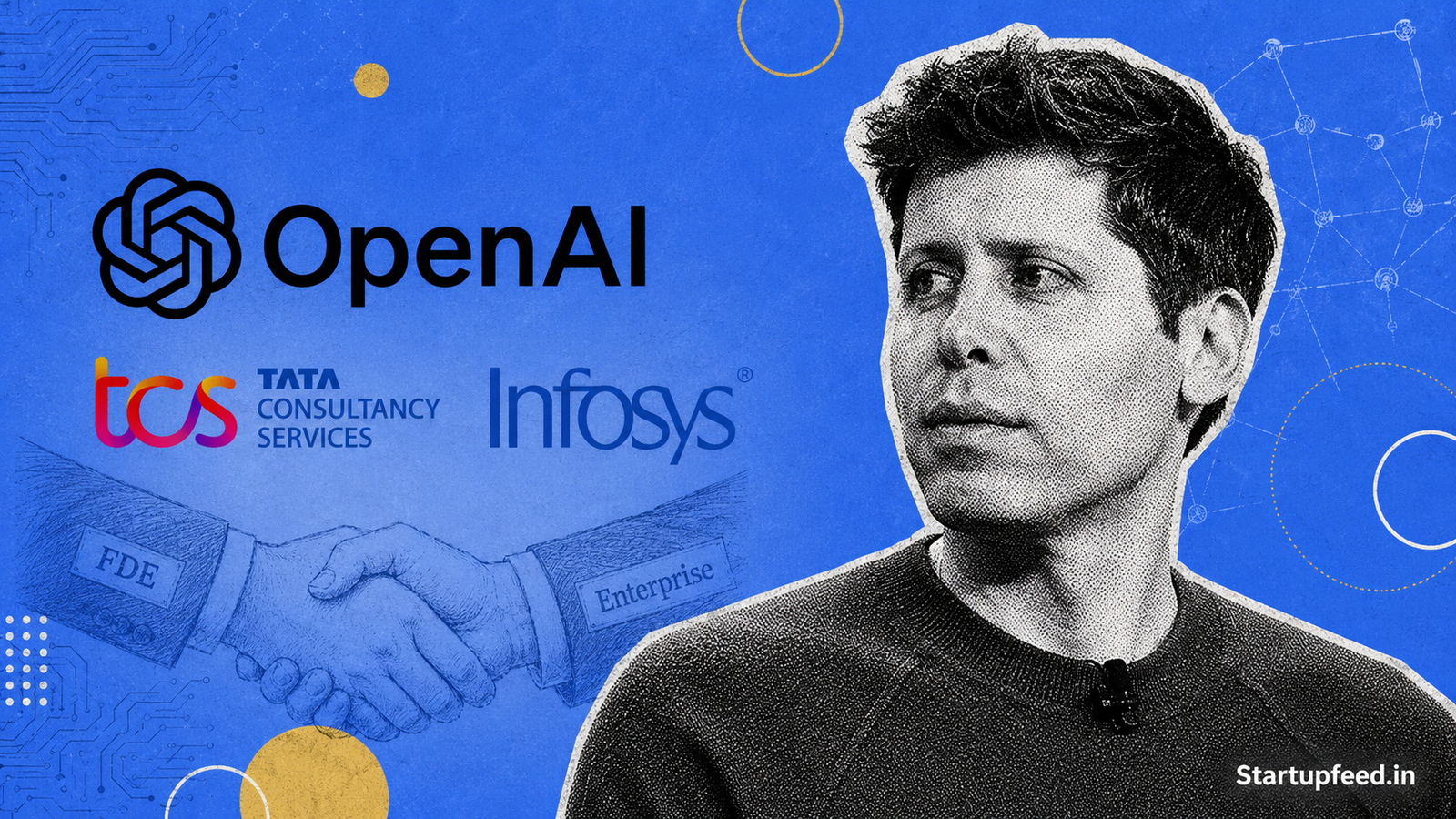
DeployCo is modelled after Palantir’s Forward Deployed Engineer strategy — a model where technology company engineers live inside client organisations, learn their operations, and build custom systems rather than handing over a software licence and walking away. OpenAI President Greg Brockman described the venture as starting with “150 forward deployed engineers and Deployment Specialists” and $4 Bn in initial investment from 19 partners.
| DeployCo Element | What It Does | Indian IT Equivalent |
|---|---|---|
| Forward Deployed Engineers (FDEs) | Embed inside client orgs to build and run AI workflows | Onsite delivery teams, IT consultants |
| AI model customisation | Tailor OpenAI models to client data and processes | Custom application development |
| Tomoro acquisition (150 engineers) | UK AI consulting firm; prior clients include Tesco, Virgin Atlantic | Offshore delivery centres, acquired practices |
| Consulting investor-partners | McKinsey, Capgemini, Bain & Co. — inside the DeployCo tent | Direct competitors — now also funding DeployCo |
| Capital raised | $4 Bn at a $10 Bn pre-money valuation | TCS market cap: ~$180 Bn; Infosys: ~$80 Bn |
| Anchor investors | TPG (lead), Advent, Bain Capital, Brookfield, Goldman Sachs, SoftBank | PE and sovereign funds that also back Indian IT |
Denise Dresser, OpenAI’s Chief Revenue Officer, framed the mission directly:
“AI is becoming capable of doing increasingly meaningful work inside organizations. The challenge now is helping companies integrate these systems into the infrastructure and workflows that power their businesses. DeployCo is designed to help organizations bridge that gap and turn AI capability into real operational impact.” — Denise Dresser, Chief Revenue Officer, OpenAI
About the OpenAI Deployment Company (DeployCo)
The OpenAI Deployment Company, launched May 11, 2026, is a majority-owned subsidiary of OpenAI designed to embed AI systems inside enterprise operations. The company raised $4 Bn in initial investment at a $10 Bn pre-money valuation from 19 partners including TPG (lead), Advent International, Bain Capital, Brookfield, Goldman Sachs, SoftBank, Warburg Pincus, B Capital, and BBVA. Consulting and integration partners include McKinsey & Company, Capgemini, and Bain & Company. DeployCo acquired Tomoro, a UK-based AI consulting firm with prior enterprise clients including Tesco, Virgin Atlantic, and Supercell, bringing approximately 150 Forward Deployed Engineers from day one. OpenAI states that more than one million businesses currently use its products and APIs.
How Large Is the Threat to Indian IT Services?
India’s IT services sector generated approximately $245 Bn in export revenues in FY25, according to NASSCOM. TCS, Infosys, HCL, and Wipro together employ more than 1.5 million professionals globally and hold long-term technology services contracts with a significant share of the Fortune 500.
Their core value proposition — integrating complex enterprise technology, managing legacy systems, and delivering custom software at offshore cost — is precisely the market DeployCo is entering.



The structural threat is to billable headcount. DeployCo’s model assumes a small team of FDEs, working alongside AI agents, can accomplish what previously required dozens of offshore engineers. If that assumption proves correct at scale, India’s labour arbitrage advantage narrows significantly.
But DeployCo is not entering this market from a standing start. It is entering alongside the same consulting firms that already have Indian IT relationships. Industry observers note that Indian IT firms are themselves partners of OpenAI and Anthropic.
One analyst quoted in Business Standard framed the tension directly: “We’ll see more co-opetition. Companies are already partnering with AI firms to accelerate adoption, even as they compete for enterprise budgets.” The danger is not a single contract lost — it is deal ownership shifting. If enterprises start engaging OpenAI DeployCo as the primary AI vendor and Indian IT firms become sub-contractors to that relationship, the pricing power and margin structure of Indian IT contracts changes fundamentally.
How Do India’s IT Giants Compare to DeployCo?
| Company | AI Platform | OpenAI Relationship | Primary Risk |
|---|---|---|---|
| TCS | TCS.AI, WisdomNext | Partner and competitor | Headcount-based billing disrupted |
| Infosys | Topaz AI platform | Partners with OpenAI and Anthropic | Mid-level consulting replaced by FDEs |
| Wipro | Wipro ai360 | OpenAI partnership active | Application management repriced by AI |
| HCL Tech | AI Force | Microsoft (OpenAI) ecosystem | Infrastructure services commoditised |
| OpenAI DeployCo | Native OpenAI models | Is OpenAI | The disruptor |
Indian IT’s genuine advantages remain: three decades of client trust in regulated industries, deep knowledge of legacy infrastructure that FDEs may not want to touch, and the regulatory and compliance expertise that financial services and healthcare clients require. Aaron Levie, CEO of Box, noted that every technology wave — from digital to cloud — has generated massive new consulting and services demand rather than eliminating it. Infosys and TCS grew through cloud adoption, not despite it. The question is whether they move fast enough this time.
This is also not only an OpenAI problem. Anthropic launched a $1.5 Bn joint venture backed by Blackstone, Hellman & Friedman, and Goldman Sachs to deploy its Claude AI model directly inside corporations. Indian IT now faces two of the world’s most capable AI labs competing for the same enterprise services contracts simultaneously.
What’s Next
Watch for Indian IT’s Q1 FY27 earnings calls — expected July-August 2026 — for explicit guidance on AI-led deal wins versus AI-impacted headcount. The signal to track is not revenue growth but deal structure: are new contracts FDE-style outcome-based engagements, or legacy time-and-materials? Any Indian IT company that reports a meaningful shift toward AI-native outcome contracts within the next two quarters is positioning correctly. Those still reporting headcount additions as a primary growth metric are not.
Will Indian IT companies partner with OpenAI DeployCo and become its largest delivery arm — or will they try to compete and lose?
Frequently Asked Questions
What is OpenAI DeployCo and how does it threaten Indian IT?
OpenAI DeployCo is the OpenAI Deployment Company, launched May 11, 2026, with $4 Bn in initial investment. It embeds its own Forward Deployed Engineers directly inside client organisations to build, customise, and operate AI systems across daily business processes. This model directly competes with the enterprise technology integration and consulting services that Indian IT firms like TCS, Infosys, and Wipro have delivered for decades. The structural threat is that AI-assisted FDE teams can potentially replace large offshore delivery headcounts, narrowing India’s traditional labour cost advantage.
Does OpenAI DeployCo replace Indian IT companies completely?
Not immediately, and possibly not at all, depending on how Indian IT firms respond. DeployCo starts with 150 engineers against an Indian IT sector employing over 1.5 million professionals. Indian IT has real advantages: deep client relationships in regulated industries, legacy system expertise, and compliance knowledge that AI models cannot replicate quickly. However, the structural risk is that deal ownership shifts — enterprises engage OpenAI DeployCo as the primary AI partner and Indian IT firms become lower-margin sub-contractors. Firms that secure strategic AI deployment partnerships in the next 18 months will own the more valuable contracts of the 2030s.


Which Indian IT company is best positioned to handle the OpenAI DeployCo threat?
Infosys has publicly partnered with both OpenAI and Anthropic, and its Topaz AI platform signals a genuine attempt to build AI-native delivery. TCS has invested in upskilling 250,000+ employees on AI tools. Wipro’s ai360 and HCL’s AI Force indicate sector-wide awareness of the shift. The differentiator will not be the platform name but actual enterprise AI deal wins: which firm lands the first large-scale contract where AI agents replace meaningful headcount while maintaining client outcomes. That firm sets the template for how Indian IT survives the next decade of competition from companies like OpenAI DeployCo.
Liked this story? Follow StartupFeed on Google so our reporting reaches you first.