
Published: November 5, 2026
StartupFeed Quick Take
- The Union Cabinet approved a Rs 2,814 Cr critical mineral processing scheme on November 4, 2026.
- It funds four plants, two for lithium and two for nickel, with a 30% capital subsidy.
- Support is capped at Rs 500 Cr per lithium plant and Rs 900 Cr per nickel plant.
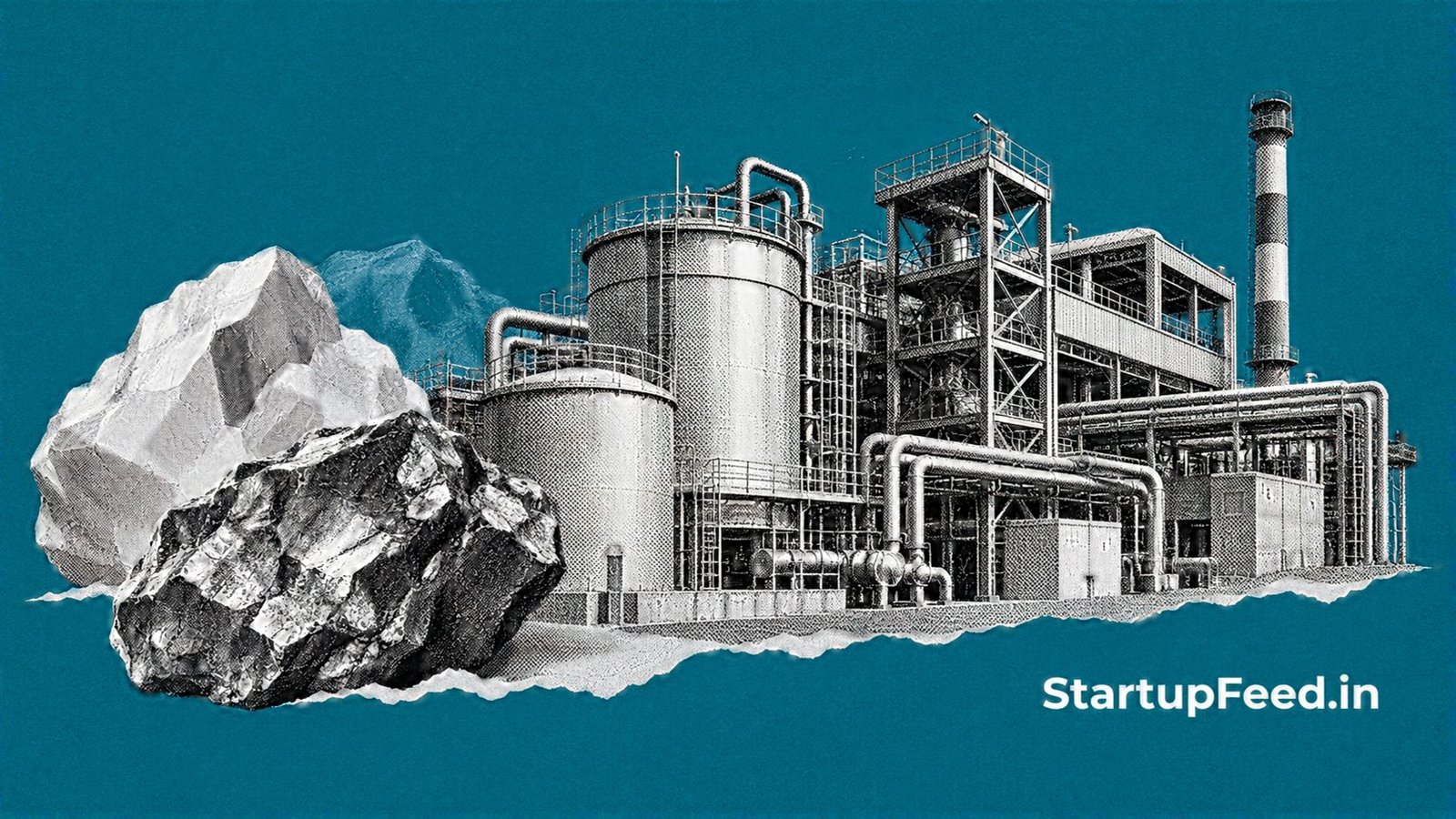
The Union Cabinet approved a Rs 2,814 crore scheme on November 4, 2026 to process lithium and nickel inside India.
This is the government’s second critical minerals scheme in just over a year. The first was a Rs 1,500 crore recycling scheme, cleared in September 2025. That scheme aimed to build 270 kilo tonnes of recycling capacity a year.
The two schemes solve different problems: the September 2025 scheme recovered minerals from e-waste and battery scrap. The new processing scheme turns fresh ore into high-purity compounds.
Information and Broadcasting Minister Ashwini Vaishnaw announced the decision after the Cabinet meeting, framing it as steady progress:
“Our National Critical Mineral Mission has been progressing in a very systematic manner.”
Ashwini Vaishnaw, Union Minister for Information and Broadcasting. From the post-Cabinet media briefing, November 4, 2026.
What the critical mineral processing scheme funds
The processing scheme gives a capital subsidy worth 30% of the qualifying investment. Two of the four plants will process lithium and two will process nickel.
Each lithium plant needs a yearly capacity of at least 30,000 tonnes. Each nickel plant needs at least 50,000 tonnes.
The money per plant is capped: a lithium plant can get up to Rs 500 crore. A nickel plant can get up to Rs 900 crore.
The plants will turn lithium and nickel ore, or part-processed material, into high-purity compounds. Cobalt will come out as a by-product of the nickel work.
These compounds feed battery cells, energy storage, electronics, defence and speciality steel. The subsidy backs the processing plants themselves, and does not pay for mining the ore.
Lithium vs nickel: how the caps work
The caps favour nickel. A nickel plant can claim up to Rs 900 crore, while a lithium plant tops out at Rs 500 crore.
The 30% subsidy also sets a floor on project size. To collect the full Rs 500 crore, a lithium plant must invest about Rs 1,667 crore.
A nickel plant must spend about Rs 3,000 crore to reach its Rs 900 crore cap. StartupFeed worked out these figures from the 30% subsidy rate.
Across all four plants, the Rs 2,814 crore could pull in close to Rs 9,300 crore of private money. The public money is the anchor, not the whole bill.
| Item | Lithium plant | Nickel plant |
|---|---|---|
| Subsidy cap per plant | Rs 500 Cr | Rs 900 Cr |
| Minimum capacity | 30,000 tonnes | 50,000 tonnes |
| Investment to reach the cap | about Rs 1,667 Cr | about Rs 3,000 Cr |
| Plants funded | 2 | 2 |
Nickel carries the higher cap because its plants are bigger.
How plants will be chosen
The government will pick the plants in two stages. First comes a technical check of each bidder, then the qualified bidders enter a price round.
For each mineral, the two bidders asking for the least capital support will win the slot. This least-cost rule keeps the public subsidy as low as the market will accept.
The subsidy is paid in three parts, each tied to a project milestone. A plant that misses its targets will not get the full amount.
Only two companies per mineral will win support, so the field is narrow by design. The scheme pays for both building each plant and running it.
Bidders must also bring their own raw material and processing know-how. The scheme’s success leans on that.
Why India is building this now
India buys almost all of its lithium, nickel and cobalt from abroad, and the government wants to change that.
Global processing sits in a few countries, which leaves buyers open to price swings and export curbs. India has very little high-purity capacity of its own.
These minerals sit at the heart of India’s electric vehicle push. India wants 30% of new cars and 80% of new two-wheelers to be electric by 2030.
India has found about 5.9 million tonnes of lithium reserves in Reasi, Jammu and Kashmir. Those reserves still need processing before any battery can use them.
The processing scheme sits inside the National Critical Mineral Mission. The Cabinet approved that mission in January 2025. Its central share is Rs 16,300 crore, with public sector firms adding about Rs 18,000 crore.
The mission has a total outlay of Rs 34,300 crore over seven years. China dominates the global processing of these minerals, and closing that gap is the point of the scheme.
Lithium and nickel came first because the battery sector needs them most.
What this means for you: If you build EV batteries, energy storage or electronics in India, your lithium and nickel could soon be refined at home. Watch for the tender; only two lithium and two nickel processors will win support, and bids turn on the lowest subsidy asked.
StartupFeed Insight
The caps tell the real story. By tilting Rs 900 crore to nickel against Rs 500 crore for lithium, the government is paying more for the bigger plant. The least-cost auction then pushes that spend back down. For founders, this is not a grant to chase casually. Only four plants will be built, and each winner must bring its own ore and a working process. Expect the tenders to open in the first half of 2027, and expect large metals and battery groups, not early-stage startups, to take all four slots.
By Avinash Mishra, Business Correspondent
Have a tip? Write to us at editorial@startupfeed.in.
Liked this story? Follow StartupFeed on Google so our reporting reaches you first.