Quick Take
- India electronics output may fall 30-40% within 3 months on a severe PCB parts shortage, per IPCA.
- AI server demand and Middle East conflict have diverted glass fibre, copper foil and resin away from standard boards.
- IPCA is seeking duty cuts and stricter anti-dumping enforcement to protect the $7.27 Bn (Rs 6,930 Cr) PCB market.
In This Article
India electronics output could fall 30-40% within three months, as a deep shortage of printed circuit board (PCB) parts chokes local manufacturing, the India Printed Circuit Association (IPCA) warned in a letter to the Centre in early August 2026.
The warning lands as global suppliers divert glass fibre, copper foil and resin away from standard electronics toward high-margin PCBs for artificial intelligence (AI) servers and 6G telecom gear. A war-hit supply chain and soaring input prices have made the crunch worse across the industry.
StartupFeed Insight
The real signal here is dependence, not just price. India makes barely 15% of the PCBs it needs, so any global input squeeze hits local assembly lines almost instantly. The people who should be watching are EMS founders and consumer electronics OEMs, because a 30-40% output cut means missed festive-season orders and thinner margins. StartupFeed expects the government to announce some form of raw-material duty relief or a copper-clad laminate import window before the end of Q3 FY27, given the political weight of the electronics export target. Firms that locked in laminate supply early will clear this quarter far more calmly than those still sourcing spot. By Avinash.
What Is Driving the PCB Shortage?
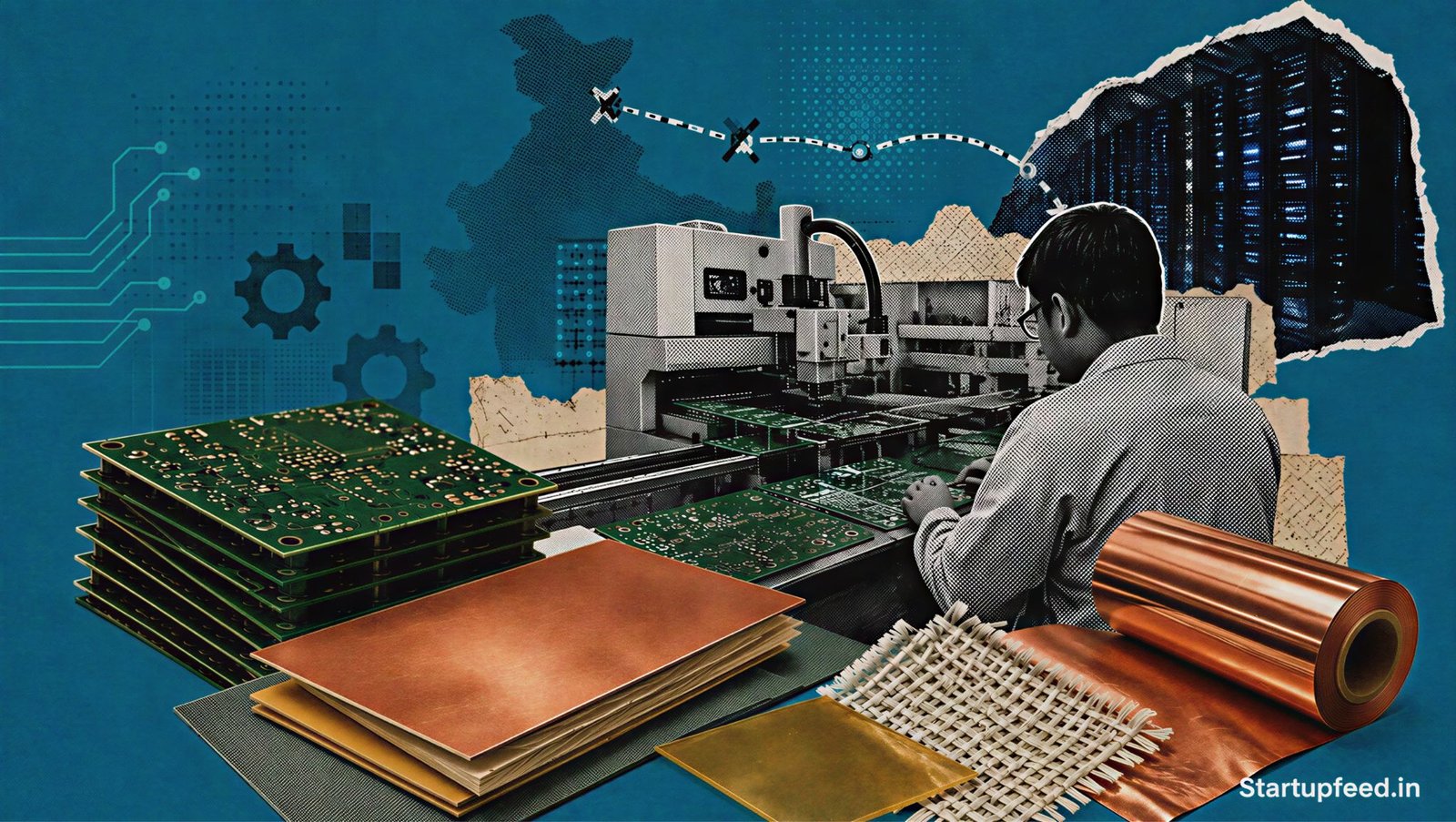
The PCB shortage in India is caused by a global diversion of core raw materials toward AI hardware, combined with war-linked supply disruption. PCBs form the physical base of every electronic device, holding and connecting its components.
Prices of copper-clad laminate (CCL), a key PCB input, have surged more than 300% in the last 12 months, according to IPCA. CCL production has come under pressure after supply of high-purity polyphenylene ether (PPE) resin dwindled. Saudi Arabia’s Jubail petrochemical complex, which makes roughly 70% of the world’s PPE resin, shut down in March 2026 following drone strikes. Other specialty chemicals and epoxy resin supplies have also been hit.
The Numbers Behind the Crunch
India electronics output is exposed because the country imports the bulk of its PCBs, leaving factories with little buffer when global supply tightens. The table below sets out the key figures from the current crisis.



| Metric | Detail | Notes |
|---|---|---|
| Projected output fall | 30-40% within 3 months | IPCA letter to Centre |
| CCL price rise | Over +300% (last 12 months) | Key raw input for PCBs |
| Domestic PCB market | $7.27 Bn (Rs 6,930 Cr) | Localisation at risk |
| Jubail PPE resin share | ~70% of global supply | Plant shut March 2026 |
| Anti-dumping duty | 30% on China, Hong Kong PCBs | IPCA seeks stricter enforcement |
| Absorbed by AI, telecom | ~40% of component flow | Diverted from standard boards |
The steepest figure is the CCL price move. A 300%-plus jump in one year on a single foundational input explains why laminate makers cannot absorb costs and why finished boards are getting scarce and expensive. USD figures are converted at Rs 95.3 to the dollar (spot rate, August 3, 2026).
About IPCA
The India Printed Circuit Association (IPCA), founded in 1985 and headquartered in Mumbai, is the leading industry body for PCB manufacturers, raw-material suppliers and equipment providers in India. It has 300-plus members spanning public and private players. IPCA coordinates policy communication with the government, runs technical seminars, and hosts the annual IPCA Electronics Show for the domestic PCB and electronics sector.
Why Is India Electronics Output at Risk?
India electronics output is at risk because nearly 85% of the country’s PCB demand is met through imports, so a global supply shock passes straight to local assembly lines. IPCA plans to write to the Centre, states, governments and banks over the next few days, seeking duty relief, emergency grants and special working capital funds for small manufacturers.
“The imposition of anti-dumping duty would be a considered decision,” Pankaj Mohindroo, Chairman, India Cellular & Electronics Association (ICEA), has said on the wider component debate.
The association is also seeking permission for traders to import duty-free CCL, similar to the treatment already given to some manufacturers. Industry voices note that with copper costs and a weaker rupee, the pressure on input prices is genuine and not merely a pricing tactic. You can follow the sector body’s positions on the official IPCA India website.
What Does This Mean for the Sector?
A 30-40% output cut threatens to affect three parts of India’s electronics chain: smartphones and consumer devices, telecom equipment, and automotive electronics. Higher board prices could feed into the final retail cost of many products if the squeeze continues.
| Segment | Exposure |
|---|---|
| Smartphones, consumer electronics | High, volume-driven, thin margins |
| Telecom, 6G gear | Competing for the same scarce boards |
| Automotive electronics | Rising board dependence, long design cycles |
What sets India apart is the scale of import reliance: even a modest global shortfall hits harder here than in countries with deeper domestic laminate capacity.
What’s Next
Watch for IPCA’s formal letters to the commerce and electronics ministries over the coming days, and for any duty-relief signal from the Centre before the end of Q3 FY27. The immediate test is whether local manufacturers can secure enough CCL to protect festive-season production runs. Will India treat PCB self-reliance with the same urgency it gave semiconductors?



Frequently Asked Questions
Have a tip? Write to us at editorial@startupfeed.in.
Liked this story? Follow StartupFeed on Google so our reporting reaches you first.