Quick Take
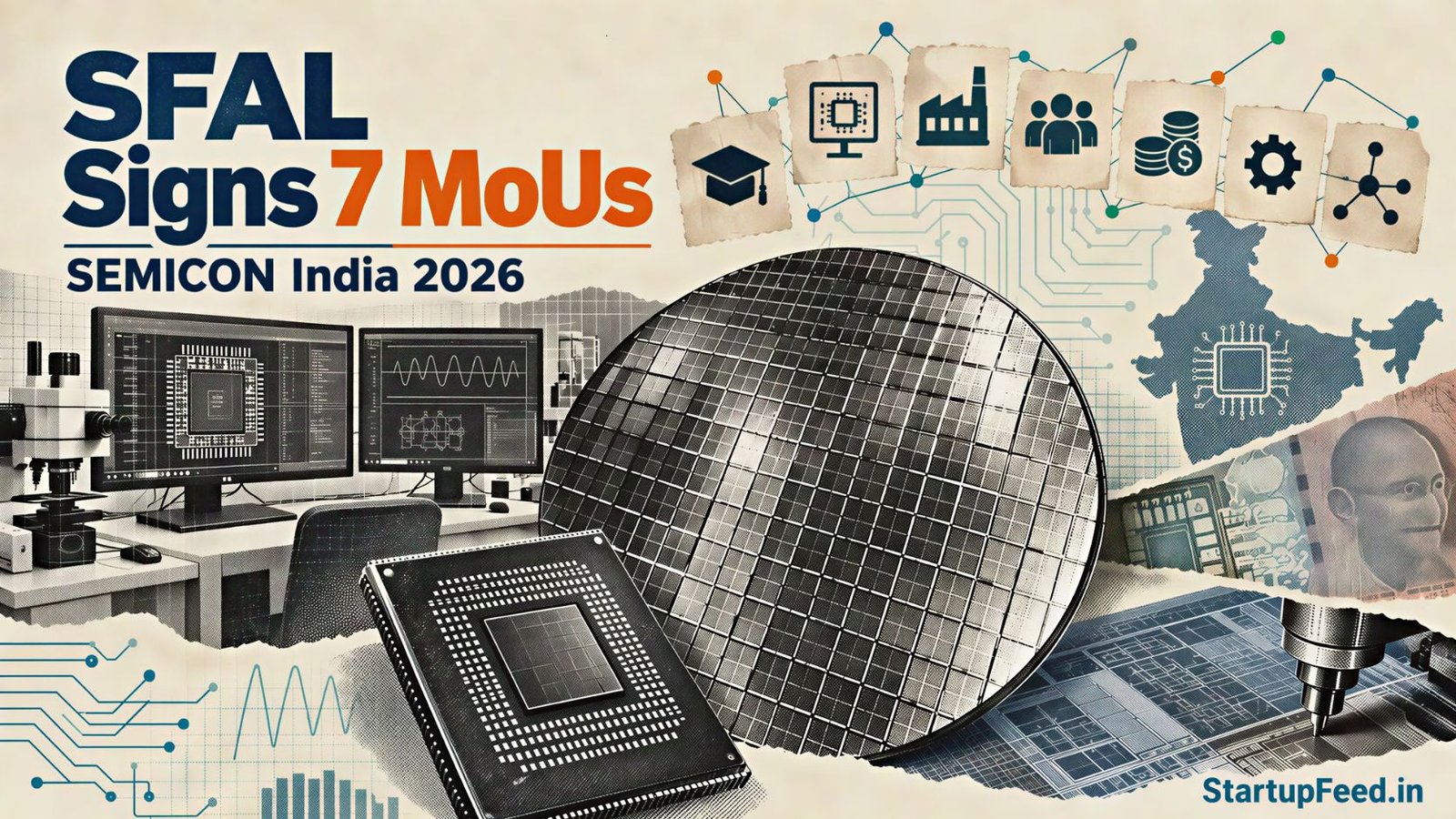
- SFAL signed 7 MoUs at SEMICON India 2026 in New Delhi on September 18, 2026.
- The partners cover chip design, EDA tools, manufacturing, talent, and funding.
- SFAL’s supported companies are now worth more than Rs 1,000 crore in total.
The Semiconductor Fabless Accelerator Lab (SFAL) signed seven partnership deals at SEMICON India 2026 in New Delhi on September 18, 2026. Each one targets a different gap that Indian chip startups hit.
SFAL is a Karnataka government-backed centre for fabless semiconductor firms. A fabless firm designs chips but does not own a factory to make them. SFAL was set up in 2019.
The seven Memoranda of Understanding (MoUs) span research, chip design, electronic design automation (EDA), manufacturing, talent, investment, and commercialisation. EDA means the software used to design and test a chip before it is built.
The partners are IISc Centre for Nano Science and Engineering (CeNSE), FourFront Ltd, PeachTree Elevate, Aarayaa Advisory Services, Kaynes Semicon, WOWSEMI Foundation, and Silvaco Inc. That is a mix of academia, industry, and finance.
Two Karnataka ministers were present as the deals were exchanged. They were Commerce and Industries Minister MB Patil, and IT and Biotechnology Minister Priyank Kharge. Members of the SFAL Board also attended.
What do the seven MoUs cover?
The seven MoUs each cover one part of the chip journey, from lab to market. Three focus on moving designs toward the factory floor. The rest cover research, skills, mentoring, and money.
Kaynes Semicon brings manufacturing know-how. It will give startups a closer look at what real production needs. That helps them get a design ready for validation.
FourFront will work on automotive electronics with SFAL. Its focus areas include power electronics, electric vehicle designs, and systems that cut electromagnetic interference.
Silvaco brings chip design and EDA tools. Startups get access to design software, technical know-how, and an industry view. Tool cost has long been a wall for young fabless firms.
Here is what each of the seven partners brings to SFAL.
| Partner | What the MoU covers |
|---|---|
| IISc CeNSE | Research in nanoscience and nanoelectronics |
| FourFront Ltd | Automotive and power electronics |
| Silvaco Inc | Chip design and EDA tools |
| Kaynes Semicon | Manufacturing and production readiness |
| PeachTree Elevate | Startup mentoring and talent |
| Aarayaa Advisory | Fundraising and financial planning |
| WOWSEMI Foundation | Skills and community programmes |
How does this help chip startups?
The deals help chip startups by joining up steps that usually sit apart. A founder often has to chase research, tools, a factory, and funding on their own. SFAL is trying to put those under one roof.
IISc CeNSE links startups to deep research in nanoscience and nanoelectronics. The IISc CeNSE tie is also meant to connect lab work with real products.
On skills, two partners step in. WOWSEMI Foundation is a Section 8 non-profit focused on chip skills. PeachTree Elevate adds mentoring and business guidance for founders.
Money is the fourth piece. Aarayaa Advisory Services will help startups with fundraising, financial planning, and investor talks. Investment has long been the hardest part for fabless firms, because returns take years.
How big is SFAL now?
SFAL now backs a portfolio worth more than Rs 1,000 crore in combined valuation. It has supported over 100 semiconductor and electronic systems companies since 2019.
The centre started with fabless chip design alone. It is now widening its scope. The new focus covers pre-silicon design, post-silicon testing, chip packaging, and electronics manufacturing services (EMS).
This wider push runs through a phase called SFAL 2.0. The Karnataka government approved SFAL 2.0 at a project cost of Rs 79.80 crore. The state will put in Rs 50 crore over five years, with the rest expected from the Centre.
The targets go further. SFAL plans to support about 75 more chip and electronics startups by 2030. It also aims to back at least five firms with 5 million dollars or more each over five years.
Why does this matter for India?
It matters because India still has few homegrown chip firms. One SFAL count put the number below 150, against about 1,000 each in Israel and Taiwan. The gap is wide.
The seven MoUs sit under the India Semiconductor Mission. That national plan wants to build local chip skills, draw investment, and grow the talent base.
Karnataka is making an early claim on this sector. Priyank Kharge said the state’s chip ecosystem was built on talent and on close work between government and industry.
“As India builds deeper capabilities across the semiconductor value chain, partnerships such as these are critical to connecting startups with research, technology, manufacturing, talent, investment and global markets,” Kharge said. He added that SFAL 2.0 would help ideas move from design through to commercialisation.
What this means for you: If you run a fabless or deep-tech hardware startup, SFAL is now a single door to EDA tools, a factory partner, and investors, so it is worth checking eligibility for its accelerator.
StartupFeed Insight
Seven MoUs in one day reads as scale, but the real signal is the shape. SFAL has stopped acting like a design lab and started acting like a full chain, from IISc research to a Kaynes factory line to Aarayaa’s investor desk. That is the piece India’s chip story keeps missing. The number to watch is not seven. It is five. SFAL’s own target of five firms at 5 million dollars each by 2030 is the true test, because funding, not design talent, is where Indian fabless startups stall. Expect the first of those five funding milestones to be named before the end of 2027. If it slips, the pipeline is still design-heavy and cash-light.
— Avinash Mishra, Business Correspondent
Frequently Asked Questions
Liked this story? Follow StartupFeed on Google so our reporting reaches you first.