
Quick Take
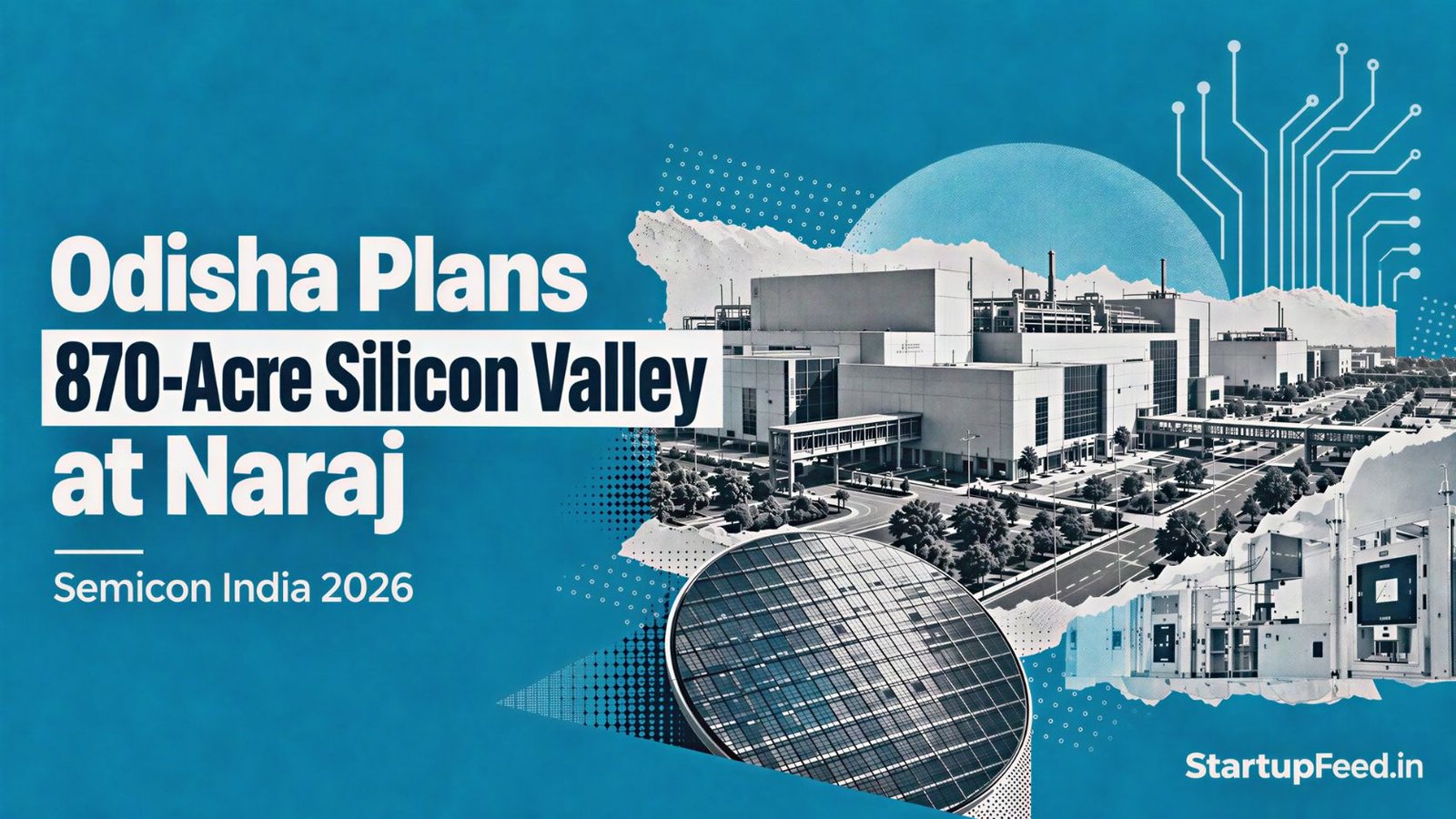
- Odisha has set aside an 870-acre land bank at Naraj, near Cuttack, for an “Odisha Silicon Valley”.
- The state drew Rs 23,600 crore in chip investment proposals at Semicon India 2026, with a jobs potential of about 6,100.
- Five approved projects worth Rs 11,000 crore are separate from those proposals, and construction has started on two.
Odisha will build an 870-acre technology hub at Naraj, near Cuttack, and brand it the “Odisha Silicon Valley”. Chief Minister Mohan Charan Majhi announced the plan on September 18, 2026, at Semicon India 2026 in New Delhi.
Most of the money is not committed yet. The state drew about Rs 23,600 crore in investment proposals at the event, with the potential for 6,100 jobs. A proposal is an intent to invest. It is not cash in the ground.
The hub will host semiconductor, electronics and information technology projects. Odisha says the Naraj site sits on the Cuttack-Bhubaneswar corridor. It has road links to the ports of Paradip and Dhamra.
The Mahanadi River runs close by. That matters for chips. Fabrication and packaging plants need large, steady supplies of water and power.
What did Odisha announce at Semicon India 2026?
Odisha announced an 870-acre land bank at Naraj for a dedicated chip and electronics hub. The state government confirmed the location and the size. Majhi made the announcement while inaugurating the Odisha pavilion at the New Delhi event.
The state also held talks with delegations from Japan, Sweden and Taiwan. Odisha officials met firms including Lam Research, Applied Materials, SiCSem, 3D Glass Solutions, Cyient, Linde and HORIBA India, according to the state government.
The Rs 23,600 crore figure is the headline number. It is the total value of proposals recorded at the event. The state has not published a company-by-company split for that total.
What projects are already approved in Odisha?
Odisha has five approved semiconductor projects worth about Rs 11,000 crore. The state says these could create around 4,500 direct jobs and over 16,000 indirect jobs. This Rs 11,000 crore is separate from the Rs 23,600 crore in fresh proposals.
Construction has begun on two central government-approved units. One is SiCSem’s silicon carbide fab and packaging plant. The other is 3D Glass Solutions’ glass-substrate packaging facility.
The table below lists the named commitments. Some are approvals. Some are only MoUs. The label matters.
| Company | Project | Status | Value |
|---|---|---|---|
| SiCSem | Silicon carbide fab and packaging | Under construction | Part of Rs 11,000 Cr set |
| 3D Glass Solutions | Glass-substrate packaging | Under construction | Part of Rs 11,000 Cr set |
| Intel and 3D Glass Solutions | Packaging partnership | MoU | Rs 30,550 Cr target |
| RiR Power Electronics | Semiconductor project | MoU | Not disclosed |
| Sancorn Technology | Semiconductor project | MoU | Not disclosed |
| ASP Semiconductor | Semiconductor project | MoU | Not disclosed |
The Intel and 3D Glass MoU targets Rs 30,550 crore and over 1,800 direct jobs. That is the largest single number in the set. It is a target inside an MoU, not committed spend.
What money and skilling is the state putting in?
Odisha has amended its semiconductor policy and will give up to 25% capital support for projects cleared under the India Semiconductor Mission. This is state money on top of central support. The India Semiconductor Mission is the central chip programme.



The state is also investing Rs 125 crore in a Rs 452 crore research hub. The hub covers integrated power electronics. Partners are IIT Bhubaneswar and the National Research Foundation.
On skills, Odisha runs training at the World Skill Center in Bhubaneswar, built with Singapore’s government. Majhi said the state will prioritise skill-based hiring over local quotas so its youth can enter the tech workforce.
What should founders and investors watch next?
Watch how much of the Rs 23,600 crore turns into signed, funded projects. Proposals at investment summits often shrink on the way to the ground. The two live construction sites are the real proof so far.
Founders in power electronics, packaging and chip design have the clearest opening. The 25% state capex and the Naraj land bank lower the cost of setting up. The skilling pipeline is the part to test hardest.
What this means for you: If you run a deep-tech or hardware startup, ask Odisha’s single-window team what the 25% capex covers before you plan a plant there.
StartupFeed Insight
Read the two numbers side by side. Odisha has Rs 11,000 crore in approved projects and Rs 23,600 crore in fresh proposals. Only the first set has real spades in the ground, at the SiCSem and 3D Glass sites. Proposals are a pipeline, not a portfolio. The honest test for Naraj is not the launch-day total. It is how many MoUs convert within 18 months. My call: by the end of 2027, expect two to four of the six named projects to reach funded, under-construction status, and the rest to stay on paper until land and power are locked. Watch the conversion rate, not the headline.
— Avinash Mishra, Business Correspondent
Have a tip? Write to us at editorial@startupfeed.in.
Liked this story? Follow StartupFeed on Google so our reporting reaches you first.