
Quick Take
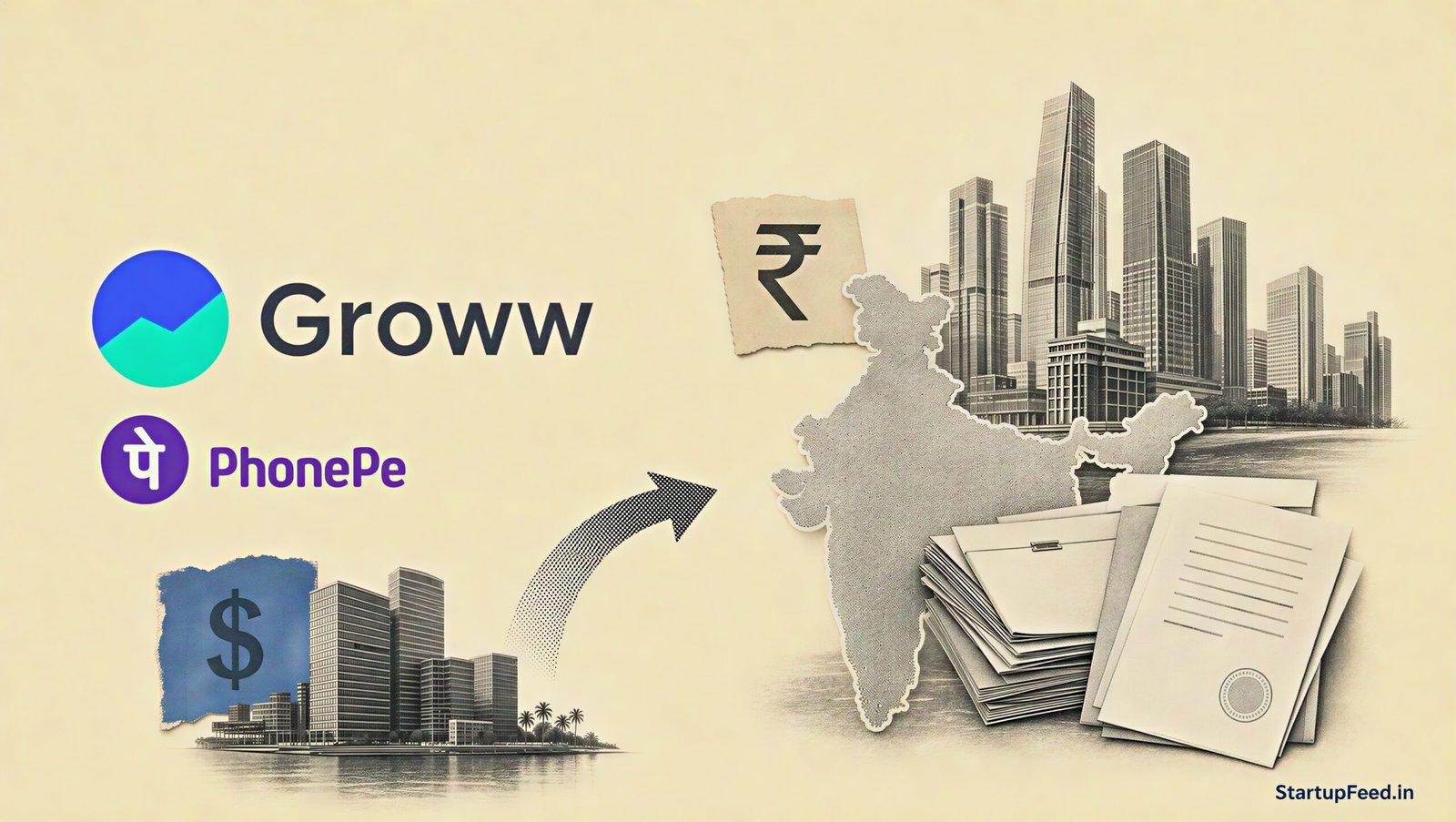
- Groww paid about Rs 1,340 crore and PhonePe nearly $1 billion in tax to shift their base back to India.
- The Supreme Court’s January 15, 2026 Tiger Global ruling made a tax residency certificate no longer conclusive proof of residence.
- A returning founder must clear both Income Tax Act and FEMA residency tests, with FEMA penalties running up to three times the amount involved.
Every week another Indian startup announces it is coming home. The founder posts a note on X. India is the future, the best place to build, the best place to lead.
Then the tax bill arrives.
Groww shifted its base from the United States to India in March 2024. The move cost the company about Rs 1,340 crore in tax. PhonePe paid nearly $1 billion to make the same trip from Singapore.
These are not footnotes. They are the price of the ticket home.
For a returning founder, the gap between the Valley pitch and the Indian rulebook is wide. This is not a story about red tape being annoying. It is a story about real money, hard law, and a homecoming harder than the LinkedIn posts admit.


The reverse-flip wave is real. It is also slowing down.
PhonePe, Groww, Zepto, Dream11 and Razorpay have already moved their legal base back to India. Meesho and Groww have listed on Indian exchanges.
Flipkart won approval from the National Company Law Tribunal to shift its holding company from Singapore to India. On paper, the homecoming looks like a parade.
But in February 2026, Business Standard reported that many startups had put reverse-flip plans on hold. Valuations had cooled, United States funding for AI had grown stronger, and one court ruling had spooked the market.
That ruling is the wall this piece is named for.
What did the Supreme Court decide on Tiger Global?
On January 15, 2026, the Supreme Court held that Tiger Global must pay capital gains tax in India on its 2018 exit from Flipkart. The stake sale to Walmart was worth about $1.6 billion, or roughly Rs 14,500 crore.
Tiger Global had routed the deal through entities in Mauritius. It claimed the India-Mauritius tax treaty made the gains tax-free.

The court disagreed. It ruled the Mauritius structure was an impermissible arrangement built mainly to avoid Indian tax. It said the entities lacked real commercial substance.
One line from the judgment matters most to founders. A tax residency certificate is no longer conclusive proof of where a company lives. For two decades that certificate was the shield.
The court has now called it a necessary paper, not a sufficient one.
The verdict overturned a 2024 Delhi High Court decision that had favoured the investor. Gouri Puri, a partner at Shardul Amarchand Mangaldas, said the ruling would touch all current and prior deals where treaty benefits were claimed.
Why does this hit returning NRI founders hardest?
A returning NRI founder sits at the crossing point of two rulebooks that do not talk to each other.
The first is tax residency. This is decided by how many days you spend in India. The Income Tax Act, 2025, which came into force on April 1, 2026, changed the thresholds for deemed residency.
The second is FEMA residency, set by the Foreign Exchange Management Act. This one is not about day count. It is about intent.
FEMA decides whether you can hold shares in a foreign company, what bank accounts you may run, and how much money you can send abroad.
Get the residency call wrong and the damage is not just a tax notice. It can restrict your right to hold shares in your own startup. Penalties under FEMA can run up to three times the amount involved.
There is a sharper trap hiding here. Say your whole team, your operations and your decisions all sit in India. The tax authority can then argue that your offshore holding company is itself an Indian tax resident.
If that argument wins, the offshore entity can be taxed on its global income at rates above 40%. The Delaware shell that felt safe in the Valley becomes a liability in Bengaluru.
What does the homecoming actually cost?
The costs come in layers, and most founders see only the top one.
The visible cost is capital gains tax on the share swap when the offshore parent merges into the Indian company. Depending on the route, this can be tax-neutral under Section 47, or it can trigger a large bill.
Groww’s Rs 1,340 crore and PhonePe’s near $1 billion show the top end.
The hidden cost is time. A cross-border merger needs approval from the National Company Law Tribunal under the Companies Act.
Even when a foreign parent owns 100% of its Indian arm, the scheme still needs sign-off from shareholders, creditors, regulators and the tribunal. That process can take 12 to 18 months.
The quiet cost is the dual-entity burden while you wait. Running two entities in two countries means parallel audits, transfer pricing studies and separate FEMA filings.
Advisory firm Treelife puts the annual cost of this dual-jurisdiction setup at Rs 30 to 60 lakh a year.
Then there is the ESOP problem. Employees who exercise options pay perquisite tax, often at slab rates up to 30%.
Only startups with both DPIIT recognition and a valid inter-ministerial board certificate can defer that tax. Nasscom has asked the government to widen this to all DPIIT-recognised startups. As of May 2026, that had not happened.
| Cost layer | What it is | Scale |
|---|---|---|
| Capital gains on merger | Tax when the offshore parent folds into the Indian entity | Groww Rs 1,340 Cr; PhonePe near $1 Bn |
| Tribunal timeline | NCLT approval for the cross-border merger | 12 to 18 months |
| Dual-entity upkeep | Parallel audits, transfer pricing, FEMA filings | Rs 30 to 60 Lakh per year |
| ESOP perquisite tax | Tax employees pay when they exercise options | Slab rates up to 30% |
Is there any relief coming?
The government has signalled that it wants founders home, and it has built some doors.
GIFT City, the financial hub in Gujarat, is being pitched as a tax-neutral landing pad for returning companies. The Union Budget 2025-26 widened the fast-track merger route to cover more startup structures, cutting some of the tribunal delay.
The startup lobby wants more. After the Tiger Global verdict, an industry group asked the government to reassure global investors and to confirm that pre-2017 investments would not be taxed. That clarification has not come.
For a founder deciding today, the message is mixed. The welcome is genuine. The paperwork is not simple.
And the tax rules are less certain than they were a year ago.
StartupFeed Insight
The reverse-flip story sold itself as a victory lap. The real story is a pricing decision. Groww’s Rs 1,340 crore and PhonePe’s near $1 billion were always the visible cost, but the Tiger Global verdict added a new one: uncertainty. When a tax residency certificate stops being a shield, every past structure is suddenly worth a second look. Watch the mid-stage SaaS founders valued above $500 million. They have the most offshore structure to unwind and the least reason to rush while United States AI money is flowing. My prediction: without a government clarification on pre-2017 deals, expect at least three more high-profile flips to slip past their planned 2026 timelines.
Harshvardhan Kothari, Technology and Policy Correspondent
What this means for you: if you are planning a move to India, budget for the tax and a 12 to 18 month wait. Then get a specialist opinion on your residency under the Income Tax Act and FEMA first.
Frequently Asked Questions
Have a tip? Write to us at editorial@startupfeed.in.
Liked this story? Follow StartupFeed on Google so our reporting reaches you first.