Quick Take
- Amazon and Future Coupons settled for Rs 11 Cr — less than 1% of Amazon’s Rs 1,436 Cr claim.
- Delhi HC formally closed the case on April 28, 2026, disposing of Future Coupons’ challenge to the SIAC award.
- The six-year battle spanned SIAC, the Supreme Court, Delhi HC, NCLAT, and the CCI — one of India’s most litigated corporate disputes.
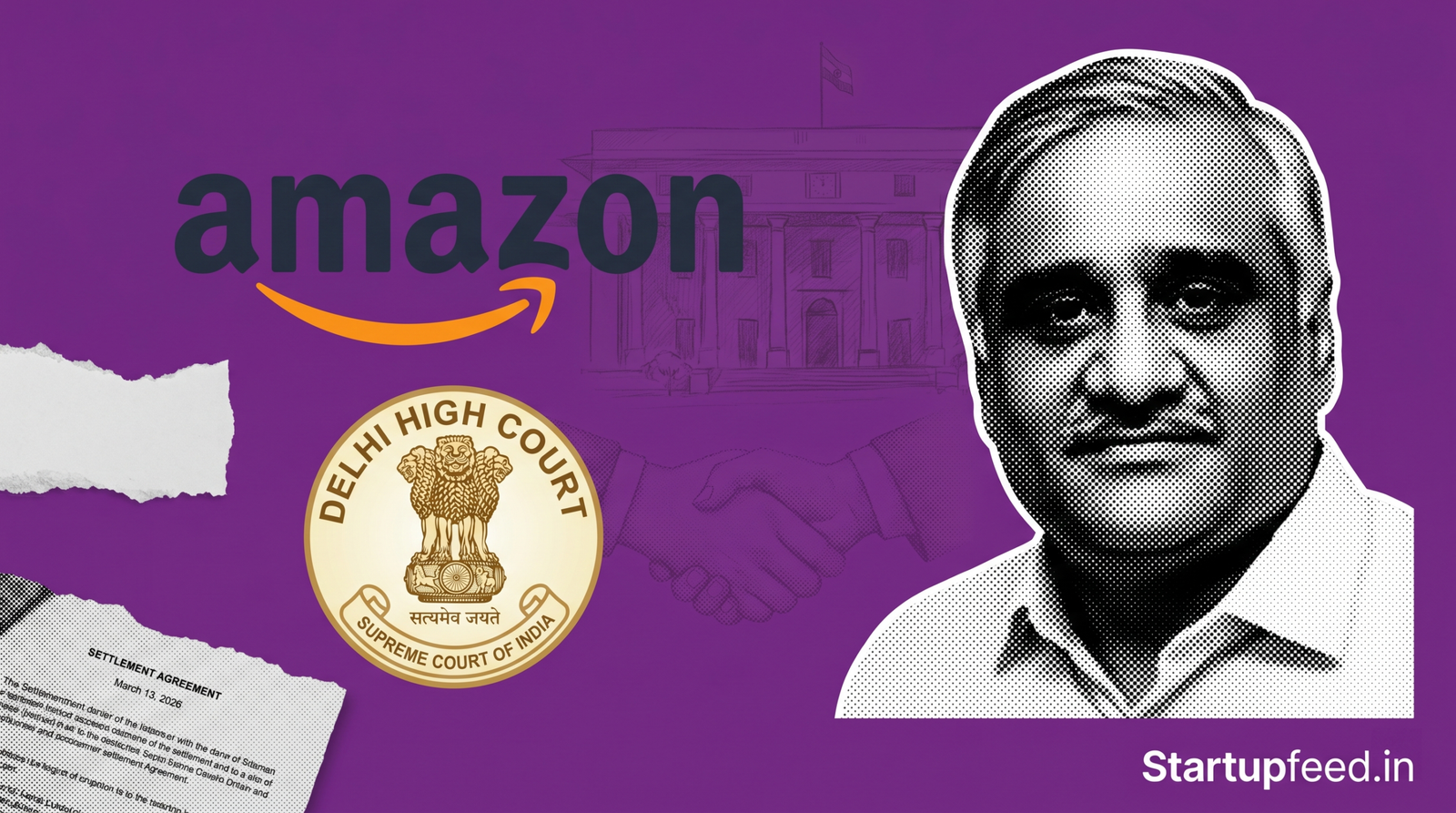
The Amazon Future Coupons Settlement — formalised in a written agreement dated March 13, 2026 — brought a definitive close to one of India’s most protracted cross-border corporate legal battles, as the Delhi High Court on April 28, 2026 disposed of all pending challenge petitions filed by Future Coupons Private Limited (FCPL) and Ashni Biyani. “Learned counsel appearing on behalf of the parties are ad idem that the disputes between the parties stand resolved and the settlement has been formally reduced into a Settlement Agreement dated 13.03.2026,” the court recorded. The settlement amount, confirmed by Inc42, stands at Rs 11 Cr — a fraction of the Rs 1,436 Cr Amazon had sought and even below the Rs 23.7 Cr
The resolution ends approximately six years of litigation — initiated when Amazon filed for arbitration at the SIAC in October 2020 after Future Group announced a Rs 24,713 Cr deal to sell its retail businesses to Reliance Industries. Amazon had argued that its Rs 1,400 Cr investment in the Future Group did not allow the latter to sell its assets to certain companies, including Reliance. That dispute multiplied across jurisdictions — drawing in the SIAC, the Delhi High Court, the Supreme Court of India, the National Company Law Appellate Tribunal, and the Competition Commission of India — before arriving at a nine-word settlement that cost Amazon roughly Rs 1,589 Cr in net losses when its full exposure is tallied.
StartupFeed Insight
The Rs 11 Cr settlement number is almost beside the point. What matters is what the Amazon-Future battle proved — and what it cost. Amazon invested Rs 1,400 Cr in Future Coupons in 2019, sought Rs 1,436 Cr in damages, was awarded Rs 23.7 Cr by an international arbitration tribunal, paid a Rs 200 Cr CCI fine for regulatory non-disclosure in the same transaction, and ultimately settled for Rs 11 Cr. Net loss to Amazon on this India investment: approximately Rs 1,589 Cr, excluding internal legal costs over six years. That is a cautionary number for every foreign investor structure built around indirect equity stakes in Indian retail and FMCG companies. The specific mechanism that made this possible
Amazon Future Coupons Settlement: The Complete Timeline
| Date | Event | Outcome |
|---|---|---|
| August 2019 | Amazon invests Rs 1,400 Cr in Future Coupons Private Limited (FCPL) | Amazon gains indirect stake in Future Retail via FCPL warrants; shareholder agreement signed |
| August 2020 | Future Group announces Rs 24,713 Cr deal to sell retail, wholesale, logistics businesses to Reliance Industries | Amazon objects — deal allegedly violates shareholder agreement |
| October 2020 | Amazon files arbitration before SIAC; SIAC grants emergency arbitration award | Reliance-Future deal halted temporarily |
| 2021-2022 | Multi-forum battle: Delhi HC, Supreme Court of India, NCLAT | Conflicting orders across tribunals; deal proceeds despite disputes; Future Retail eventually collapses into insolvency |
| January 2023 | CCI suspends approval for Amazon’s 2019 FCPL investment; CCI imposes Rs 200 Cr penalty on Amazon for non-disclosure | Amazon penalised; challenges CCI order in Supreme Court |
| June 2025 | SIAC tribunal (Prof van den Berg, Prof Paulsson, SC Hwang) issues final award | Awards Rs 23.7 Cr in damages + Rs 77.3 Cr legal costs + ~Rs 6 Cr arbitration fees to Amazon; rejects Rs 1,436 Cr claim |
| November 2025 | Future Coupons and Ashni Biyani file petitions in Delhi HC challenging SIAC award; parties indicate settlement talks | Delhi HC adjourns to January 14, 2026 |
| March 13, 2026 | Settlement Agreement signed between Amazon and Future Coupons parties | Settlement amount: Rs 11 Cr — formally documented |
| April 28, 2026 | Delhi HC disposes of all challenge petitions; notes settlement | All proceedings closed; case concluded across all forums |
About the Key Entities
Future Coupons Private Limited (FCPL) was an investment vehicle of the Kishore Biyani-led Future Group. Amazon held preference shares in FCPL, which in turn held warrants that could be converted into equity shares in Future Retail Limited (FRL), the publicly listed entity that operated the Big Bazaar chain. This indirect holding structure — designed to navigate India’s FDI restrictions on multi-brand retail — placed Amazon outside direct ownership of FRL while giving it contractual rights over FCPL’s strategic decisions. Amazon.com NV Investment Holdings LLC was the Amazon entity that held the FCPL shares. The dispute concerned whether FCPL’s shareholders’ agreement prohibited Future Group from entering the Reliance deal without Amazon’s consent.
What the Amazon Future Coupons Settlement Means for Indian Arbitration Law
The case is a landmark in Indian arbitration jurisprudence for reasons that extend well beyond the business dispute itself. Three elements stand out.
First, the SIAC award quantum. Amazon had sought Rs 1,436 Cr in damages — representing the full amount it invested in Future Coupons. The three-member tribunal found Future Group in breach of contract but awarded only Rs 23.7 Cr, observing that Amazon’s investment would not have been fully recovered in any scenario given FRL’s deteriorating business value and the COVID-19 pandemic’s impact. This reasoning — that a party can be in contractual breach but the damage awarded should reflect only what the non-breaching party would actually have received absent the breach — sets a significant precedent for how Indian courts and tribunals will assess consequential damages in complex multi-layered investment disputes.


Second, the enforceability journey. Amazon’s emergency arbitration award from October 2020 was challenged in the Delhi High Court, affirmed on appeal, challenged again, affirmed by the Supreme Court, and then effectively rendered moot when Future Retail collapsed into insolvency. The dispute travelled multiple forums including the Supreme Court of India, the National Company Law Appellate Tribunal, and the Competition Commission of India, which had earlier imposed a Rs 200 Cr penalty on Amazon for non-disclosure of information related to its 2019 investment in Future Coupons. This multi-forum experience demonstrates that even a party holding a valid international arbitration award cannot enforce it quickly in India when an insolvent counterparty is involved and domestic courts remain open to parallel challenges.
Third, the CCI precedent. The Rs 200 Cr penalty imposed on Amazon — for not disclosing the full strategic intent of its FCPL investment when seeking CCI approval — remains one of the largest non-disclosure fines in Indian competition law history. The Competition Commission of India had suspended Amazon’s original 2019 deal approval on January 10, 2023. This aspect of the case is now settled separately, but it sent a clear signal to every foreign strategic investor: CCI disclosure obligations extend to the full commercial rationale of an investment, not just the stated financial purpose.
What Did Amazon Actually Lose on the Future Group Investment?
| Component | Amount | Direction |
|---|---|---|
| Amazon’s 2019 investment in FCPL | Rs 1,400 Cr | Out (lost — Future Retail insolvent) |
| CCI penalty for non-disclosure | Rs 200 Cr | Out |
| SIAC award in Amazon’s favour (damages) | Rs 23.7 Cr | Award — but settled for Rs 11 Cr |
| SIAC award (legal costs) | Rs 77.3 Cr | Award — partially included in settlement |
| SIAC award (arbitration fees) | ~Rs 6 Cr | Award — partially included in settlement |
| Final settlement received by Amazon | Rs 11 Cr | In |
| Estimated net loss to Amazon (investment + CCI fine, minus settlement) | ~Rs 1,589 Cr | Net loss (excluding internal legal costs) |
The Rs 11 Cr settlement represents approximately 0.77% of Amazon’s original Rs 1,436 Cr damages claim and 0.79% of its original Rs 1,400 Cr investment. By any commercial metric, this is a near-total write-off — though Amazon’s legal team will note that the SIAC tribunal did find Future Group in breach of contract, preserving Amazon’s moral and legal position even if it could not translate that win into meaningful financial recovery.
What Does This Settlement Mean for India’s FDI and Retail Policy?
The Amazon-Future dispute was fundamentally triggered by India’s foreign direct investment restrictions on multi-brand retail, which prevented Amazon from holding direct equity in Future Retail. The indirect investment structure through FCPL — warrants convertible into FRL shares held by FCPL in which Amazon held preference shares — was a legal workaround that ultimately collapsed when it needed to be enforced against an insolvent counterparty and a reluctant Indian judiciary.
India has since liberalised its retail FDI rules in several respects, and the government’s stated objective is to attract more foreign capital into organised retail. But the Amazon-Future case documents precisely the risk that indirect structures carry when the underlying promoter’s financial position deteriorates: the contractual chain that protects the investor in good times becomes a litigation maze in distress. Every PE and strategic investor using a similar structure for Indian retail or FMCG investments should re-examine their enforcement rights in a post-Future-Retail, post-insolvency world.
What’s Next
With the Amazon-Future matter formally closed, attention turns to the broader question of what happened to the Future Group’s retail assets. Big Bazaar stores were acquired by Reliance, which converted most locations to its own retail formats. Kishore Biyani, once India’s most celebrated retailer, faces no further legal liability to Amazon under the settlement. The CCI matter — which involved a separate Rs 200 Cr penalty on Amazon, not on Future Group — is a distinct proceeding with its own appeal history in the Supreme Court. Watch for any Supreme Court developments on the CCI penalty matter, which remains the last unresolved thread of this six-year saga. Will India’s insolvency and arbitration framework
Frequently Asked Questions
What is the Amazon Future Coupons Settlement and why does it matter?



The Amazon Future Coupons Settlement refers to a Rs 11 Cr agreement signed on March 13, 2026, formally closing a six-year legal dispute between Amazon.com NV Investment Holdings LLC and Kishore Biyani’s Future Coupons Private Limited (FCPL). The Delhi High Court disposed of all pending petitions on April 28, 2026, recording the settlement. The dispute began in 2020 when Amazon objected to Future Group’s Rs 24,713 Cr deal to sell its retail businesses to Reliance Industries, arguing the deal violated its 2019 shareholders’ agreement. The case is significant because it tested the limits of international arbitration enforcement in Indian courts and resulted in Amazon recovering less than 1% of its Rs 1,436 Cr claim.
How much did the SIAC award Amazon in the Future Group case?
The Singapore International Arbitration Centre (SIAC) in June 2025 awarded Amazon Rs 23.7 Cr in damages — against Future Coupons, its 11 promoters including Kishore Biyani, plus interest from March 9, 2022. The tribunal also directed Future Group to pay Rs 77.3 Cr in litigation costs and approximately Rs 6 Cr in arbitration fees. Amazon had sought Rs 1,436 Cr — its full investment amount. The tribunal found Future Group in breach of contract but awarded only a fraction, citing FRL’s deteriorating financial value and the COVID-19 pandemic’s impact on the business. The parties subsequently settled for Rs 11 Cr on March 13, 2026 — below even the Rs 23.7 Cr damages award.
What was the CCI’s role in the Amazon-Future dispute?
The Competition Commission of India played a significant and separately damaging role for Amazon. In January 2023, the CCI suspended its original 2019 approval for Amazon’s investment in Future Coupons, finding that Amazon had not fully disclosed the strategic purpose of the investment when seeking regulatory clearance. The CCI also imposed a Rs 200 Cr penalty on Amazon for this non-disclosure under the Competition Act 2002. Amazon challenged the CCI ruling in the Supreme Court. The Rs 200 Cr CCI fine — added to the Rs 1,400 Cr investment loss and minus the Rs 11 Cr settlement — means Amazon’s total financial exposure on the Future Group investment approaches Rs 1,589 Cr, excluding internal legal costs over six years.
Written by Dr. Mayank Raj. Published: May 1, 2026. Updated: May 1, 2026. Have a tip? Write to us at editorial@startupfeed.in.
Liked this story? Follow StartupFeed on Google so our reporting reaches you first.