
Quick Take
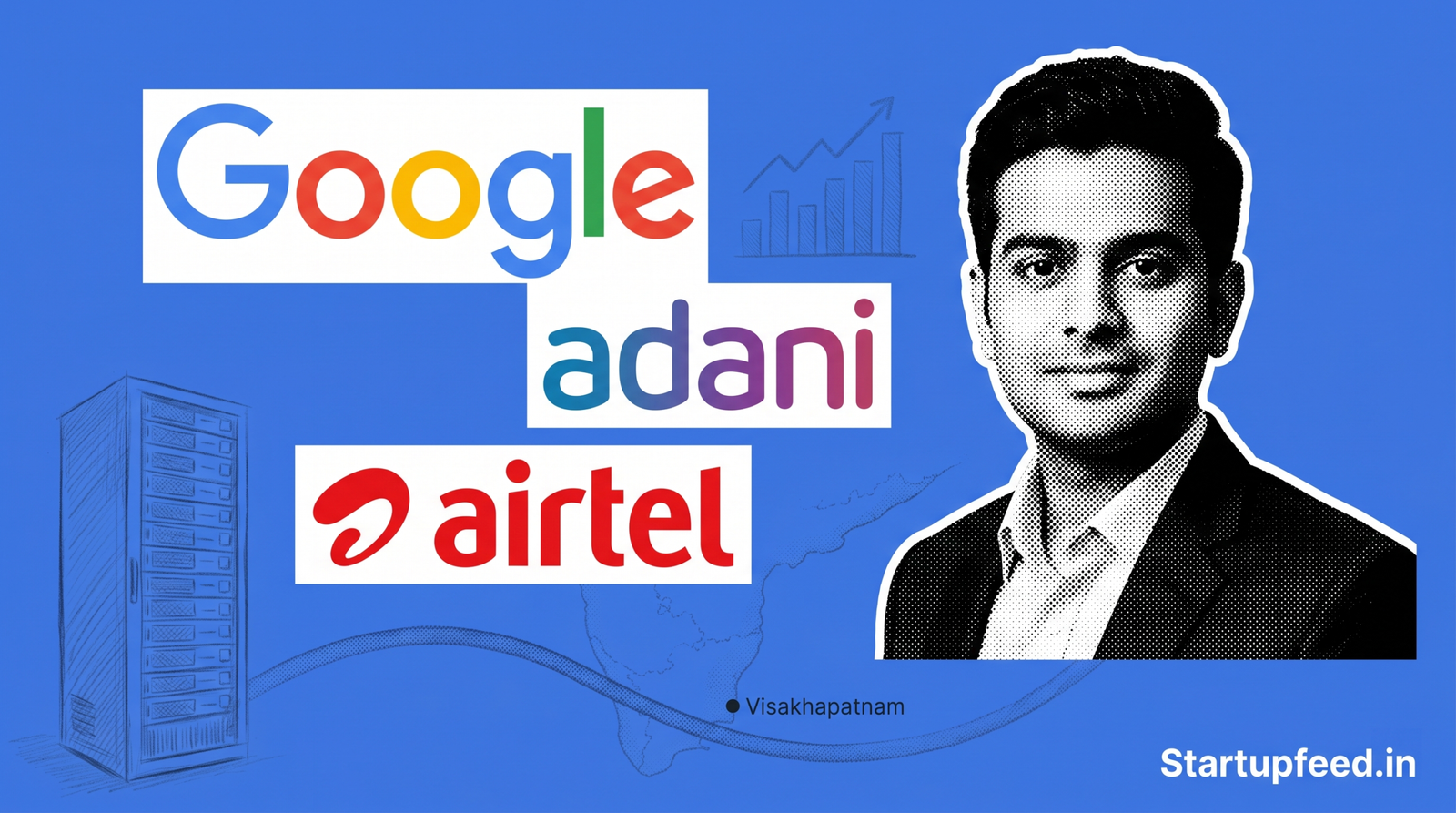
- Google, AdaniConneX, and Nxtra by Airtel broke ground on a $15 Bn, 1 GW AI hub in Vizag on April 28, 2026.
- Three data centre campuses across 601 acres will make this Asia’s largest AI infrastructure complex outside the US.
- Three new subsea cables from Vizag create India’s first new international internet gateway since Chennai.
Google Breaks Ground on Vizag AI Hub — its largest-ever investment in India — at Tarluvada, Visakhapatnam, Andhra Pradesh in strategic partnership with AdaniConneX and Nxtra by Airtel. The $15 billion investment, spread across five years from 2026 through 2030, makes it one of the largest Foreign Direct Investments in India’s history. The Vizag hub will include three data centre campuses with combined capacity approaching one gigawatt — placing it among the largest AI infrastructure projects announced in Asia.
The facility will span approximately 601 acres across three campuses covering the villages of Tarluvada, Adavivaram, and Rambilli. Three separate Special Purpose Vehicles have been formed to manage the different components of the project, with Adani Infrastructure serving as the primary implementation partner on the ground. The groundbreaking ceremony was attended by Union IT Minister Ashwini Vaishnaw, Andhra Pradesh Chief Minister N. Chandrababu Naidu, AP IT Minister Nara Lokesh, Bikash Koley (VP, Google Global Infrastructure), Karan Adani and Jeet Adani (Adani Group), and Rakesh Mittal (Vice Chairman, Bharti Enterprises).
StartupFeed Insight
The most significant, and least reported, element of the Vizag project is not the data centres — it is the subsea cable gateway. For two decades, nearly all of India’s international internet traffic has passed through two coastal chokepoints: Mumbai on the west coast and Chennai on the south-east. When either of these routes is disrupted — by a ship’s anchor, by trawlers, by undersea geology — large portions of India’s enterprise internet become unreliable. Google is now building India’s third international gateway at Visakhapatnam, with three new cables linking Vizag to South Africa, Singapore, Australia, and the US West Coast. That routing diversity will reduce latency for users across eastern and southern India, improve resilience for the UPI platform.
What Makes the Google Breaks Ground on Vizag AI Hub the Largest of Its Kind?
Google Cloud CEO Thomas Kurian framed the Vizag hub as a deliberate effort to bring the full weight of Google’s AI capabilities to Indian enterprises — not a partial deployment but a complete, integrated AI stack operating from Indian soil: “We are excited to announce our largest-ever investment in India: $15 billion to establish our first full-stack AI Hub in India. The multi-faceted investment in Visakhapatnam will deploy cutting-edge infrastructure, establish a new international subsea gateway, and deliver gigawatt-scale compute to power services globally.”
The three-partner structure divides responsibilities with deliberate clarity. AdaniConneX and Nxtra will lead construction, covering civil infrastructure, power systems, and connectivity integration, while Google will deploy AI and cloud workloads on top of this capacity. AdaniConneX — Adani Group’s joint venture with US-based EdgeConneX — is responsible for the hyperscale data centre campus itself: the buildings, power systems, transmission lines, and energy storage. Nxtra by Airtel handles fibre, 5G integration, the next-generation cable landing station, and pan-India ultra-low latency connectivity. Google provides the AI compute, cloud software stack, and global traffic routing.
Jeet Adani, Director of the Adani Group, put the infrastructure thesis plainly at the groundbreaking: “India’s AI moment will be defined by infrastructure. What we are building in Visakhapatnam — nearly 1 GW in a single location — signals that shift.” Gopal Vittal, Executive Vice Chairman of Bharti Airtel, added: “With Visakhapatnam emerging as a new hub on the world’s AI map, we will ensure that India sets the pace for innovation and sustainable growth — not just for our people, but for the whole world. Our full stack of best-in-class data centers, use of green power, pan-India ultra-low latency fiber, and a next-gen cable landing station will enable large-scale, world-class AI infrastructure in Vizag.”


Project Breakdown: Three Partners, Three Roles, One Gigawatt
| Partner | Role in the Project | Key Contribution |
|---|---|---|
| Google Cloud | Lead investor and AI workload deployer | $15 Bn investment; AI compute stack; global traffic routing; STAR skills programme |
| AdaniConneX | Hyperscale data centre construction and operation | Civil infrastructure; power systems; energy storage; transmission lines; renewable generation in Andhra Pradesh |
| Nxtra by Airtel | Fibre, connectivity, and cable landing station | Pan-India ultra-low latency fibre; next-gen cable landing station; 5G integration; operational support |
| Project Metric | Detail |
|---|---|
| Total Investment | $15 Bn (Rs 1,24,500 Cr) over 5 years (2026-2030) |
| Capacity | ~1 GW — gigawatt-scale; single-location, the largest in Asia outside the US |
| Land Area | ~601 acres across 3 campuses |
| Campus Locations | Tarluvada, Adavivaram, Rambilli (all in Visakhapatnam district) |
| Special Purpose Vehicles | 3 SPVs formed — one per project component |
| New Subsea Cables | 3 cables: Vizag–South Africa–US; Vizag–Singapore–Australia–US West Coast; Mumbai–Western Australia |
| Energy Commitment | New renewable generation (solar + wind + storage) in Andhra Pradesh by Adani |
| State Compute Target | 6.5 GW — Andhra Pradesh’s longer-term state-wide AI compute ambition anchored by this project |
| Groundbreaking Date | April 28, 2026 — Tarluvada, Anandapuram mandal, Visakhapatnam |
About AdaniConneX and Nxtra by Airtel
AdaniConneX is Adani Group’s data centre joint venture with American firm EdgeConneX, focused on hyperscale and campus-scale data centre infrastructure across India. It brings Adani’s land, power, and civil construction capabilities together with EdgeConneX’s global data centre design expertise. Nxtra by Airtel is Bharti Airtel’s data centre and fibre infrastructure subsidiary, operating facilities across major Indian cities with a focus on enterprise and carrier-grade connectivity. Together, the two form the physical infrastructure backbone of the Vizag AI hub — while Google supplies the compute workloads and global cloud fabric on top.
Why Did Google Choose Visakhapatnam — and Why Now?
Three structural factors made Vizag the right location. First, subsea cable geography. Mumbai’s cable landings are saturated and physically congested. Chennai is full. Vizag was a clean slate in a strategically excellent location — and its eastern coast position gives it direct cable paths to Southeast Asia, Australia, and around the African coast to the Americas. Second, power. A 1 GW data centre needs roughly the electricity output of a mid-sized power plant, running 24/7 for years. Adani’s separate commitment to bring new renewable generation online in Andhra Pradesh — solar, wind, plus storage — gave Google a clean-energy story it would have struggled to put together in most other Indian states.
Third, government speed. Andhra Pradesh CM Chandrababu Naidu’s government has been aggressive in chasing this kind of investment, and IT Minister Nara Lokesh — who is also the CM’s son — has been working Google for nearly two years. The state’s “speed of doing business” framework reportedly cleared regulatory hurdles in months that would normally take years. The deal was reportedly first discussed in September 2024, meaning the entire journey from initial engagement to groundbreaking took under 18 months — a speed that would be exceptional for a project of this scale anywhere in the world.
How Does the Vizag Hub Compare to Other India Data Centre Investments?
| Investor | Investment in India | Focus | Announced |
|---|---|---|---|
| Google (Vizag AI Hub) | $15 Bn (2026-2030) | AI compute + subsea cables + cloud | April 28, 2026 |
| Microsoft | $3 Bn (2024-2026) | AI and cloud data centres | January 2025 |
| Amazon Web Services | $12.7 Bn (2030 target) | Cloud infrastructure and data centres | Ongoing |
| Reliance Jio | Undisclosed — JioBrain AI infra | Sovereign AI and cloud | 2025-2026 |
| Adani Group (standalone) | Significant — via AdaniConneX | Hyperscale data centre construction | Multi-year |
Google’s $15 billion commitment will, when complete, nearly double India’s total data centre capacity. No other single infrastructure investment in India’s digital history — public or private — comes close to that scale in a single project window. For comparison, Microsoft’s entire India AI investment announced in early 2025 is $3 Bn — one-fifth of Google’s Vizag commitment alone.
What Is the STAR Programme and How Will Vizag Benefit Locally?
Google announced the Skills Trade and Readiness (STAR) programme to create sustainable career paths for local talent and develop a homegrown workforce ready to drive India’s digital acceleration. The programme is designed to train workers in Visakhapatnam and the surrounding Andhra Pradesh region in data centre operations, AI infrastructure management, and cloud engineering — the specialist skills required to staff and maintain a gigawatt-scale facility. Google conducted a thorough community impact assessment based on consultations with local communities before beginning construction, embedding a community-first approach into the project’s design phase.
What’s Next
Construction across all three campuses begins immediately. The five-year build timeline (2026-2030) suggests the first capacity tranches will come online incrementally — industry practice for projects of this scale is to bring 100-200 MW increments online every 12-18 months as power systems and civil infrastructure are commissioned. Watch for the cable landing station timeline: the Vizag-to-Singapore-Australia cable is likely to be the first energised, given Southeast Asia’s position as the highest-priority routing improvement for Google’s India traffic. Andhra Pradesh’s ambition to reach 6.5 GW of compute capacity state-wide makes Vizag a template for what concentrated government dealmaking combined with private sector infrastructure capital can produce. Will other Indian states — Telangana, Tamil Nadu, Maharashtra
Frequently Asked Questions
What is Google’s Vizag AI Hub and who are the partners?


Google’s Vizag AI Hub is a $15 Bn (Rs 1,24,500 Cr) gigawatt-scale AI infrastructure project in Visakhapatnam, Andhra Pradesh, developed in partnership with AdaniConneX and Nxtra by Airtel. Google broke ground at Tarluvada on April 28, 2026, marking the start of a five-year construction plan (2026-2030). The hub will span 601 acres across three campuses — Tarluvada, Adavivaram, and Rambilli — with combined capacity approaching 1 GW, making it the largest AI data centre complex built outside the United States and Google’s largest-ever investment in India.
What role do Adani and Airtel play in the Vizag data centre project?
AdaniConneX — Adani Group’s joint venture with American firm EdgeConneX — is responsible for building and operating the hyperscale data centre campus itself, including all civil infrastructure, power systems, energy storage, and transmission lines. Adani is also co-investing in new renewable energy generation in Andhra Pradesh to power the facility on clean energy. Nxtra by Airtel handles the connectivity layer: pan-India ultra-low latency fibre, a next-generation cable landing station at Vizag, and 5G integration. Google deploys its AI compute workloads and global cloud software stack on top of the infrastructure that the two Indian partners build and operate.
What subsea cables are being built at Vizag and why does it matter?
Three new subsea cables are part of the project: one linking Vizag to South Africa and then to the United States; one connecting Vizag to Singapore, Australia, and the US West Coast; and one connecting Mumbai to Western Australia. These cables plug into Google’s existing global network of approximately 2 million miles of subsea fibre. This makes Visakhapatnam India’s third international internet gateway — after Mumbai and Chennai — for the first time in over a decade. It improves routing diversity, reduces latency for eastern and southern India, and provides resilience when existing cables on the Mumbai or Chennai routes are disrupted.
Written by Dr. Mayank Raj. Published: April 29, 2026. Updated: April 29, 2026. Have a tip? Write to us at editorial@startupfeed.in.
Liked this story? Follow StartupFeed on Google so our reporting reaches you first.