
Quick Take:
|
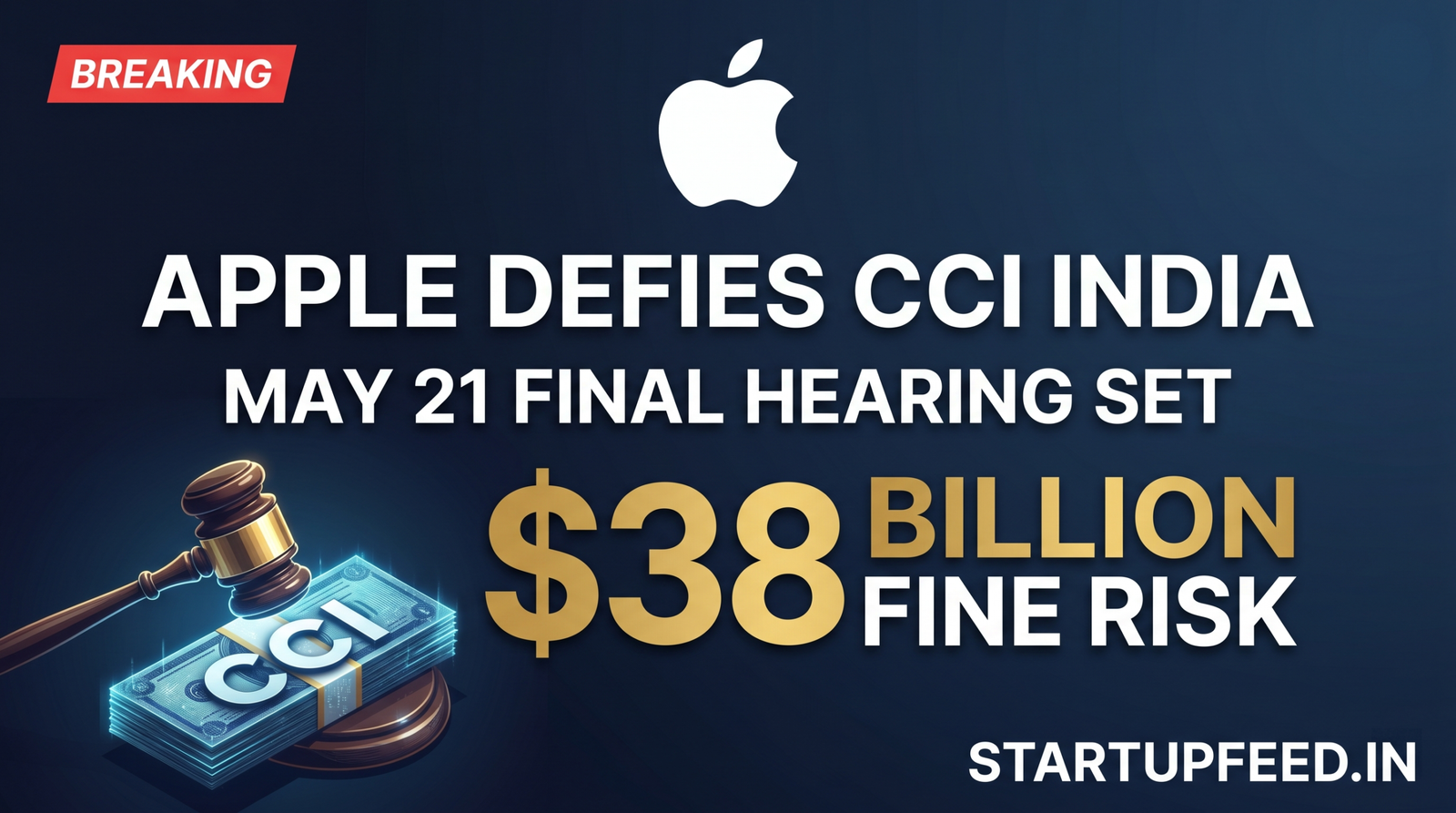
India’s Competition Commission (CCI) has set a final hearing date of May 21, 2026 in its antitrust investigation against Apple — and the stakes could not be higher. According to a CCI order reviewed by Reuters, Apple has not submitted details of its financials or its views on the investigation since October 2024. Without this data, the regulator could calculate Apple’s penalty based on its global turnover — which Apple itself has said could result in a fine of up to $38 billion (approximately Rs 3.48 lakh crore), potentially the world’s largest single antitrust fine ever imposed on a company.
The CCI has found Apple guilty of abusing its dominant position in the iPhone apps market — specifically, forcing app developers to use Apple’s proprietary in-app purchase (IAP) system, which charges commissions of 15-30% on all digital transactions. Apple’s response has been to challenge the entire proceeding: denying market dominance, challenging India’s penalty calculation rules in the Delhi High Court, and most recently asking the CCI to pause its case entirely while the court challenge proceeds. The CCI has rejected every attempt to delay.
| StartupFeed Insight — Why This Case Matters for India’s Tech Ecosystem The strategic logic behind Apple’s refusal:
What May 21 means: The setting of a final hearing date is the CCI’s clearest signal yet that it will not grant Apple indefinite delay. After May 21, the CCI has three options: (1) issue a penalty order using Apple’s publicly known global turnover, (2) accept whatever limited financial data Apple submits in the next two weeks and calibrate the fine accordingly, or (3) settle if Apple engages substantively. Option 1 produces the largest fine. Option 2 is Apple’s incentive to submit real data showing India-specific revenue is far smaller. Option 3 would require Apple to concede some wrongdoing and commit to remedies. The India manufacturing paradox: Apple has invested billions in India manufacturing — assembling iPhones at Foxconn’s Tamil Nadu and Tata’s Karnataka plants, targeting major export production from India. A $38 billion fine, or even a fraction of it, would dwarf Apple’s India manufacturing investment and create a hostile regulatory environment for its deepest manufacturing bet outside China. This is the paradox Apple must resolve: its India business is too important to abandon, but fighting the CCI this aggressively risks exactly that. |



The Complete CCI-Apple Case Timeline
| Date / Period | Event |
| 2021 | CCI begins investigating Apple’s App Store practices following complaints from app developers; core allegation — Apple abuses dominant position by requiring developers to use proprietary IAP system (15-30% commission) with no alternative |
| 2024 (CCI investigation report) | CCI investigators formally conclude Apple exploited dominant position in iPhone apps market; found Apple forced developers to use proprietary in-app purchase system — contravening Indian competition law |
| October 2024 | Apple last responded to or filed submissions with the CCI; since this date, Apple has not submitted financial data or its views on the investigation findings |
| November 2025 | Apple files challenge in Delhi High Court questioning validity of India’s 2024 Competition Amendment — which allows CCI to calculate penalties based on a company’s global turnover (not just India revenues); Apple labels the rules ‘arbitrary, unconstitutional, and grossly disproportionate’ |
| December 31, 2025 | CCI confidential order: Rejects Apple’s request to pause proceedings while Delhi HC hears the penalty rules challenge; accuses Apple of ‘undermining procedural discipline’ by seeking repeated extensions since October 2024 |
| January 27, 2026 | Delhi High Court hearing on Apple’s challenge to the antitrust penalty rules |
| March 2026 | Apple requests CCI put its proceedings ‘in abeyance’ while DHC hears the case — CCI rejects the request |
| April 8, 2026 | CCI order (not public, reviewed by Reuters) — formally records that Apple has not submitted financial information or views on investigation findings since October 2024; sets two-week deadline for Apple to respond |
| April 20, 2026 | Reuters reports the April 8 CCI order; sets final hearing for May 21, 2026 |
| May 21, 2026 (upcoming) | CCI final hearing — if Apple does not submit financials, CCI may calculate penalty using Apple’s publicly known global turnover; potential fine exposure up to $38 billion |
The Core Legal Dispute — India’s Global Turnover Penalty Rule
The $38 billion exposure stems from a specific provision in India’s 2024 Competition (Amendment) Act — which amended the penalty calculation framework to allow the CCI to base fines on a company’s global turnover, not just its India-specific revenue. This is the same principle applied by the EU under its Digital Markets Act and by the UK Competition and Markets Authority.
Apple’s argument against the global turnover rule:
- ‘Arbitrary, unconstitutional, and grossly disproportionate’ — Apple’s characterisation in its Delhi High Court challenge
- Apple’s global turnover (~$380+ billion) bears no relationship to its India-specific App Store revenues, which are a small fraction of global revenue
- Applying global turnover to an India-only infringement would set a precedent that no multinational could responsibly operate in India without existential fine risk
- At 10% of global turnover, the fine would be ~$38 billion — larger than Apple’s entire annual net profit, and larger than any antitrust fine ever imposed anywhere in the world
The CCI’s (and broader regulatory) counterargument:
- Global turnover-based fines are necessary to create ‘real deterrent value’ against deep-pocketed multinationals — a company that generates $380 billion globally does not feel an India-only revenue-based fine
- The principle is consistent with global antitrust practice (EU Digital Markets Act, UK CMA guidelines)
- Apple’s global iPhone business benefits from App Store policies globally, not just in India — limiting the fine to India revenues would allow Apple to treat India-only penalties as an acceptable cost of global business
- CCI’s approach is supported by Gautam Shahi (antitrust partner): Apple has the opportunity to submit its India-specific financials with an auditor’s certificate and then argue for a lower quantum based on those numbers — the refusal to submit is strategic, not principled
Apple’s India Position — Why This Matters So Much
| India Metric | Data |
| iPhone market share India (2026) | 9% — up from 4% two years ago (Counterpoint Research) |
| iPhone market share trajectory | Fastest-growing major market for Apple globally |
| India manufacturing presence | iPhone assembly at Foxconn’s Tamil Nadu facility and Tata’s Karnataka facility; major export production target |
| India revenue | Not publicly disclosed for India specifically — this is precisely what CCI is asking for |
| Apple’s global annual revenue | ~$380 billion+ (FY2025) — the number that produces the $38 billion fine exposure |
| App Store commission rates | 15-30% on all in-app purchases processed through proprietary IAP system |
The India stakes for Apple are large and growing. With iPhone market share doubling from 4% to 9% in two years, India is now among Apple’s most strategically important markets. The company has also positioned India as a critical manufacturing hub to reduce China supply chain dependence. A hostile regulatory outcome — particularly a landmark fine that could set a global precedent — risks souring the India relationship at exactly the moment Apple is deepening it.
Expert View — What May 21 Could Produce
Antitrust lawyers have outlined the choices Apple faces before May 21:


- Submit financials, argue for lower quantum: If Apple submits India-specific financials with an auditor’s certificate by the next two-week deadline, the CCI can calculate a proportionate fine based on India revenues — almost certainly a far smaller number than $38 billion. This is what Gautam Shahi (antitrust partner, Dutt Menon Dunmorrsett) has publicly recommended
- Continue refusal, risk global turnover calculation: If Apple still does not submit, the CCI can proceed at May 21 hearing with publicly available global turnover. Apple’s publicly disclosed revenues are a matter of record. The resulting fine could be historically large — and Apple would have lost its opportunity to argue quantum
- Negotiate settlement: Apple could engage with CCI on remedies — the global App Store antitrust pattern (EU DMA, UK CMA, Japan, South Korea) has increasingly resulted in Apple agreeing to allow alternative payment systems and sideloading in specific markets. A settlement that commits to app developer remedies in India could close the case without a precedent-setting penalty
What do you think — should CCI use global turnover to fine Apple, or is India-specific revenue a more proportionate basis? Tell us on X @StartupFeed_news
Liked this story? Follow StartupFeed on Google so our reporting reaches you first.