
| QUICK TAKE: | |
| Policy | IT (Intermediary Guidelines & Digital Media Ethics Code) Second Amendment Rules, 2026 |
| Authority | Ministry of Electronics and IT (MeitY) |
| Affects | Social media platforms, content creators, news publishers, OTT platforms |
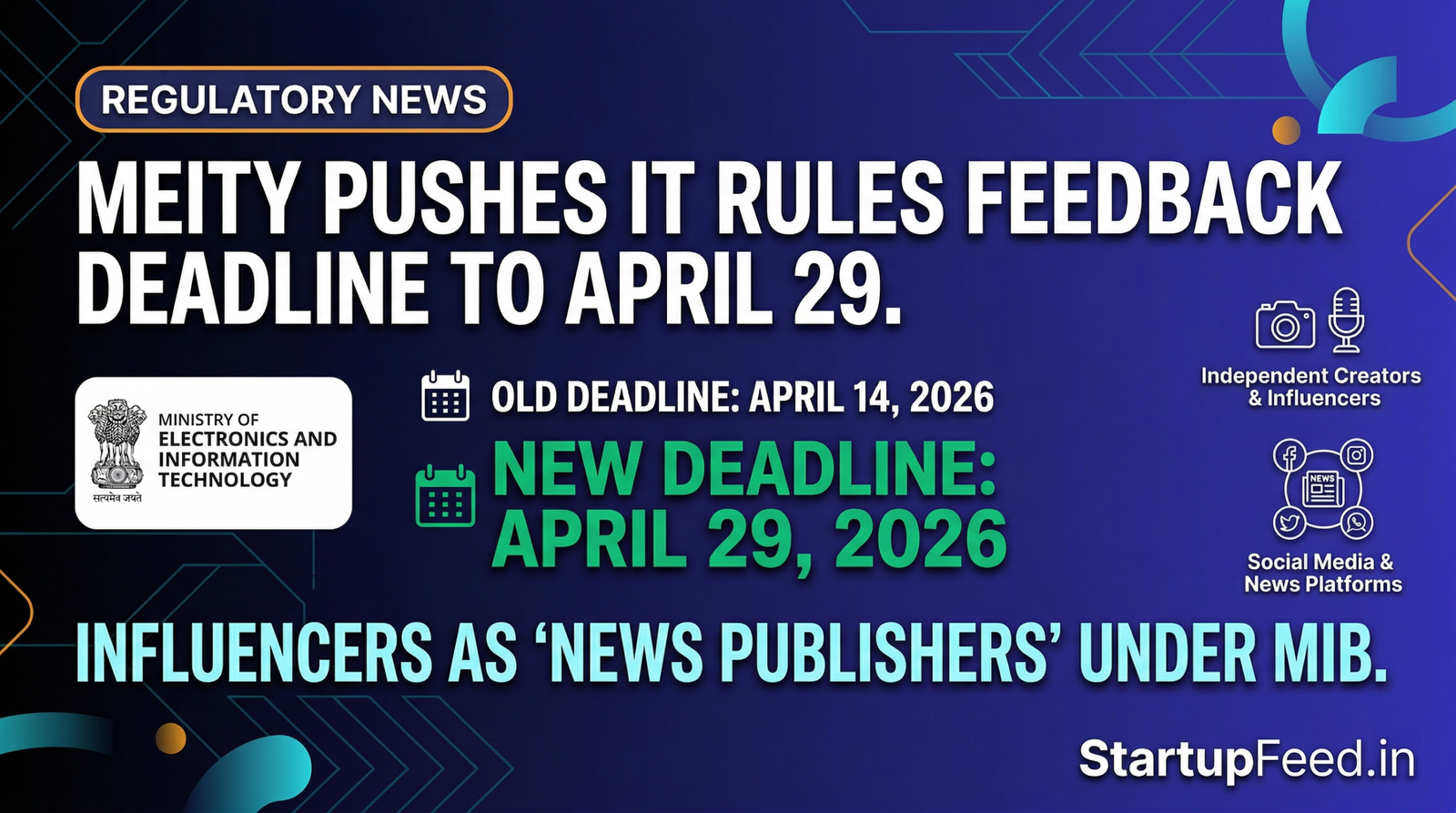
| New Deadline | April 29, 2026 (extended from April 14, 2026) |
| Key Change | Influencers and creators treated as news publishers under MIB oversight |
MeitY has extended the deadline for stakeholders to submit feedback on proposed amendments to the IT (Intermediary Guidelines and Digital Media Ethics Code) Rules, 2021, moving it from April 14 to April 29, 2026. The ministry had originally floated the draft on March 30, giving stakeholders just 15 days to respond.
The extension signals that the government is aware the proposed rules carry far-reaching consequences — but the breathing room alone is unlikely to resolve the core objections being raised across the digital ecosystem.
| StartupFeed Insight |
| What this means: The draft hands MIB oversight over every creator who posts on ‘news and current affairs’ — effectively ending the legal distinction between a journalist and a YouTuber making commentary videos. Winners:
Losers:
Action required: Submit feedback to it-rules-comments@meity.gov.in by April 29, 2026. Platforms should engage legal counsel before the deadline to assess safe harbour exposure under proposed Rule 3(4). |
What’s New
The draft amendments aim to tighten accountability for intermediaries and redefine the ethical code for digital media. The most striking proposal extends MIB’s Code of Ethics — previously limited to digital news publishers and OTT platforms — to user-generated content related to “news and current affairs” posted by individual users. MIB can now also initiate formal reviews of digital content through the Inter-Departmental Committee (IDC) without waiting for a public complaint.
A second key proposal introduces Rule 3(4), which mandates that intermediaries comply with Ministry-issued clarifications, advisories, directions, SOPs, codes of practice, and guidelines as part of due diligence under Section 79 of the IT Act. Platforms that fail to comply risk losing their safe harbour protections — the legal shield that currently protects them from liability over user-generated content.
A third proposal requires intermediaries to retain user data for 180 days when users register for a computer resource — a provision critics say conflicts with India’s data protection law, which mandates erasure of personal data once its specified purpose is fulfilled.



Key Provisions
| Provision | Old Rule | New Rule | Impact |
| News content oversight | MIB governed registered publishers only | MIB governs all ‘news and current affairs’ UGC | Creators and influencers face broadcaster-level compliance |
| Advisory compliance | Voluntary; no safe harbour risk | Mandatory; non-compliance risks Section 79 protection | Platforms may over-comply to avoid liability |
| IDC review trigger | Public complaint required | MIB can initiate proactively | Faster, broader content review without complaints |
| Data retention | No specific mandate | 180-day minimum retention | Raises data breach risk for all platforms |
Who’s Affected
The amendments would bring news and current affairs content posted by private individuals — including YouTubers, Instagram reels creators, X users, and influencers — under Part III of the rules, a three-tier oversight mechanism previously reserved exclusively for professional media organisations.
The proposed rules affect three distinct groups simultaneously: platforms that host content, creators who produce it, and digital news publishers who now compete in a newly regulated common space.
Impact Analysis
| Sector | Impact | Why |
| Social media platforms | Negative | Safe harbour conditioned on compliance with informal MeitY instruments |
| Independent creators & influencers | Negative | Brought under MIB’s Code of Ethics without distinction from registered publishers |
| Digital news publishers | Mixed | Competitive field levels, but broader crackdown raises censorship risk |
| OTT platforms | Neutral to Negative | Already under MIB framework; broader IDC powers could expand scrutiny |
| Legal and compliance firms | Positive | Surge in advisory mandates expected across the digital ecosystem |
Compliance Checklist for Startups and Platforms
| # | Action Item | Deadline |
| 1 | Submit detailed written feedback to MeitY | April 29, 2026 |
| 2 | Conduct internal audit of compliance with MeitY advisories and SOPs | April 25, 2026 |
| 3 | Engage legal counsel to assess safe harbour exposure under proposed Rule 3(4) | Immediately |
| 4 | Review data retention policies against the proposed 180-day mandate | April 29, 2026 |
Industry Reaction
IT Secretary S. Krishnan, speaking after a stakeholder meeting on April 7, said the ministry was “open-minded” and would examine all suggestions. He noted that feedback received ranged from requests for more time to demands for outright withdrawal of the draft amendments.
A key issue repeatedly raised at the meeting was the lack of clarity over the distinction between users, intermediaries, and publishers. Issues around user liability, scope of powers, and enforcement remained unresolved at the end of the consultations.
IFF called the proposed amendments “a dangerous expansion of executive power over online speech,” warning that the practical effect of Rule 3(4) is a perpetual compliance threat — pushing platforms toward over-compliance and over-censorship.
What’s Next
MeitY’s April 29 deadline will be the real test of whether the government is willing to substantially revise the draft or simply absorb feedback and proceed. The consultation period now includes India’s major tech platforms, civil society organisations, and legal advocacy groups — all of whom have signalled they want more than cosmetic changes.


Possible modifications reportedly under consideration include a master index of all advisories with clarity on whether each is mandatory, and greater definitional clarity around the terms “news” and “current affairs.”
The question the ecosystem is now asking: will MeitY withdraw the most contested provisions, or will April 29 mark the end of consultation and the beginning of enforcement?
Liked this story? Follow StartupFeed on Google so our reporting reaches you first.