
Published: October 13, 2026
StartupFeed Quick Take
- The Union Cabinet approved a Rs 10,000 Cr SME Growth Fund on October 6, 2026, to buy equity in small and medium enterprises.
- Most of the money will go to manufacturing SMEs, including firms in Tier II and Tier III industrial clusters.
- The fund manager, cheque sizes and rules on who can apply are still to be announced, so founders cannot apply yet.
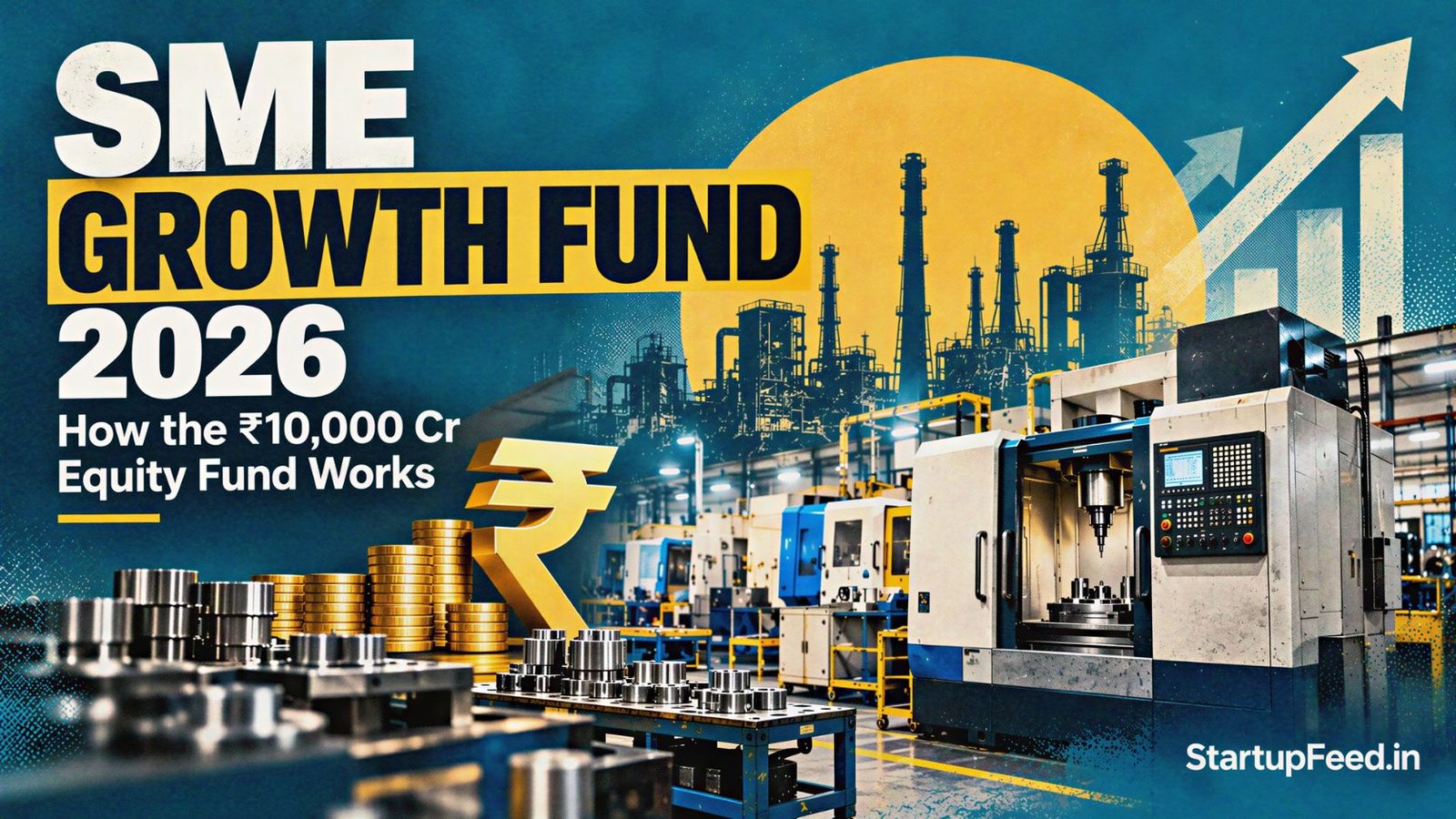
The SME Growth Fund is a Rs 10,000 Cr government-backed equity fund for small and medium enterprises that are ready to scale. The Union Cabinet cleared it on October 6, 2026, under Para 28 of the Union Budget 2026-27. The money is not a loan. It is not a grant either. It is equity, aimed at the companies India keeps calling its missing middle. This guide covers what it does, how it compares with older schemes, and what is still unknown.
In This Article
What the SME Growth Fund Is, and What Changed on October 6
The SME Growth Fund is a pool of Rs 10,000 Cr that the central government has committed to back equity in small and medium enterprises. The Union Cabinet, chaired by Prime Minister Narendra Modi, approved it on October 6, 2026. The commitment comes from Para 28 of the Union Budget 2026-27, part of a push the government calls Creating Champion MSMEs.
The money will sit in an Alternative Investment Fund, or AIF. That is a pooled fund regulated by SEBI. Through it, the government plans to buy minority stakes in growth-stage firms rather than lend to them.
Most of the capital will go to manufacturing SMEs, the government’s October 6 statement said. It will also look at enterprises in industrial clusters in Tier II and Tier III cities. The target is firms with proven viability and the scope to grow into larger, globally competitive companies.

Ashwini Vaishnaw, the minister who briefed reporters after the meeting, said the fund is also meant to help Indian SMEs use openings from recent trade agreements.
Prime Minister Narendra Modi called the decision a big boost for the MSME sector. He put it this way on X:
“A major step towards creating the next generation of Indian business leaders.”
Narendra Modi, Prime Minister of India. From a post on X, October 6, 2026.
The Growth-Stage Gap the Fund Wants to Close
The SME Growth Fund targets a specific gap: equity for firms that are too big to be startups and too small to raise money from banks and markets easily. India has close to 9.78 crore enterprises registered on the Udyam and Udyam Assist portals as of October 2026. Most are micro units, and very few grow into mid-sized firms.
Early-stage startups can raise seed money. Large companies can tap banks and markets. A manufacturer with Rs 50 Cr in sales and a plan to double capacity often finds neither cheap debt nor patient equity. Economists call this the missing middle. India’s smaller firms face a credit gap estimated at about Rs 30 lakh crore, and equity is even harder to find than debt.
The government says existing equity schemes have not closed this gap, as most back early-stage ventures or micro units. It is pitched as the piece that fills the growth-stage hole, with equity that stays invested for years.
This kind of money is called patient capital. It does not demand a quick exit or fixed repayments. In return for a stake, the fund shares in the company’s growth over time. For a factory owner weighing a new line, that can matter more than another working-capital loan.
How It Compares to India’s Other Equity Schemes
The SME Growth Fund is not India’s first government equity scheme for small firms. It is the fourth big one, and the most directly aimed at growth-stage companies.

The closest match is the Self-Reliant India Fund, or SRI Fund. Announced in 2020 under the Atmanirbhar Bharat package, it targets Rs 50,000 Cr: Rs 10,000 Cr from the government and Rs 40,000 Cr from private investors. But it does not invest in companies directly. It is a fund of funds, feeding money through about 60 daughter funds that then back MSMEs. Firms with turnover up to Rs 500 Cr can qualify.
The other two routes sit on the startup side. The Fund of Funds for Startups, cleared by the Cabinet in 2016 and run by SIDBI, the government’s small-industries bank, is a Rs 10,000 Cr pool. It too backs SEBI-registered funds rather than startups directly, and each fund must invest at least twice the government money it receives into startups. The Startup India Seed Fund Scheme is smaller at Rs 945 Cr. It routes grants and early debt to new startups, under two years old, through incubators, with up to Rs 20 Lakh for a prototype and up to Rs 50 Lakh for market entry. It is meant to support about 3,600 startups.
The difference is twofold. The new fund is built for growth-stage small and medium enterprises, not seed-stage startups. And it is designed to put equity to work more directly, as an AIF of its own. The table below sets the four side by side.
| Scheme | Total size | Who it backs | How it invests |
|---|---|---|---|
| SME Growth Fund | Rs 10,000 Cr (government) | Growth-stage SMEs, mostly manufacturing | Direct equity, as an AIF |
| SRI Fund | Rs 50,000 Cr target (Rs 10,000 Cr government) | MSMEs with growth potential | Through daughter funds (fund of funds) |
| Fund of Funds for Startups | Rs 10,000 Cr | Startups, early to growth stage | Through SEBI-registered funds (fund of funds) |
| Startup India Seed Fund | Rs 945 Cr | New startups, under two years old | Grants and early debt, via incubators |
What SMEs Still Do Not Know
The approval is a commitment, not a rulebook. On October 13, 2026, a week after the Cabinet cleared the SME Growth Fund, the practical details that decide who gets money are still missing.
The government has not named who will manage the fund. The SRI Fund is run by NSIC Venture Capital Fund Limited, with SBICAP Ventures as investment manager. The Fund of Funds for Startups is run by SIDBI. No manager has been named here yet, and in the SRI Fund that manager also decides which daughter funds get money, so the choice shapes where capital flows.
There is also no word on cheque size. A growth-stage equity deal can run from a few crore to tens of crore, and the band matters for who can realistically apply. The rules on who can apply, including any turnover ceiling, company age or sector list, have not been published. Nor has the application route, or the date the fund opens.
Until those are out, no SME can actually apply. The table below separates what is settled from what is not.
| What is confirmed | What is not yet known |
|---|---|
| Rs 10,000 Cr government commitment | Who will manage the fund |
| Set up as an AIF, investing equity directly | Minimum and maximum cheque size |
| Most money for manufacturing and Tier II and III clusters | Rules on who can apply (turnover, age, sector) |
| Targets growth-stage firms with proven viability | How and where to apply, and the opening date |
What Founders Should Do Now
There is no application window yet, but growth-stage founders can prepare. The SME Growth Fund will want companies that already look investable: real revenue, clean books and a credible plan to scale. A business with two profitable years and a clear expansion plan is better placed than a fast-growing but loss-making one.
Pace expectations too. Government equity funds take months, and sometimes years, to put money to work, as the record below shows. For now, treat this as a 2027 option rather than a 2026 one, and keep other fundraising live. If your firm is early-stage, this is probably the wrong door; the Startup India Seed Fund and the Fund of Funds for Startups are built for younger companies.
A quick checklist:
- Keep your Udyam registration current so your MSME status is clear.
- Get two to three years of audited accounts and a written growth plan ready.
- Track the MSME Ministry, the Finance Ministry and PIB, the government’s press bureau, for the manager and the rules.
- If you are early-stage, look at the Startup India Seed Fund or the Fund of Funds for Startups instead.
- Do not pause other fundraising; plan as if this money arrives in 2027.
About the SME Growth Fund: The SME Growth Fund is a Rs 10,000 Cr equity fund approved by the Union Cabinet on October 6, 2026, under Para 28 of the Union Budget 2026-27. Set up as an Alternative Investment Fund, it will buy minority stakes in growth-stage small and medium enterprises, with most of the money going to manufacturers in India’s industrial clusters.
StartupFeed Insight
The number that matters is not Rs 10,000 Cr. It is Rs 10,979 Cr. That is what the older SRI Fund actually invested, across 577 MSMEs, in roughly four years, against a Rs 50,000 Cr target, most of it going to firms in Karnataka, Maharashtra and Delhi. Patient equity moves slowly. A manager has to be picked, daughter structures built, and each company checked. Growth-stage founders in manufacturing hubs like Pune, Coimbatore and Rajkot should track this fund closely, but plan the next 12 months as if the money has not arrived. Expect the manager and the first rules on who can apply before the financial year ends in March 2027. Treat anything faster as a bonus.
By Avinash Mishra, Business Correspondent
Frequently Asked Questions
Have a tip? Write to us at editorial@startupfeed.in.
Liked this story? Follow StartupFeed on Google so our reporting reaches you first.