
QUICK TAKE:
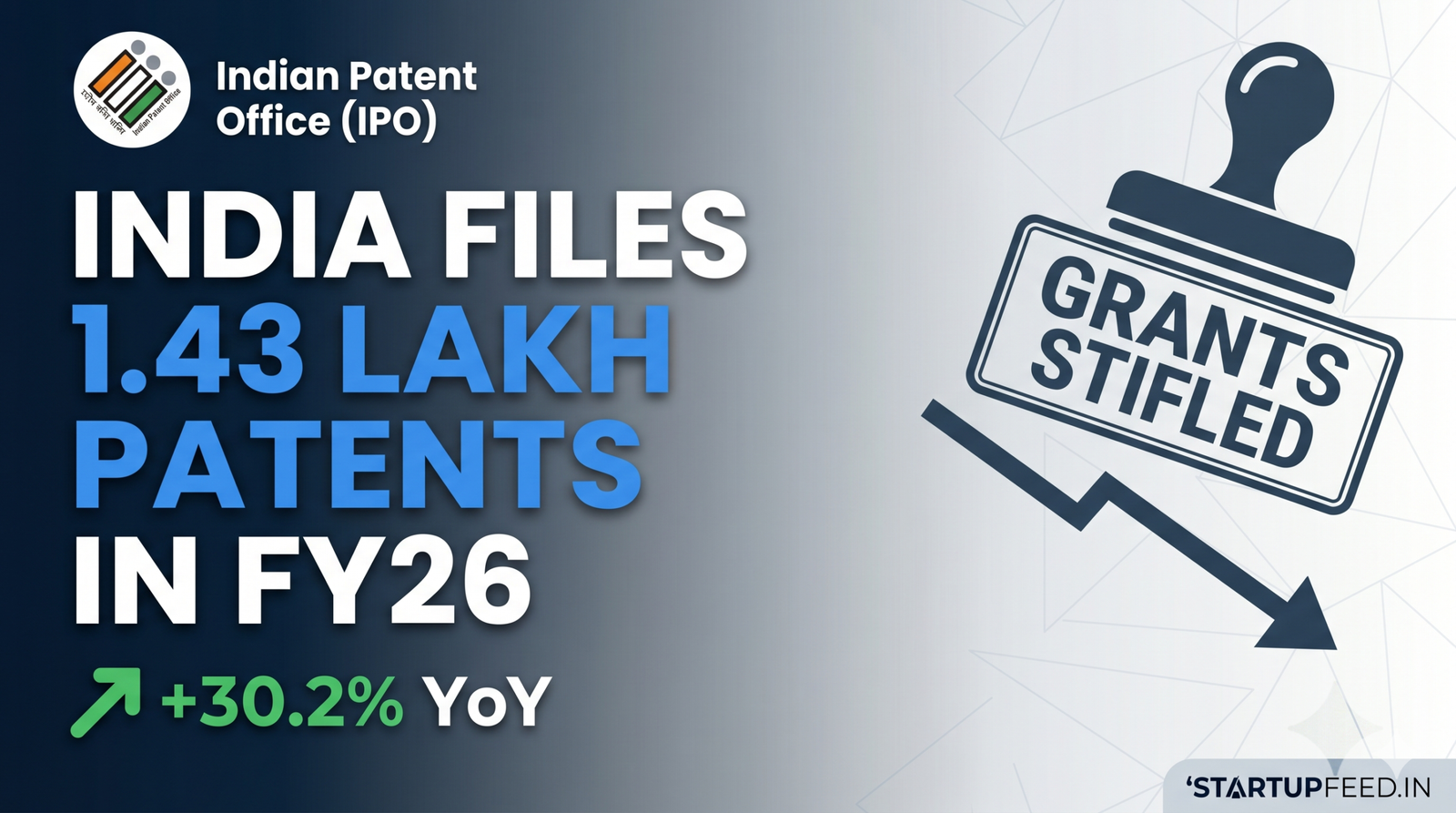
- Filings: 1,43,729 patent applications in FY26 — up 30.2% YoY, a decade-high
- Grants: Fell ~36% from FY24’s peak of 1,03,057; First Examination Reports dropped 79% since FY21
- Who’s Filing: Educational institutions led with 36.5% share (~52,450); Startups filed just 4,480 (3.1%)
- The Barrier: Section 3(k) of Patents Act blocks software, AI, and algorithm patents — hits India’s tech-first startups hardest
- Global Context: India ranks #6 globally in filings, but China filed 1.8 Mn in the same period — 12.5x more
India’s Indian Patent Office (IPO) recorded 1,43,729 patent applications in FY 2025-26 — up 30.2% from 1,10,375 in FY25 and the highest ever in the country’s history. Commerce Minister Piyush Goyal called it a signal that “India’s innovation engine is unstoppable.” The numbers are real. But behind them lies a structural contradiction: as filings surged, grants declined by approximately 36% from FY24’s peak of 1,03,057, and First Examination Reports fell by 79% over five years. Filing more is not the same as innovating more.
The divergence matters because patents only deliver commercial value when granted. An unexamined or refused patent application protects nothing, signals nothing to investors that matters in court, and blocks no competitor. For India to become a genuine deeptech powerhouse, the system needs to convert filings into grants — especially for startups and software-led sectors that are currently shut out by Section 3(k) of the Patents Act, 1970.
StartupFeed Insight
What the numbers say: India is building a filing culture, not yet an innovation culture. At 36.5% of FY26 filings, educational institutions dominate the ledger — their patents are often pre-commercial and rarely monetised. Startups, who actually need IP to compete and raise capital, filed just 3.1% of total applications.
What this means for you:



- If you’re a Founder: File patents strategically, not symbolically. A granted patent is an asset; a pending one abandoned pre-examination is a liability. Budget for prosecution, not just filing fees.
- If you’re a Investor: Ask portfolio companies about grant status, not just filing count. The gap between filings and grants is where IP value evaporates — and your due diligence should close it.
- If you’re a Policymaker: Section 3(k) was written for a pre-SaaS world. Every major software economy — US, EU, China — has found ways to patent tech-adjacent software innovations. India cannot be the exception if it wants a deeptech economy.
Our prediction: Unless Section 3(k) is amended or judicially reinterpreted by Q1 FY28, India’s software-led startup cohort will continue filing patents primarily for investor optics — and abandoning them before grant. The grant-to-filing ratio for startups (under 17%) will remain the lowest in the ecosystem for at least the next two fiscal years.
The Filing Surge — By the Numbers
India’s patent filings have grown 146% over five years — from 58,503 in FY21 to 1,43,729 in FY26. Domestic filers now drive the surge: resident applications rose from 24,326 in FY21 to 98,771 in FY26, a jump of over 300% and now representing 68.7% of all filings. Tamil Nadu led states in FY26 with 22,995 applications, followed by Karnataka and Maharashtra.
| Metric | FY24 | FY25 | FY26 |
| Patent Filings | 92,172 | 1,10,375 | 1,43,729 |
| Domestic Filings | ~46,000 | 68,201 | 98,771 |
| Foreign Filings | ~46,000 | 42,174 | 44,008 |
| YoY Filing Growth | ~17% | +19.5% | +30.2% |
| Patent Grants (FY24: Peak) | 1,03,057 (peak) | ~66,000 est. | Declining |
| FERs Issued | N/A | 14,756 | Backlogged |
The headline number is impressive. But the grant data tells a different story. In FY24, India granted a peak of 1,03,057 patents — a 17-fold increase from FY15’s 5,978. By FY25, that momentum reversed. First Examination Reports (FERs) — the critical step before a grant — fell from 71,138 in FY21 to just 14,756 in FY25, an 80% collapse. The Indian Patent Office has been unable to keep pace with the filing surge it helped create.
Who’s Filing — And Who Should Be Filing More
Educational institutions filed 36.5% of all patents in FY26 — approximately 52,450 applications. This is the single largest category, overtaking multinationals. But academic patents rarely translate to commercial products, licensed technologies, or startup spin-offs without dedicated technology transfer offices and industry linkages, which most Indian universities lack.



| Applicant Category | FY26 Filings | Grant-to-Filing Ratio | Key Concern |
| Educational Institutions | ~52,450 (36.5%) | Moderate | Quality of academic IP |
| MSMEs & Individuals | ~30,000+ | Higher | Limited prosecution resources |
| Startups (DPIIT recognised) | 4,480 (3.1%) | Very Low (~16.6%) | Filings for signalling, not strategy |
| Multinationals (Foreign) | 44,008 (30.6%) | High | None — well-resourced filers |
Startups — the entities most likely to convert patents into products, jobs, and export revenue — filed just 4,480 patents in FY26, up from 2,850 in FY25. That’s progress, but it’s 3.1% of total filings. More alarming: of the 13,089 startup patents filed between FY21-FY25, only 2,174 were granted — a grant rate of under 17%. In FY25 alone, startups filed 10,429 trademarks — nearly 8 times their patent filings — suggesting the startup ecosystem is optimising for brand differentiation, not technological depth.
The Section 3(k) Problem — India’s Deeptech Wall
Section 3(k) of the Indian Patents Act, 1970 excludes mathematical methods, business methods, computer programs per se, and algorithms from patentability. Enacted to prevent monopolisation of abstract ideas, the provision has become a significant barrier for software-led startups in SaaS, fintech, AI/ML, healthtech, and edtech sectors — the very segments that define India’s startup ecosystem.
| Provision | What It Restricts | Sectors Most Affected |
| Section 3(k) | Mathematical methods, business methods, algorithms, and computer programs per se | SaaS, Fintech, AI/ML, EdTech, HealthTech |
| Workaround Required | Must demonstrate concrete ‘technical effect’ beyond mere software execution | Requires specialised IP counsel — cost barrier for most startups |
| Comparison: USPTO | Post-Alice (2014): broader but pragmatic; technical character test evolving | Less restrictive than India for software-adjacent innovations |
To overcome a Section 3(k) objection, an applicant must demonstrate a concrete ‘technical effect’ — a real-world, hardware-linked outcome, not just improved software behaviour. This requires specialised IP counsel and detailed claim drafting, typically beyond the budget of early-stage startups. The result: many valid innovations go unprotected in India while the same IP gets registered at the USPTO or EPO.
India vs The World — How Far Behind Are We?
India’s 1.43 lakh filings earned it the #6 global rank. But context matters: China filed 1.8 million applications in calendar year 2024 — 12.5 times India’s total. The US filed approximately 600,000. India’s filings are growing at the right rate but from a far lower base, and grant efficiency is a separate, more urgent challenge.
| Country | FY/CY Filings | Global Rank | Grant Rate (est.) |
| India | 1,43,729 (FY26) | #6 | ~45-50% (declining) |
| China | 1.8 Mn (CY2024) | #1 | ~70%+ |
| USA | ~600,000 (CY2024) | #2 | ~55% |
| Japan | ~290,000 (CY2024) | #3 | ~65% |
China’s patent system is not a perfect benchmark — its volume includes a significant share of low-quality filings incentivised by government grants per application. But even discounting that, India’s grant rate, examiner capacity, and deeptech patent density remain structurally weaker than economies with comparable innovation ambitions.
What’s Next — Three Fixes India Needs Now
- Expand examiner capacity urgently. The IPO cannot process 1.43 lakh applications with the current staffing — especially after FERs dropped 80% in four years. A structured recruitment drive and expedited examination tracks for startups and deeptech applicants are non-negotiable.
- Reform or reinterpret Section 3(k). The provision as applied today is too broad. A DPIIT-led consultation — bringing together IP lawyers, startup founders, and Patent Office officials — should define clearer standards for technical effect that don’t require applicants to work around a 1970s-era provision.
- Build quality into the filing culture. With 36.5% of filings from educational institutions, the IP system needs to reward granted patents, not filed ones. University ranking frameworks, government recognition schemes, and startup support programmes should weight grants over applications.
The filing surge is a genuinely positive signal — India’s innovation culture is deepening. But a filing that never becomes a grant is an unfulfilled promise. The next chapter for India’s IP story must be about quality, speed, and structural reform — not just volume.
What do you think? Should India amend Section 3(k) to unlock software patents for startups? Share your view at @StartupFeed_news
Liked this story? Follow StartupFeed on Google so our reporting reaches you first.