
Quick Take:
|
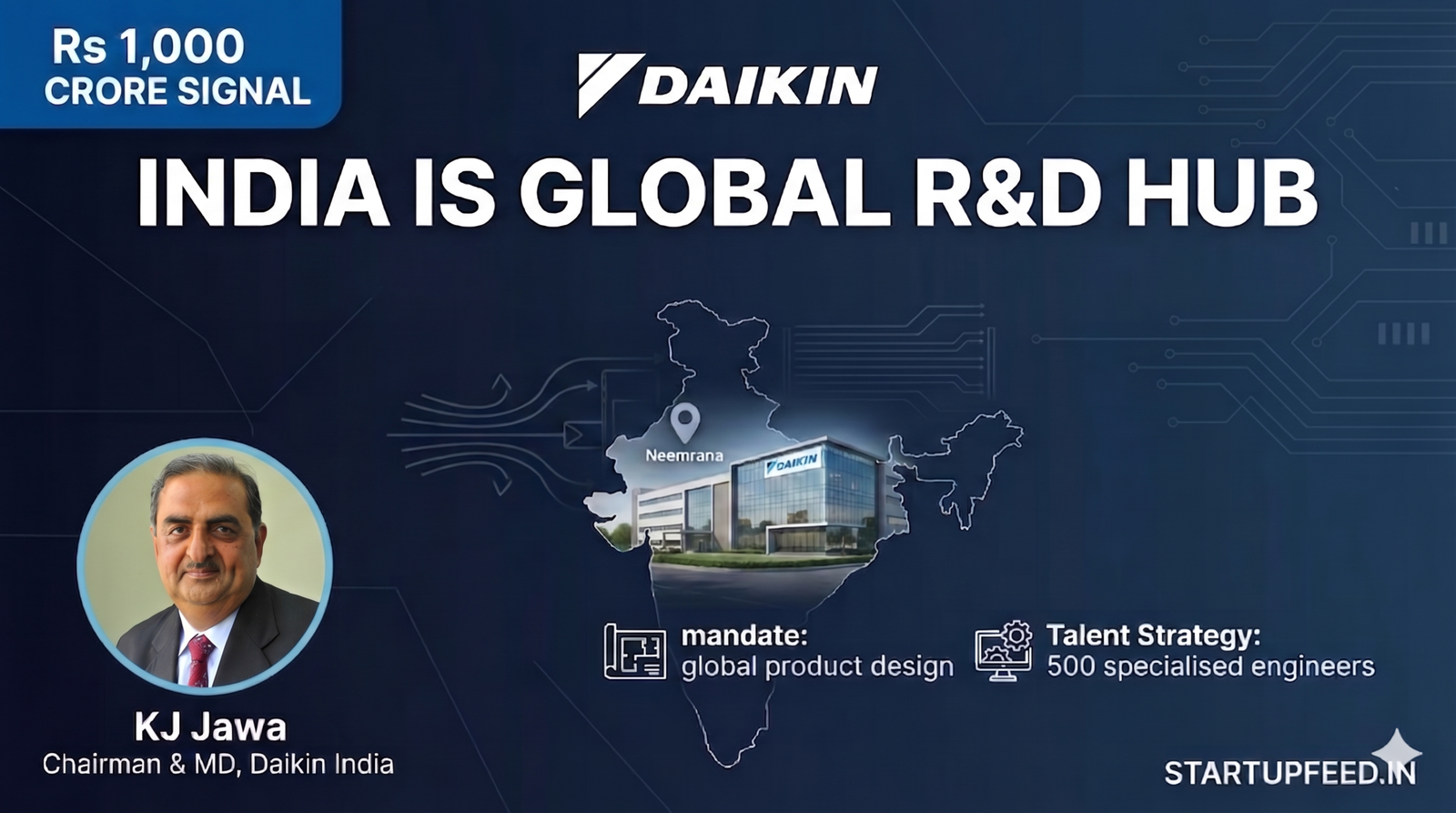
For the first time in its history, Daikin Industries — the world’s largest air-conditioning manufacturer, headquartered in Osaka, Japan — has chosen to place a global R&D centre outside Japan. The location it chose was not Germany, not China, not the United States. It chose Neemrana, Rajasthan, India
The investment: Rs 1,000 crore (~$108 million). The mandate: software and product development for cooling systems that will serve global markets — not just India. The talent plan: 500 specialised engineers, hired from India’s technical institutions, doing work that will design products exported to 100 countries. This is not a back-office. This is not a support centre. This is, by Daikin’s own characterisation, the global innovation hub — the place where the world’s most important HVAC company will increasingly decide what its next generation of products look like.
For India, this is a defining validation moment — the moment that a Japanese industrial giant with $33 billion in global revenues publicly stated that India’s engineering talent ecosystem is mature enough to anchor global product R&D. It follows a pattern that India’s tech sector has known for years (Google, Microsoft, Amazon, Intel all run major R&D out of India) but that India’s advanced manufacturing and industrial sector is only beginning to experience.
| StartupFeed Insight — Why Daikin Chose India for Global R&D The three structural reasons India won this decision:
What this means for India’s industrial innovation ecosystem: Daikin’s choice establishes a new category of Indian R&D centre — not IT services, not software development, but deep industrial product R&D. If Daikin succeeds here (and the evidence from Neemrana’s existing R&D track record suggests it will), the move will be studied and replicated by other Japanese, European, and Korean industrial majors. India’s next competitive advantage may not be in software — it may be in hardware and thermal engineering Our prediction: By 2028, the Neemrana facility will have designed at least two globally-deployed Daikin product lines that originated entirely in India. This will be the moment the ‘India as global R&D hub for physical products’ narrative becomes undeniable — the same inflection that happened for Indian software R&D when Google’s search algorithms started being written in Bengaluru. |
Daikin Industries — Who They Are
| Parameter | Details |
| Founded | 1924, Osaka, Japan |
| Global Revenue | $33+ billion |
| Market Position | World’s largest air-conditioning manufacturer |
| Global Footprint | ~100 production units; customer base in 170+ countries |
| Core Products | Residential AC, commercial AC, VRV systems, chillers, refrigeration, air purification, heating systems, fluorochemicals |
| India Revenues (FY25) | ~Rs 13,000 crore; 8-9% YoY growth; targeting Rs 15,000 crore by FY27 |
| India Exports | Currently 54 countries; targeting 100 markets under Vision 2030 |
| Total India Investment (prior) | Rs 2,800 crore — manufacturing, R&D, components |
| India Manufacturing | Neemrana (Rajasthan) — two factories; Sri City (Andhra Pradesh) — third factory |
| Vision 2030 revenue target from India | $4 billion (~Rs 33,000 crore) in medium term |
The R&D Investment — What Is Being Built
| Component | Investment | Details |
| Global R&D Centre — Neemrana | Rs 1,000 crore | First global R&D facility outside Japan; focus on software and product development for AC systems and chillers; new facility proximate to existing R&D and manufacturing base |
| Data Centre Chiller Manufacturing | Rs 200 crore (additional) | Local manufacture of data centre chillers; designs sourced from Italy; Daikin already supplying data centre chillers domestically from imported product |
| Existing R&D infrastructure (April 2025) | Rs 500 crore (third R&D centre inauguration, April 2025) | Third R&D centre at Neemrana; 22 specialised testing laboratories; 6 acres; 500 engineers; focus on HVACR solutions for Indian and global markets |
| AI-IoT Lab (existing) | Not separately disclosed | AI-IoT research lab in Hyderabad — complements Neemrana mechanical R&D |



The cumulative R&D picture: Daikin has now committed to three separate R&D facilities in India — the Neemrana mechanical centre, the Hyderabad AI-IoT lab, and now the new Rs 1,000 crore global centre. This is not a single bet; it is a systematic buildup of India’s R&D capability that has been underway for several years. The Rs 1,000 crore announcement is the capstone of a deliberate strategy, not an opportunistic pivot.
The Data Centre Cooling Opportunity — Daikin’s Most Strategic Market
India’s data centre buildout is the single largest near-term revenue opportunity for Daikin’s India operations. Every hyperscale data centre requires precision thermal management — chillers that maintain specific temperature and humidity windows with near-zero tolerance for failure, 24 hours a day, 365 days a year, with no acceptable downtime
- Google Vizag AI Hub: $15 billion investment; 1 GW compute; the largest single AI infrastructure bet in India’s history — requires massive sustained cooling infrastructure
- AWS, Microsoft Azure, Google Cloud: All expanding India data centre capacity aggressively; each new hyperscale facility is a multi-year chiller procurement relationship
- Domestic data centre players: Adani, Hiranandani, NTT, STT GDC, CtrlS — India’s domestic data centre market growing at 20%+ annually
- Daikin already supplying: The company is already supplying chillers for major Indian data centre projects; the Rs 200 crore manufacturing investment makes this a local supply chain, reducing delivery timelines and custom-designing for India’s power grid characteristics
The engineering challenge Daikin’s Neemrana R&D will solve: India’s power grid is more variable than Europe or Japan — voltage fluctuations, phase imbalances, and brownouts are more frequent. Data centre chillers designed for Japanese or German grid conditions fail more often in Indian conditions. Designing chillers for Indian electrical characteristics at Neemrana means Daikin can deliver Indian-grid-optimised products that imported competitors cannot match.
The Talent Strategy — 500 Engineers at the Intersection of Thermal and Digital
Daikin’s hiring plan for the new R&D centre goes beyond traditional mechanical engineering. The 500-engineer profile targets what observers call ‘Full-Stack Thermal Engineering’ — professionals at the intersection of physical engineering and digital intelligence:
- Computational Fluid Dynamics (CFD): Engineers who model airflow, heat transfer, and pressure dynamics in 3D simulation environments — designing cooling systems that work correctly before physical prototypes are built
- Power Electronics: Specialists in how cooling systems interact with power supply — inverter design, variable frequency drives, efficiency optimisation across power grid conditions
- Refrigerant Chemistry and Compliance: With global refrigerant phase-out regulations (R-22, R-410A being replaced by lower-GWP alternatives), Daikin needs engineers who design products around next-generation refrigerants
- Firmware and Control Logic: Modern HVAC systems are increasingly software-controlled — the compressor, the fan, the valve, and the thermostat all communicate through embedded firmware. Value creation in HVAC is increasingly in control logic, not the compressor itself
- AI and IoT: Predictive maintenance, adaptive thermal management, remote monitoring — the software layer that makes modern HVAC systems smart; Daikin’s Hyderabad AI-IoT lab has been developing this capability
- Sustainability Modeling: With global energy standards tightening (EU EcoDesign, India BEE star ratings, US DOE efficiency standards), engineers who can model and optimise energy efficiency across different regulatory contexts
Daikin India’s Investment Journey — Rs 3,800 Crore and Counting
| Investment Round | Amount | What Was Built |
| Cumulative prior (manufacturing + components + R&D) | Rs 2,800 crore | Two Neemrana manufacturing factories; compressor manufacturing; refrigerant production; two R&D centres (mechanical Neemrana + AI-IoT Hyderabad); Sri City (AP) manufacturing facility |
| Third R&D Centre, Neemrana (April 2025) | Rs 500 crore | 22 testing labs; 6 acres; 500 engineers; HVACR R&D for Indian and global markets |
| Data Centre Chiller Manufacturing (2026) | Rs 200 crore | Local manufacture of data centre chillers; Italy-sourced designs adapted for Indian market |
| Global R&D Centre (announced 2026) | Rs 1,000 crore | First global R&D facility outside Japan; software + product development; 500 engineers; global product mandate |
| Total committed investment | Rs 4,500+ crore | — |
KJ Jawa, Chairman and MD, Daikin India: “Daikin India has so far invested Rs 2,800 crore in developing world-class infrastructure across the country, reinforcing our long-term commitment to India. The newly established R&D centre is a significant milestone in this journey and will be instrumental in positioning Daikin as a pioneer in innovation, technology, and engineering within the Indian market.”
Masanori Togawa, President and CEO, Daikin Industries Japan: “We have about 100 production units globally and a customer base in over 170 countries, but India holds a special significance. As we expand our manufacturing footprint in India, we reemphasize the importance of India in Daikin’s global vision.”
Vision 2030 — Making India Daikin’s Largest Base Outside Japan
- Revenue target: $4 billion from India in the medium term (current: ~Rs 13,000 Cr / ~$1.5 Bn FY25); FY27 target: Rs 15,000 crore
- Export expansion: From 54 countries currently to 100 markets — India as a manufacturing and design hub for products exported globally, particularly to MENA, Africa, Southeast Asia, and South Asia
- Manufacturing depth: Over 100 global component suppliers have visited Neemrana recently to evaluate India supply chain integration — Daikin is actively building a local supplier ecosystem
- PLI scheme: Daikin is the primary investor in the Indian government’s Production Linked Incentive (PLI) scheme for air conditioners — directly benefiting from manufacturing incentives as it localises production
- Compressor manufacturing: Daikin is scaling up local compressor production — the most critical and highest-value component in any AC system; local compressor manufacturing transforms India from an assembly base to a genuine manufacturing hub


What do you think? Is India ready to become the global R&D capital for industrial hardware, not just software? Tell us on X @StartupFeed_news
Liked this story? Follow StartupFeed on Google so our reporting reaches you first.