QUICK TAKE
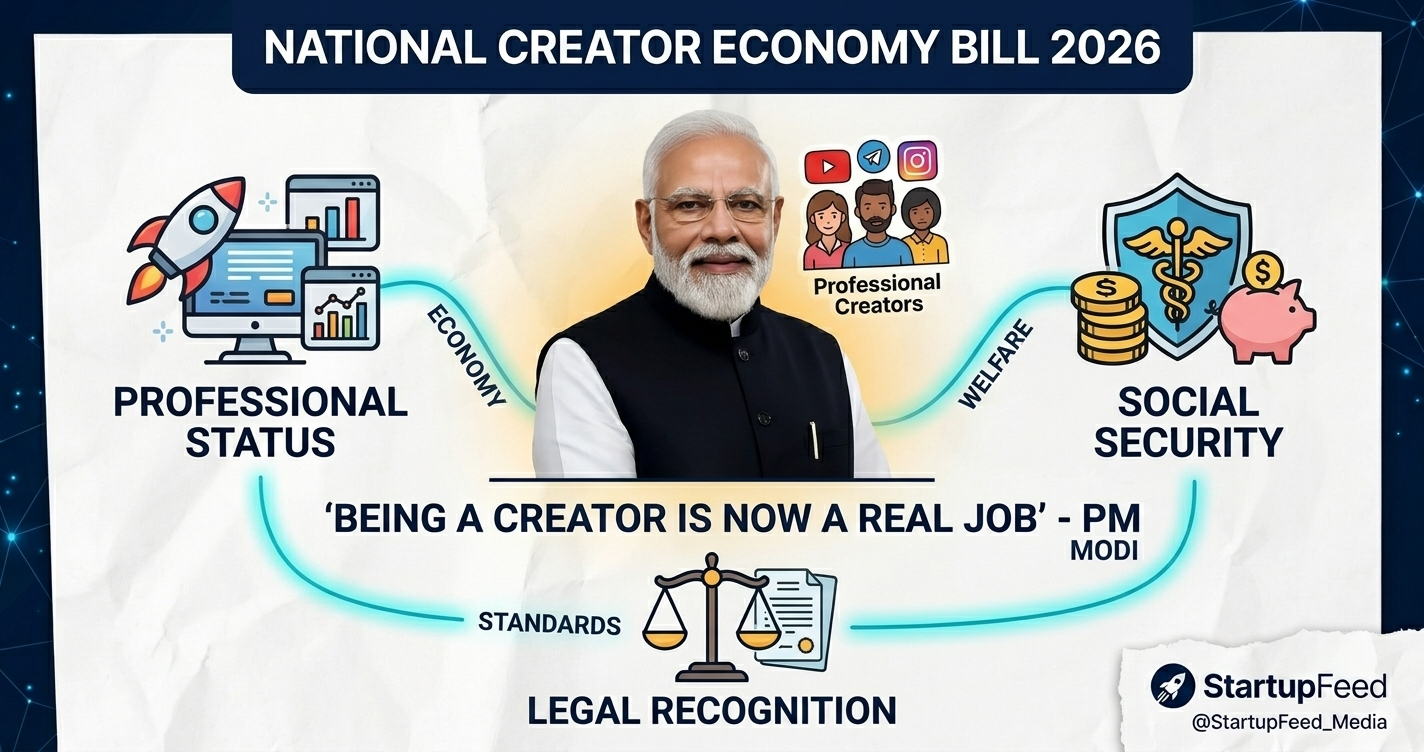
- What Passed:: National Creator Economy Bill 2026 — Rajya Sabha, April 14, 2026
- Who It Covers:: Social media influencers, YouTubers, digital artists, and professional creators
- Creator Welfare Fund:: Health insurance + retirement benefits — first-ever creator social security in India
- Key Provisions:: Professional recognition, mandatory registration, standardised contracts, dispute resolution
- Market Context:: India’s creator economy valued at ~$15 Bn in 2026, projected to reach $61.87 Bn by 2033
- What’s Next:: Registration portal launch, Welfare Fund operationalisation, contract templates notified
India’s creator economy officially became a formal profession on April 14, 2026, when the Rajya Sabha passed the National Creator Economy Bill 2026 — giving legal recognition to social media influencers, YouTubers, and digital artists for the first time. Prime Minister Narendra Modi, responding to the passage, said that “being a creator is now a real job,” marking a cultural shift in how India’s government views the country’s 100 million-strong creator community.
The Bill does more than symbolic recognition. It establishes a Creator Welfare Fund offering health insurance and retirement benefits, mandates registration for professional creators above an income threshold, and introduces standardised contracts and a dispute resolution mechanism for brand-creator payment conflicts — three problems that have plagued the industry for years and that no platform or brand has been willing to solve voluntarily.
StartupFeed Insight
What the numbers say: India’s creator economy is valued at ~$15 Bn in 2026 and growing at 22.4% CAGR. But only 8-10% of its 100 million+ creators monetise effectively. The Bill’s Welfare Fund and registration system directly targets this gap — not by adding a platform feature, but by inserting the government as guarantor of creator livelihoods.
What this means for you:
- If you’re a creator: Registration will be mandatory past an income threshold — start tracking your earnings formally now. The Welfare Fund is India’s first creator-specific social security net; access will likely be tied to registration compliance.
- If you’re a brand or agency: Standardised contracts mean the days of informal WhatsApp deal structures are ending. Due diligence on creator registration status will become part of brand compliance. Dispute resolution gives creators legal recourse they didn’t have before — payment delays get expensive.
- If you’re a platform (YouTube, Instagram, ShareChat): Mandatory creator registration creates a formal creator database. This may intersect with GST compliance, TDS obligations, and ASCI disclosure rules — expect additional compliance requirements from MeitY in follow-on regulations.
Our prediction: By Q2 FY28, India’s formally registered creator base will exceed 5 lakh — pulling creator income into the formal tax net and adding Rs 2,000-3,000 Cr annually to GST collections from influencer marketing. The creator economy will be the next gig economy — and like Ola/Swiggy drivers before them, creators will discover that formalisation brings both benefits and obligations.
What the Bill Actually Does — Key Provisions
The National Creator Economy Bill 2026 introduces five structural changes to how digital content creation is governed in India:
| Provision | What It Does | Who It Helps Most |
| Professional Recognition | Influencers, YouTubers & digital artists legally classified as professionals | All full-time creators across all platforms |
| Creator Welfare Fund | Health insurance, retirement benefits funded via industry contributions | Mid-tier creators without employer benefits |
| Mandatory Registration | Creators above an income threshold must register with a designated body | Professional & full-time creators — enables access to formal credit |
| Standardised Contracts | Templates for brand deals, sponsorships & agency agreements | Creators battling delayed or disputed brand payments |
| Dispute Resolution | Dedicated mechanism for payment & IP conflicts between creators and brands | Nano & micro-creators with no legal recourse today |
The most commercially significant provision is the standardised contract framework. India’s influencer marketing industry has long operated on informal terms — verbal agreements, WhatsApp deal structures, and delayed brand payments averaging 60-90 days. The Bill’s dispute resolution mechanism gives creators legal standing to enforce payment timelines without expensive litigation.
The Market This Bill Is Trying to Formalise
India’s creator economy is already one of the world’s largest — and among its fastest-growing. YouTube alone contributed $1.8 Bn to India’s GDP in CY2024 and generated 930,000 jobs in its creative ecosystem. The broader market is significantly larger:
| Metric | 2025 (Current) | 2026 (Estimated) | 2030 (Projected) |
| Market Size | ~$2.5 Bn | ~$15 Bn | $61.87 Bn |
| Active Creators | 100 Mn+ | ~110 Mn | N/A |
| Consumer Spend Influenced | $350 Bn/yr | ~$450 Bn/yr | $1 Tn+/yr (BCG) |
| YouTube GDP Contribution | $1.8 Bn (CY24) | Growing | N/A |
| Jobs in Creator Ecosystem | 930,000+ (YouTube alone) | 1 Mn+ est. | 2 Mn+ (AVGC) |
| Creators Monetising Effectively | 8-10% | Improving post-Bill | Target: 25%+ |
The Bill arrives at an inflection point. Budget 2026 had already earmarked Rs 250 Cr for National Creator Labs in 15,000 secondary schools and 500 colleges — signalling the government’s intent to build the next generation of creators through the formal education system. The passage of this Bill converts that intent into a legal framework.
What PM Modi Said
Being a creator is now a real job. India’s young people are not just consuming content — they are creating culture, creating livelihoods, and creating India’s story for the world.”
— Prime Minister Narendra Modi, on passage of the National Creator Economy Bill 2026
Modi’s framing signals a deliberate political calculation: India’s 100 million+ creators are a constituency, not just an economy. The government’s Rs 10,000 Cr+ investment in the creator economy — spanning WAVES 2025, Budget 2026 labs, and now this Bill — positions Digital India as a creator-first agenda ahead of state elections where youth unemployment remains a sensitive issue.
How India Got Here — Policy Timeline
| Date / Period | Milestone | Significance |
| Jan 2026 | Budget 2026: Rs 250 Cr earmarked for National Creator Labs in 15,000 schools & 500 colleges | Formal investment in creator skilling |
| Mar 2025 | Govt announces $1 Bn creator economy fund at WAVES 2025 summit | Largest single creator economy commitment |
| Apr 14, 2026 | Rajya Sabha passes National Creator Economy Bill 2026 | Legal recognition day — historic |
| Post-Bill (Est.) | Creator registration portal launch + Welfare Fund operationalised | Formal sector formalisation begins |
| 2027 (Est.) | First set of standardised contracts & dispute resolution framework notified | Creator-brand contracts become enforceable at scale |
The Bill’s passage is not an isolated event — it is the legislative culmination of a three-year government push to formalise the creator economy that began with the $1 Bn WAVES 2025 commitment and accelerated through the Budget 2026 Creator Labs initiative.
Who Should Be Watching This Closely
| Stakeholder | Why This Bill Matters to Them |
| Google / YouTube | Already pays $2.5 Bn+ to Indian creators; mandatory contracts may require platform-level compliance with dispute norms |
| Meta (Instagram / Reels) | 1 Mn+ Indian creators monetise via Reels; registration norms could reshape creator partnership agreements |
| Influencer Marketing Agencies | Standardised contracts end informal deals — agencies must adapt or lose leverage in brand negotiations |
| Brands (FMCG, D2C, Fintech) | Dispute resolution mechanism makes brand-creator contracts legally enforceable — due diligence on creator registration becomes mandatory |
| Tax Authorities / GST Council | Mandatory registration creates an audit trail — undeclared creator income increasingly difficult to hide from formal tax net |
The most consequential near-term impact will fall on influencer marketing agencies, which currently operate as informal intermediaries between brands and creators. Standardised contracts reduce the information asymmetry agencies exploit — and dispute resolution gives creators a path to recourse that doesn’t require agency mediation.
What’s Next
The Bill’s passage through Rajya Sabha is the beginning, not the end. Three things to watch in the next 12 months:
- Registration portal and income threshold notification: The government must define what income level triggers mandatory registration. Too low and it burdens nano-creators; too high and the formal system misses the mid-tier creator class that the Bill is designed to protect.
- Creator Welfare Fund structure: Who contributes — only the creator, or brands and platforms too? A platform levy model (similar to ESI for gig workers) would be the most impactful, but also the most contested.
- GST and TDS implications: Mandatory registration will create a tax audit trail for creator income. Expect a follow-on circular from the GST Council and a revised TDS framework for brand payments to registered creators by Q3 FY27.
The real question is enforcement. India has a strong track record of landmark legislation and a weaker track record of operationalising it. Whether the Creator Welfare Fund becomes a meaningful safety net or a bureaucratic formality will depend entirely on how the implementing rules are notified — and how quickly.
What do you think? Will the Creator Economy Bill change how you operate as a creator or brand? Tell us at @StartupFeed_in
Liked this story? Follow StartupFeed on Google so our reporting reaches you first.