

Quick Take:
|
India is buying gold the way it buys groceries — one small UPI transaction at a time. In March 2026, digital gold purchases via the Unified Payments Interface hit a record 254 million transactions — a number that would have been inconceivable when UPI was launched in 2016 and digital gold was a niche concept discussed only in fintech circles.
The scale of what is happening deserves a moment’s pause: 254 million individual gold purchase transactions in a single month translates to approximately 8.2 million people buying gold via their phones every day. Not large ticket investments. Not jewellery counter purchases. Gold bought in amounts as small as Rs 1 — fractional, digital, frictionless, accessible to anyone with a UPI ID and a phone. The democratisation of gold investment is no longer a theoretical fintech aspiration; it is a statistical fact tracked by NPCI’s monthly data series.
| StartupFeed Insight — Why 254 Million Matters for Fintech India The two forces driving this record:
The regulatory tension at the heart of this story: Digital gold is, by any honest description, the most successful unregulated financial product in India’s history. 254 million monthly transactions. Rs 3,900+ crore monthly value. 90%+ via UPI. And yet: no investor protection framework, no disclosure norms, no guaranteed safeguard if a platform fails, no regulatory body responsible for consumer complaints. SEBI has said clearly it is not regulated. RBI has not claimed it either. The product operates in a gap between securities law and banking regulation that was never designed for an instrument of this scale Our prediction: SEBI will announce a regulatory framework for digital gold by FY27 — the combination of Rs 3,900+ crore monthly transaction value, 254 million monthly users, and the precedent of regulated gold instruments (ETFs, SGBs) makes continued regulatory silence unsustainable. The question is whether the framework expands or contracts the market. If SEBI simply requires disclosure norms and vault audits, the market will grow further. If it imposes demat requirements or minimum ticket sizes, it risks destroying the accessibility that is the category’s core proposition. |
The Digital Gold via UPI — Complete Data Timeline
| Period | Transactions (Mn) | Value / Notes | Key Driver |
| Jan 2025 | ~21 Mn (est.) | Rs 762 crore | Early-stage; gold prices beginning their 2025 run |
| Apr 2024 | 20.92 Mn | Rs 550 crore | Joins NPCI top 10 medium-volume merchant categories for first time |
| August 2025 | 99.77 Mn | Rs 1,184 crore (2x from April 2024 in value) | 377% volume growth in 16 months; gold at Rs 11,021/gram (+44% YoY); momentum buying |
| October 2025 | ~150 Mn (est.) | Rs 2,290 crore | Gold record highs; festive season demand |
| November 2025 | Dipped | ~Rs 1,200 crore | SEBI advisory warning about unregulated status caused brief sentiment dip |
| December 2025 | 180 Mn | Rs 2,100 crore | Rebound; global uncertainty + market volatility drove safe-haven buying |
| January 2026 | 219 Mn | Rs 3,926 crore (~2.6 tonnes physical gold equivalent) | 4x YoY; gold scaled 12 all-time highs in first 6 weeks of 2026; 90%+ via UPI |
| February 2026 | ~230 Mn (est.) | Rs 3,030 crore (~1.9 tonnes) | 53% above 13-month average in volume terms; below Jan peak (gold prices corrected slightly) |
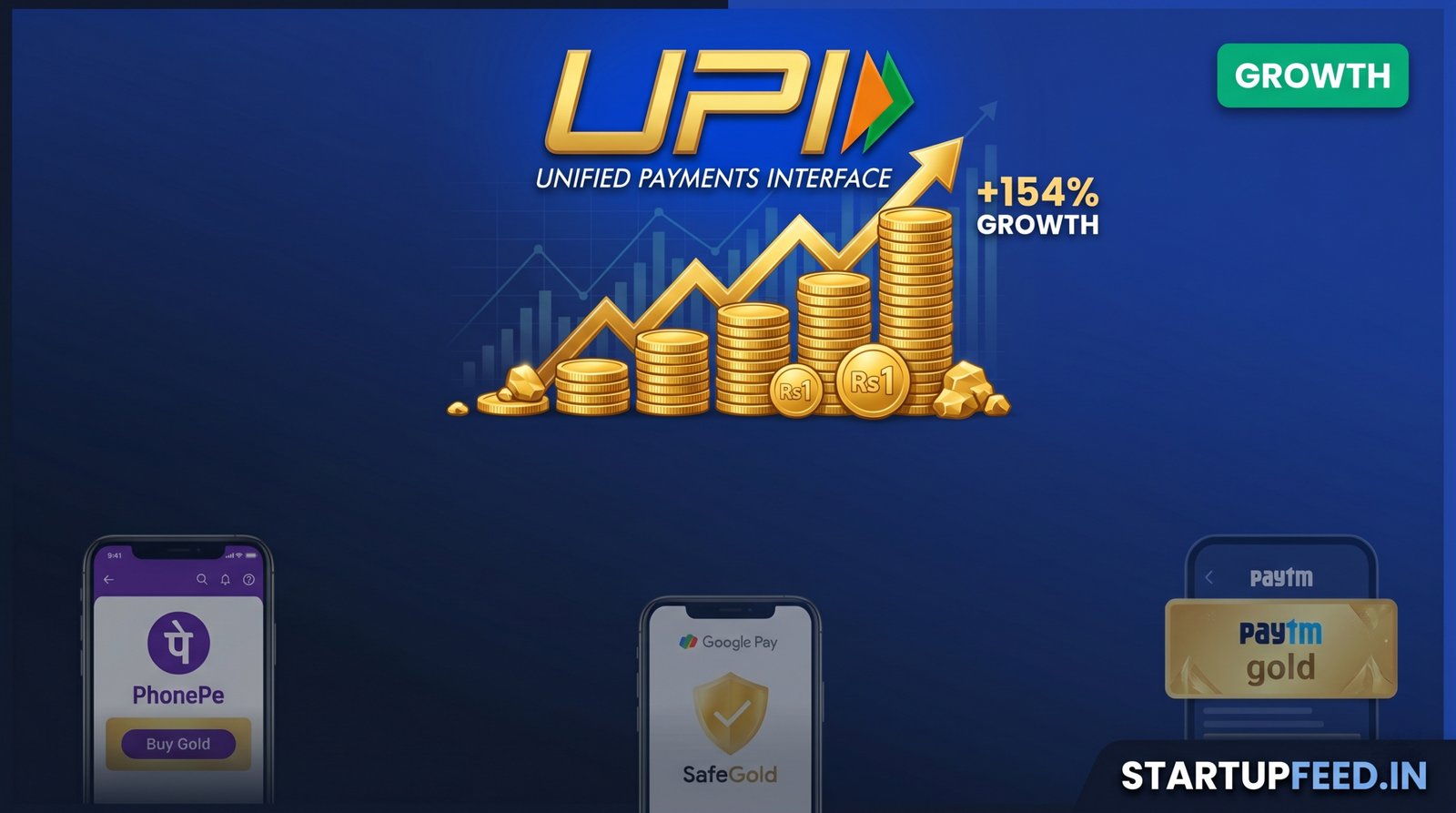
| March 2026 (RECORD) | 254 Mn | Record — Q4 FY26 fiscal year-end; gold price recovery | FY26 financial year-end drives investment; gold price recovery; 154% growth vs Aug 2024 |
Why 90%+ of Digital Gold Flows Through UPI
The UPI dominance in digital gold is not an accident — it is the result of a deliberate strategy by platforms and a structural advantage of UPI’s architecture:
- Zero friction onboarding: Every Indian with a bank account can use UPI. No new account creation, no KYC beyond what is already completed for banking. Buying gold for the first time via UPI takes under 60 seconds on PhonePe, Google Pay, or Paytm
- Rs 1 minimum: Physical gold requires minimum purchases of gram quantities. Gold ETFs require demat accounts and face NAV-based pricing with brokerage. Digital gold on UPI can be bought for a single rupee — making it the first gold investment instrument genuinely accessible to India’s 500+ million UPI users who have small, irregular investment capacity
- UPI Autopay: Recurring investment mandates allow users to set up automatic daily, weekly, or monthly gold purchases — transforming a one-time transaction into a systematic investment plan. This is the SIP (Systematic Investment Plan) model applied to gold, without the demat requirement
- Platform embedding: PhonePe, Google Pay, and Paytm have embedded digital gold purchase directly into their main payment apps. The conversion path from ‘I just paid my electricity bill’ to ‘I bought Rs 100 of gold’ is 2 taps. This ambient accessibility is unreplicable by any other gold investment vehicle
- Instant delivery notification: Unlike physical gold or paper gold products, digital gold purchase confirmation is instantaneous — the user sees their balance update in real time, creating the psychological satisfaction loop that drives repeat usage
The Gold Price Context — Why 2025-26 Created Perfect Conditions
| Gold Price Metric | Data |
| Gold price appreciation (2025) | 67% gain — highest annual return since 1979 |
| Domestic price peak (January 2026) | Rs 1,75,231 per 10 grams — record |
| International gold record (January 2026) | $5,400+ per ounce — record; 12 all-time highs in first 6 weeks of 2026 |
| YoY gold price gain (January 2026) | 24% in INR terms; aided by INR depreciation |
| 24-carat gold price (August 2025) | Rs 11,021 per gram — up 44% YoY |
| Gold as share of RBI reserves | 13.9% (2025); RBI added 880 tonnes — sent strong signal to retail investors |
| Gold import value (India, FY25) | ~$59 billion — broadly stable, but volumes declining as prices rise |
The investor logic: When gold gains 67% in a year, every Indian who didn’t buy gold in 2024 experiences regret. That regret converts into demand in 2025 and 2026 — and for the first time, the demand can be satisfied with Rs 1 at the push of a UPI button. The price momentum is the advertising; UPI is the distribution. The combination is why digital gold transactions have grown 154% in volume between August 2024 and March 2026.



UPI March 2026 — The Broader Context
| UPI Metric — March 2026 | Figure |
| Total UPI transactions | 22.64 billion — all-time record |
| Total UPI transaction value | Rs 29.53 lakh crore — all-time record |
| YoY transaction volume growth | 24% |
| YoY transaction value growth | 19% |
| Average daily transactions | 730 million |
| Average daily transaction value | Rs 95,243 crore |
| Digital gold as % of total UPI volume | ~1.1% (254 Mn out of 22,640 Mn) |
| UPI market share in global real-time payments | 49% of global real-time payment transaction volume |
| Countries where UPI is operational | 8+ (UAE, Singapore, Bhutan, Nepal, Sri Lanka, France, Mauritius, Qatar) |
| Top UPI app by volume (Feb 2026) | PhonePe — 45.5% share; Google Pay — ~33%; Paytm — ~7-8% |
The SEBI Regulatory Gap — The Biggest Risk in the Category
The number that no one should read without understanding: 254 million transactions in March 2026. Rs 3,900+ crore per month at peak. Approximately 13.5 tonnes of physical gold equivalent purchased via UPI in 2025. And not one rupee of it is regulated under Indian securities law
SEBI’s November 2025 advisory stated explicitly that digital gold products are not regulated under existing market frameworks. This means:
- No investor protection: If a digital gold platform fails, there is no investor compensation fund, no guarantee that the gold held in vaults against user balances is correctly audited, and no regulatory body with mandate to investigate
- No disclosure norms: Platforms are not required to disclose storage costs, counter-party risk, or the quality of vault audits to users
- No grievance framework: SEBI received only 371 complaints across 5 years (17 in 2020, rising to 112 in 2025), but with 254 million monthly transactions, this complaint rate is almost certainly a significant undercount — most users do not know where to complain
- Platforms operate in grey zone: PhonePe, Paytm, Google Pay, and jewellery brands all offer digital gold without the regulatory oversight that governs Gold ETFs, Sovereign Gold Bonds, or physical gold imports
- Why it bounced back post-SEBI warning: When SEBI warned in November 2025, transactions dipped to ~Rs 1,200 crore. By December, they were Rs 2,100 crore. By January, Rs 3,926 crore — a new record. The market’s response to the regulatory warning was essentially: ‘Thank you for the heads-up. We’ll continue.’ This tells you something important about retail investor behaviour in a bull gold market: convenience and price momentum override regulatory caution
The regulatory options: SEBI can bring digital gold under its securities framework (requiring demat accounts — which would likely collapse the market’s accessibility proposition), create a new bespoke regulatory category for digital gold with lighter-touch disclosure and vault audit requirements, or designate RBI as the regulatory authority for digital gold as a payment-adjacent product. The market’s scale has now made inaction the most dangerous regulatory choice.
What Platforms Are Driving Digital Gold Growth
- PhonePe: Market leader in UPI (45.5% share); digital gold embedded prominently in the app; Autopay investment options available
- Google Pay: Second in UPI share (~33%); digital gold offering through SafeGold partnership; strong diaspora and metro user base
- Paytm: Third in UPI (~7-8% share); one of the early movers in digital gold; large existing user base from wallet era
- Jewellery brands: Tanishq, Malabar Gold, and other jewellery brands have launched their own digital gold schemes — allowing customers to accumulate digital gold toward physical jewellery purchases; the ‘jewellery layaway’ use case is a growing adoption driver
- Fintech platforms: Groww, Jar, CRED, and other fintech apps have integrated digital gold as an entry-level investment product, targeting first-time investors who want something simpler than mutual funds
What do you think? Should SEBI regulate digital gold like a securities product — or create a new regulatory category that preserves its accessibility? Tell us on X @StartupFeed_news
Liked this story? Follow StartupFeed on Google so our reporting reaches you first.