
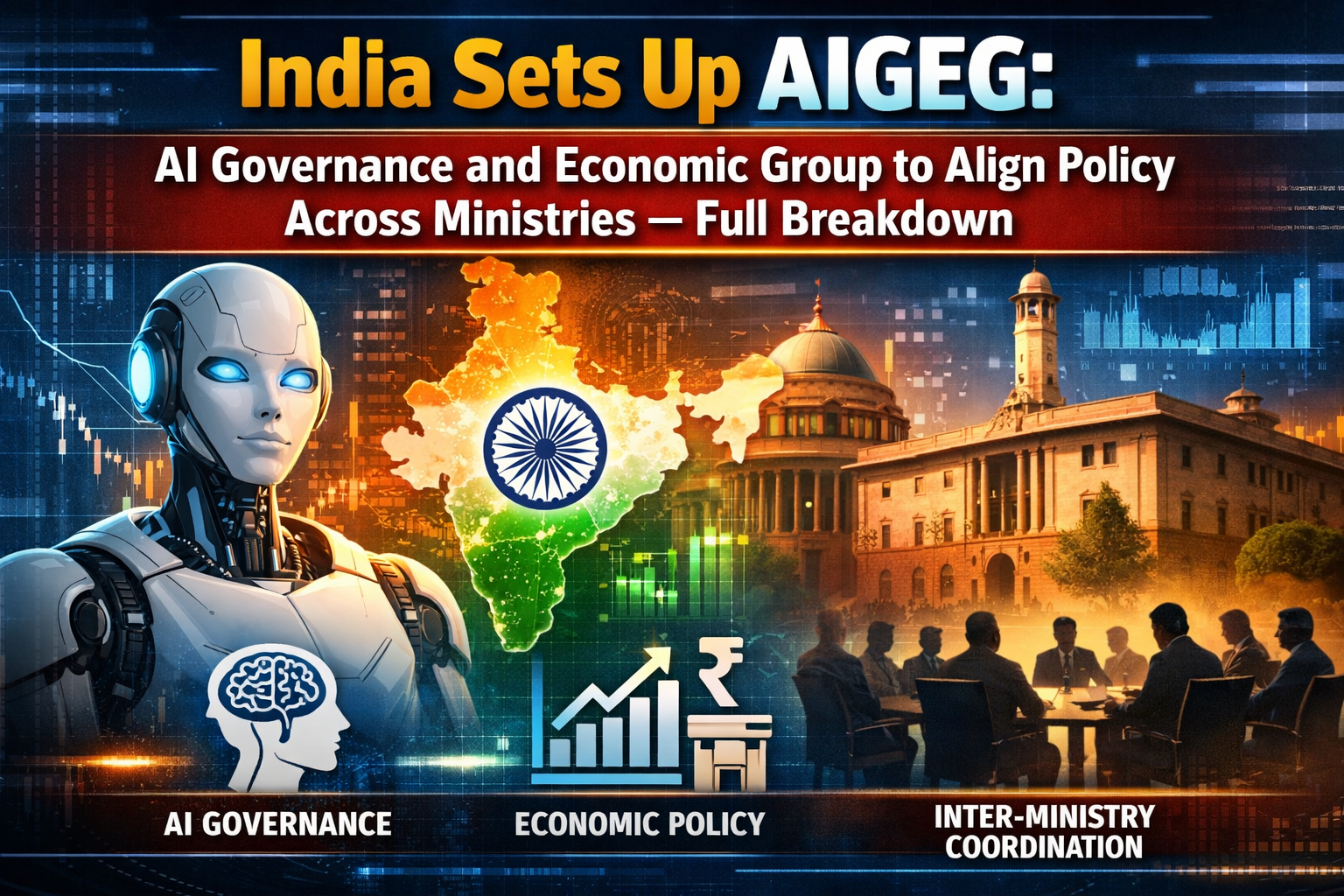
India has been building one of the world’s most ambitious AI infrastructure programmes — 38,000+ subsidised GPUs, a national AI compute facility, 570 AI data labs, and a sovereign LLM project. What it was missing was a single institutional mechanism to coordinate all of it across the government. AIGEG is that mechanism.
Quick Take
- Body: AI Governance and Economic Group (AIGEG) — constituted April 16, 2026
- Leadership: Chair: Ashwini Vaishnaw (Union Minister, Electronics & IT, Railways, Information & Broadcasting); Vice Chair: Jitin Prasada (Minister of State, Electronics & IT)
- Structure: Apex inter-ministerial coordination body + Technology and Policy Expert Committee (TPEC) as advisory arm + AI Safety Institute (AISI) for research and risk
- Mandate: Coordinate AI policymaking across all ministries, departments, and sectoral regulators; oversee national AI governance across public and private sectors
- Key Powers: Review and issue compliance guidelines; assess AI labour market impacts; develop India’s international AI governance position; promote responsible AI innovation
- Legal Basis: Formally implements recommendations in India’s AI Governance Guidelines (released Nov 2025 under IndiaAI Mission) and the Economic Survey (Jan 2026)
- Critical Mandate: Assess AI’s labour market impact in advance and develop mitigation strategies — accounting for India’s informal economy and skill gaps
The Centre has constituted the AI Governance and Economic Group (AIGEG) — India’s highest-level inter-ministerial body for coordinating artificial intelligence policy across the government. Chaired by Union Minister for Electronics and Information Technology Ashwini Vaishnaw, and with Minister of State Jitin Prasada as vice chairperson, the AIGEG is designed to function as the apex institutional mechanism through which India’s entire AI policy ecosystem — spanning ministries, departments, regulators, and advisory bodies — is aligned around a coherent national strategy.
The constitution of AIGEG gives formal effect to recommendations made in two foundational documents: India’s AI Governance Guidelines, released by MeitY under the IndiaAI Mission in November 2025, and the Economic Survey presented in January 2026, which had explicitly called for a coordinating body to align AI deployment with India’s labour realities and social stability priorities.
StartupFeed Insight

- What this signals for startups: AIGEG’s mandate to issue guidelines ensuring firms are held accountable for compliance with local laws is the clearest signal yet that AI regulation in India is moving from voluntary guidelines to enforceable frameworks. Startups building AI products — especially in fintech (RBI oversight), healthcare (CDSCO), and media (MIB) — need to start mapping their AI systems against sectoral regulatory requirements now, before the guidelines arrive.
- The labour mandate is non-trivial: AIGEG is specifically mandated to assess AI’s labour market impact in advance and develop mitigation strategies that account for informality and skill gaps. This is directed squarely at India’s 90%+ informal workforce — the most politically sensitive dimension of AI adoption. Any startup deploying AI that affects employment (RPA, warehouse automation, customer service chatbots at scale) should expect this to become a regulatory consideration, not just a CSR one.
- The international dimension: AIGEG’s mandate includes developing and overseeing India’s position on AI governance in global forums. This is India formally entering the geopolitics of AI — alongside the EU AI Act, the US executive orders, and China’s AI regulation framework. India’s ‘innovation-first, lightweight regulation’ stance is now AIGEG’s to defend and advance in multilateral settings.
- What changes for big tech in India: AIGEG’s compliance and accountability mandate effectively creates a new channel through which multinational AI companies (Google, Microsoft, Meta, OpenAI) will need to engage with the Indian government. The body’s ability to issue guidelines has real teeth — especially for companies deploying AI in regulated sectors like banking, healthcare, and telecom.
- Our prediction: AIGEG will publish its first set of AI compliance guidelines by Q3 2026, focused on high-risk sectors (healthcare, financial services, critical infrastructure). A mandatory AI incident reporting framework will follow by FY27, modelled on CERT-In’s cybersecurity incident reporting requirements. Indian AI startups should begin internal governance audits now.
What AIGEG Is — The Institutional Architecture
AIGEG is not a regulator in the traditional sense — it does not have the power to levy fines or grant licences. It is a coordination and oversight body that operates at the apex of India’s AI governance institutional framework. Understanding where it sits requires mapping the three-layer structure that the AI Governance Guidelines proposed:
| Layer | Body | Role | Status |
| Apex Coordination | AI Governance and Economic Group (AIGEG) | Inter-ministerial policy coordination; compliance oversight; labour impact assessment; international AI governance strategy | Constituted April 16, 2026 — ACTIVE |
| Expert Advisory | Technology and Policy Expert Committee (TPEC) | Advisory to AIGEG on global AI developments, emerging technologies, risks, regulation, and evolving policy priorities | To be constituted — role defined in guidelines |
| Safety & Research | AI Safety Institute (AISI) | Central body for safe and trusted AI use; testing, risk assessment, capacity building; represents India in global AI safety forums; supports TPEC and AIGEG with risk assessments | Proposed in AI Governance Guidelines — not yet constituted |
| Sectoral Implementation | Existing regulators (RBI, SEBI, TRAI, CDSCO, etc.) | Incorporate AI governance principles into their domain regulations; sector-specific enforcement | Existing — mandated to align with AIGEG framework |
AIGEG sits at the top of this hierarchy — above the sectoral regulators but below the Cabinet. It does not replace the regulators; it aligns them. When RBI issues AI guidance for banks, SEBI issues AI rules for trading platforms, and TRAI issues AI standards for telecom — AIGEG is the body that ensures these guidelines are coherent, not contradictory.
AIGEG’s Terms of Reference — What It Will Actually Do
| Mandate | Detail | Implications for AI Companies |
| Policy Coordination | Coordinate AI policy across all ministries, departments, and sectoral regulators; prevent policy fragmentation | Reduces risk of contradictory regulatory requirements across sectors; creates a single point of policy engagement |
| Compliance & Accountability | Review existing mechanisms and issue guidelines to ensure firms are held accountable for compliance with local laws | Binding guidelines expected; AI companies must map their products to applicable laws — DPDP Act, IT Act, sector-specific rules |
| National AI Initiatives Oversight | Oversee all national AI governance initiatives across public and private sector | IndiaAI Mission, AI compute scheme, AIKosh dataset platform — all under AIGEG’s oversight umbrella |
| Responsible AI Innovation | Promote responsible AI innovation and beneficial deployment of AI in key sectors | Signals government’s intent to enable, not block, innovation — but within guardrails |
| Risk Identification | Study emerging risks of AI, regulatory gaps, and the need for legal amendments | Will identify areas where existing laws are insufficient — potentially triggering new legislation for deepfakes, algorithmic bias, automated decision-making |
| Labour Market Impact Assessment | Assess AI’s labour market impacts in advance; develop mitigation strategies accounting for informality and skill gaps | AI companies automating significant workflows may face pre-deployment impact assessments; informal sector implications are central |
| International AI Strategy | Develop and oversee India’s position and strategy on AI governance in global forums (G20, GPAI, bilateral) | India’s stance on global AI regulation, cross-border data flows, and AI safety standards is now AIGEG’s domain |
| Regulatory Gap Analysis | Identify legal amendments needed as AI evolves | Ongoing legislative watch function — could trigger amendments to IT Act, DPDP Act, competition law, IP law |
The Policy Foundations — What AIGEG Is Built On
| Foundation Document | Date | Relevance to AIGEG |
| India AI Governance Guidelines (MeitY / IndiaAI Mission) | November 5, 2025 | Recommended establishment of inter-ministerial body (AIGG/AIGEG), TPEC, and AISI. Proposed ‘lightweight, adaptive regulation’. AIGEG directly implements this recommendation. Key principle: ‘Do No Harm’; sandbox for innovation; risk mitigation framework. |
| Economic Survey (FY26) | January 29, 2026 | Called for an ‘AI Economic Council’ as coordinating authority to align AI deployment with labour realities, skill development, and social stability. AIGEG subsumes this mandate — the labour market assessment is a direct Economic Survey recommendation. |
| IndiaAI Mission | Ongoing since 2023 | 38,000+ GPUs onboarded; AIKosh (9,500+ datasets, 273 sectoral models); 40+ petaflop supercomputing systems; 500 AI PhDs; 570 AI Data Labs; Sarvam AI sovereign LLM project. AIGEG oversees governance of these assets. |
| India AI Impact Summit 2026 | February 2026 | AI Governance Guidelines publicly released at this summit; Ashwini Vaishnaw and PM Modi as key participants; AIGEG’s constitution is the follow-through action from Summit commitments. |
The Leadership — Who Chairs AIGEG
| Official | Role in AIGEG | Portfolio Context |
| Ashwini Vaishnaw | Chairperson | Union Minister for Electronics & IT + Railways + Information & Broadcasting. His combined portfolio gives AIGEG cross-sectoral authority — AI in railways (automation, safety), broadcasting (deepfakes, content regulation), and digital infrastructure all fall within his ministerial remit. Former IAS officer; IIT Kanpur and Wharton alumnus. |
| Jitin Prasada | Vice Chairperson | Minister of State for Electronics & IT. Previously served as Minister of State for other portfolios under UPA and NDA governments; closely involved in DPIIT startup policy including Startup India FoF 2.0 notification (Apr 13, 2026). Represents legislative continuity across MEITY’s AI governance work. |
| Membership (broader) | Senior stakeholders from across government | Brings together officials from policy development, science & technology, security, and economic affairs — a whole-of-government composition. Specific ministry-wise membership not publicly detailed at announcement. |
What’s New — India vs Other Major AI Governance Bodies
| Jurisdiction | Governance Body | Approach | India’s Position |
| European Union | AI Office (under EU AI Act) | Risk-based mandatory regulation; prohibitions on certain AI uses; fines up to 7% of global turnover | India’s AIGEG takes a softer, coordination-first approach — innovation-enabling vs EU’s compliance-first model |
| United States | NIST AI Risk Management Framework + Executive Orders | Voluntary frameworks; sector-specific guidance from regulators; recent AI Safety Institute | Similar to US in emphasising voluntary guidelines + sectoral enforcement; AIGEG parallels NIST’s coordination role |
| China | Cyberspace Administration + AI regulations (2023, 2025) | Mandatory regulation; algorithmic recommendation rules; generative AI management measures | India more permissive; AIGEG focuses on enabling ‘lightweight’ regulation vs China’s prescriptive approach |
| United Kingdom | AI Safety Institute + Frontier AI Taskforce | Frontier AI safety focus; sector-led regulation; pro-innovation stance | Closest to India’s approach — lightweight, innovation-first; AISI (proposed) mirrors UK’s AI Safety Institute |
| G20 / GPAI | Global Partnership on AI + G20 AI Principles | Multilateral coordination; AI for social good; responsible AI principles | AIGEG’s international mandate includes representing India at GPAI and G20 AI discussions |
What’s Next — The Implementation Roadmap
AIGEG’s constitution is a beginning, not an end. The following near-term actions are either mandated or likely:
- TPEC formation: The Technology and Policy Expert Committee must be constituted to advise AIGEG. Its membership — expected to include technologists, legal experts, ethicists, and industry representatives — will signal where regulatory focus lands first.
- AISI establishment: The AI Safety Institute, proposed in the AI Governance Guidelines, is yet to be constituted. AIGEG’s oversight mandate will be significantly enhanced once the AISI is operational — particularly for testing AI systems before deployment in high-risk sectors.
- Sector-specific guidelines: AIGEG is expected to issue the first wave of binding compliance guidelines for high-risk sectors (healthcare AI, financial services AI, critical infrastructure AI) by Q3 2026.
- Labour impact framework: The mandated labour market assessment framework is among the most politically sensitive deliverables. A methodology for pre-deployment AI impact assessment — likely sector-wise — is expected by end of FY27.
- India’s international AI position: With AIGEG now formally mandated to represent India’s stance in global AI forums, expect India to take more assertive positions at GPAI, ITU, and bilateral AI governance discussions — particularly around cross-border data flows, AI safety standards, and the Global South’s interests in AI governance.
India’s AI governance journey has moved in a clear sequence: Build the infrastructure (IndiaAI Mission, GPU compute, AIKosh) → Draft the guidelines (Nov 2025) → Create the coordinating institution (AIGEG, Apr 2026) → Implement sector-by-sector (FY27 and beyond). AIGEG marks the transition from the second phase to the third.
Liked this story? Follow StartupFeed on Google so our reporting reaches you first.