Quick Take:
|
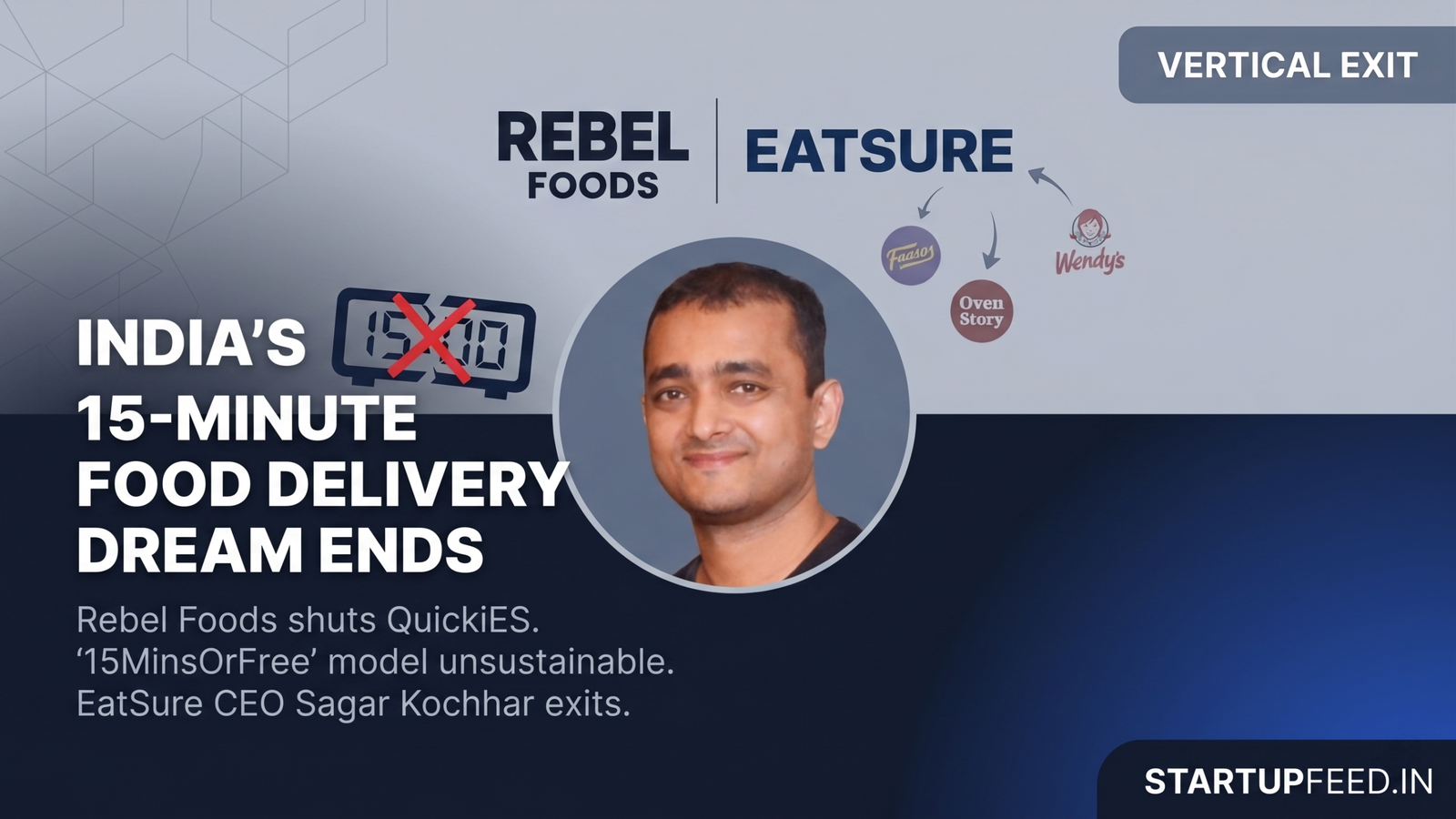
On Valentine’s Day 2025, EatSure cofounder and CEO Sagar Kochhar announced QuickiES on LinkedIn with the tagline “Love at First Bite! Introducing QuickiES – The World’s First 15MinsOrFree Quick Food Delivery App!” The pitch was compelling: restaurant-quality food from 45+ brands including Faasos, Wendy’s, and Oven Story, delivered to your door in under 15 minutes — and if it arrived even one minute late, it was free.
About fourteen months later, QuickiES no longer exists. Rebel Foods shut the vertical quietly in early 2026, with zero public announcement. The shutdown was reported by Inc42. The product page is gone. Kochhar — who built and ran the vertical — exited the company in late 2025. And Rebel Foods, in its typical fashion, declined to comment.
With this exit, India’s 15-minute restaurant food delivery experiment is effectively over at scale. Swiggy had already pulled back its SNACC product. Zomato’s Bistro has recalibrated its positioning. And now Rebel Foods — the company that pioneered the cloud kitchen model in India and should have been, theoretically, the most structurally advantaged player to crack ultra-fast delivery — has made the same call. The dream was real. The economics were not.
| StartupFeed Insight — What the QuickiES Failure Teaches Every Food Tech Founder The core lesson: QuickiES failed not because the product was bad but because the cost architecture of 15-minute food delivery is incompatible with the revenue architecture of food ordering at India’s current price points. The ’15 minutes or free’ guarantee was both QuickiES’s marketing genius and its economic undoing — every failed delivery was not just a customer satisfaction issue, it was a direct P&L event. In a category where margins are already thin, a free order penalty model requires near-perfect operational execution that dark store-based food delivery simply cannot guarantee consistently. The three structural problems that killed 15-minute food delivery for hot meals:
Our prediction: The category will not die — it will narrow. Blinkit Bistro will continue to serve a small, premium urban segment of consumers who want hot food in under 15 minutes and are willing to pay premium prices for a narrow menu of items that can be genuinely prepared in time. The mass-market 15-minute hot food promise — across 45 brands, at normal food delivery prices — is dead. The premium, narrow-menu, single-brand version will survive as a niche product for Zomato’s top 5% users. |
QuickiES — From Valentine’s Day Launch to Quiet Shutdown
| Timeline | Event |
| February 14, 2025 | EatSure CEO Sagar Kochhar launches QuickiES on LinkedIn — ‘The World’s First 15MinsOrFree Quick Food Delivery App.’ Pilot in select Mumbai pin codes. 45+ brands, cafe snacks (poha, idli, medu vada, Maggi). Marketing blitz: Mumbai hoardings, ASMR videos, influencer campaigns, microsite |
| March–June 2025 | Expansion to select pin codes of a few major cities beyond Mumbai; operational pressure on kitchen readiness and delivery sync begins to show |
| July 2025 | Major leadership reshuffle at Rebel Foods — cofounder Ankush Grover elevated to global CEO; Jaydeep Barman transitions to Chairman and Group CEO. IPO narrative building |
| Late 2025 | Sagar Kochhar (EatSure cofounder and CEO, the driver of QuickiES) exits Rebel Foods — confirmed via LinkedIn profile update |
| Early 2026 | Rebel Foods quietly shuts QuickiES; no public announcement. Standard delivery (25-40 min) continues under EatSure. Operations centralised in Mumbai from Gurugram and Bengaluru offices |
| April 2026 | Inc42 reports the shutdown; Rebel Foods declines to comment |
The Industry Exit Sequence — Everyone Made the Same Call
| Player | Product | What Happened | Current Status |
| Swiggy | SNACC — 10-minute food delivery via Instamart dark stores | Launched to significant buzz in late 2024; dark store infrastructure struggled to maintain consistent hot food quality at 10-minute windows; recalibrated | Scaled back; repositioned as a premium convenience feature rather than a mass-market product |
| Zomato (Blinkit) | Bistro — 10-minute food delivery via Blinkit dark stores | Launched December 2024 as Blinkit’s food delivery entry; narrowed product menu to items with short preparation times; repositioned around reliability over speed | Still operational but with narrowed menu and revised positioning — premium niche vs mass market |
| Zepto | Zepto Cafe — food delivery alongside grocery | Integrated into Zepto’s grocery dark store model; cafe-style items (coffee, snacks) better suited to quick pickup from dark stores than full meals | Operational at lower ambition level than original claims |
| Rebel Foods (QuickiES) | QuickiES — 15-minute food delivery, 15MinsOrFree guarantee, 45+ brands | Launched February 2025; operational across select city pin codes; leadership exit (Sagar Kochhar); quietly shut in early 2026 | Shut. Operations absorbed back into EatSure standard delivery (25-40 min) |
The verdict from the market: Every major food tech player that attempted 15-minute (or 10-minute) hot restaurant food delivery at scale has either shut or significantly scaled back. The single player that has maintained the most aggressive approach — Blinkit Bistro — has done so by narrowing the menu to items with genuinely short preparation times, not by attempting to deliver a 45-brand restaurant experience in 15 minutes.
Why 15-Minute Hot Food Delivery Is Structurally Harder Than Grocery
The quick commerce model works brilliantly for groceries because the core activity is picking and packing pre-packaged items — a process that takes 1-3 minutes and requires only a well-organised dark store. The delivery itself can then be completed in 7-12 minutes in dense urban areas. The total process maps cleanly to a 10-15 minute window.
Hot food is categorically different:
- Cooking is non-negotiable: Unlike grocery picking, cooking cannot be compressed below a certain time. Biryani takes 15+ minutes. Pizza takes 8-12 minutes in a commercial oven. Even simple items like idli require 5-7 minutes of steaming. A 15-minute total delivery window effectively means the food must be 80% cooked before the order is placed — which requires anticipatory production
- Temperature degrades quality: Grocery items tolerate 10-15 minutes of transit without quality degradation. Hot food does not — biryani packed 12 minutes before delivery and then held in a delivery bag arrives at a different quality than biryani packed 2 minutes before handoff
- Multi-brand complexity multiplies failure points: QuickiES offered 45+ brands in a single delivery. A single-brand 15-minute guarantee is achievable with extreme kitchen standardisation (Domino’s, McDonald’s). A 45-brand guarantee means 45 different preparation times, 45 different kitchen workflows, and 45 different quality standards — all of which must resolve simultaneously within the same 15-minute window
- The free penalty is a structural cash drain: Grocery quick commerce can absorb small operational failures (a missing item, a substitution) without a catastrophic P&L event. QuickiES’s ’15 minutes or free’ guarantee converted every operational failure into a full-revenue-loss event. In practice, this meant that rider delay on a Rs 350 biryani order resulted in a Rs 350 loss — pure cash, not just customer dissatisfaction
Rebel Foods — Where It Stands Now
| Metric | Details |
| Founded | 2011 by Jaydeep Barman and Kallol Banerjee — started as delivery-only Faasos |
| Cloud Kitchen Network | 450+ kitchens across 75+ Indian cities; also operating in MENA, Indonesia, and the UK |
| Brand Portfolio | Faasos, Behrouz Biryani, Oven Story Pizza, LunchBox, The Good Bowl, Sweet Truth, Mandarin Oak, Firangi Bake, The Biryani Life, Wendy’s |
| FY25 Net Loss | Rs 336.6 Cr — down 11.5% from Rs 380.3 Cr in FY24 (and down from Rs 656.5 Cr in FY23) |
| FY24 Operating Revenue | Rs 1,420.2 Cr — up 19% YoY |
| Total Funding Raised | $773 Mn |
| Key Investors | KKR, Temasek, Lightbox, Evolvence |
| IPO Status | Eyeing public listing; no confirmed timeline; loss reduction and profitability narrative are the pre-IPO priorities |
| Leadership (Post-QuickiES) | Ankush Grover: Global CEO (elevated July 2025) | Jaydeep Barman: Chairman and Group CEO |
| Post-QuickiES moves | Office consolidation (Mumbai; closed Gurugram + Bengaluru offices); exploring Smoor chocolate stake sale (57%) |
| EatSure evolution | ‘Elite’ loyalty programme upgrade being developed to retain customers who were drawn to QuickiES’s speed; standard delivery remains 25-40 min |
The IPO Lens — Why This Shutdown Makes Perfect Sense Right Now
QuickiES was always more of an experiment than a core business — but the timing of its shutdown is inseparable from Rebel Foods’ IPO preparation. The company has been on an explicit loss-reduction trajectory:
- FY23 net loss: Rs 656.5 Cr
- FY24 net loss: Rs 378 Cr (−42% YoY)
- FY25 net loss: Rs 336.6 Cr (−11.5% YoY)
The trend is positive — but public market investors, as every Indian startup has discovered in 2025-26, are demanding demonstrated operating discipline and a credible profitability path, not just narrowing losses. QuickiES was the opposite of operational discipline — it was a high-cost, high-risk experiment with structural cash-drain mechanics built into its guarantee structure.
The ‘cleaning of the house’ framing used by industry observers is accurate: before Rebel Foods files its DRHP, it needs to present a clean, focused business narrative to public market investors. That narrative is: 450+ cloud kitchens, 10+ iconic brands, Rs 1,400+ Cr revenue, narrowing losses, global presence. QuickiES — with its shutdown, its leadership exit, and its unresolved unit economics — was a distraction from that narrative. Removing it strengthens the IPO story.
What’s Next — The Cloud Kitchen Core
Rebel Foods’ strategic clarity post-QuickiES: focus on what has always worked — owning multiple high-margin brands and manufacturing them at scale from shared kitchens. The cloud kitchen model, pioneered in India by Rebel Foods starting with Faasos in 2011, remains the most capital-efficient way to build a food brand at scale in India. The brand economics are compelling: no real estate premium, no front-of-house staff, shared kitchen infrastructure, and the ability to shut underperforming brands without closing a physical restaurant.
- EatSure consolidation: The platform returns to its ‘food court on an app’ core value proposition — multi-brand ordering, reliable 25-40 min delivery, the EatSure Elite loyalty programme as the retention mechanism
- Smoor exit: Rebel Foods is reportedly looking to sell its 57% stake in premium chocolate brand Smoor — a further de-cluttering of the portfolio to focus exclusively on scalable, delivery-first food brands
- Global operations: MENA, Indonesia, and UK operations continue — the cloud kitchen model has proven exportable, and international operations are part of the IPO growth narrative
- IPO: Still targeted for 2026; the loss reduction from Rs 656.5 Cr in FY23 to Rs 336.6 Cr in FY25 tells the right story for public market investors; FY26 results will be the final input before a DRHP filing decision
What do you think? Was QuickiES a mistake from the beginning — or the right experiment at the wrong time? Tell us on X @StartupFeed_news


Liked this story? Follow StartupFeed on Google so our reporting reaches you first.