
Quick Take
- DPIIT issued operational guidelines for the Rs 10,000 Cr ($1.04 Bn) Startup India FoF 2.0 scheme.
- Money flows through SEBI-registered Category I and II AIFs, with SIDBI as first implementation agency.
- Four segments now split the corpus: deep tech, micro VC, manufacturing and sector-agnostic funds.
In This Article
The Department for Promotion of Industry and Internal Trade (DPIIT) issued operational guidelines for Startup India FoF 2.0 on April 25, 2026, activating a Rs 10,000 Cr ($1.04 Bn) corpus for India’s startup ecosystem.
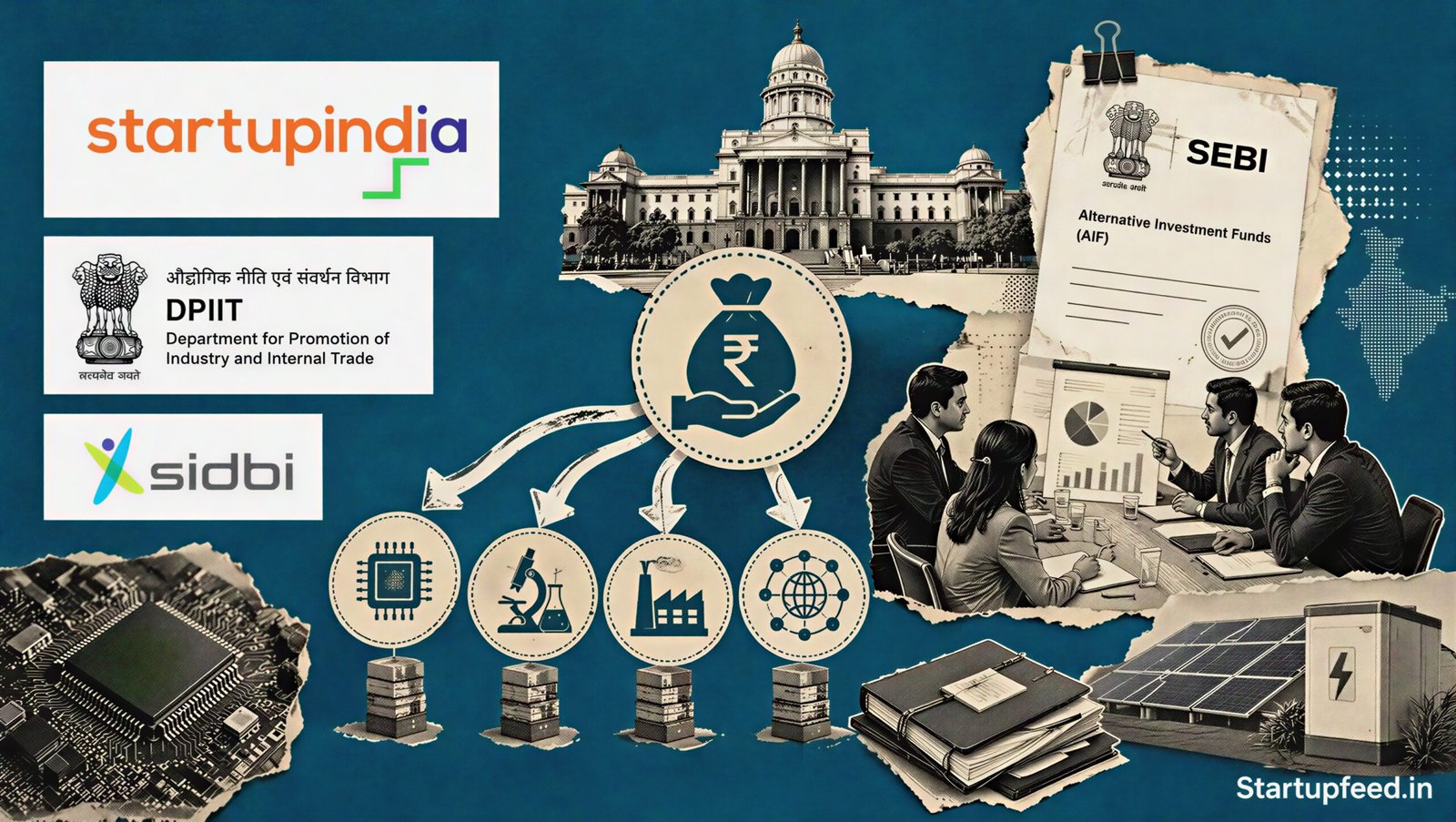
The scheme will not invest in startups directly. Instead, it puts government money into SEBI-registered Category I and Category II Alternative Investment Funds (AIFs). Those funds then back DPIIT-recognised startups. The Small Industries Development Bank of India (SIDBI) acts as the first implementation agency, according to the Ministry of Commerce and Industry announcement.
StartupFeed Insight
The real signal sits in the investment multiplier, not the corpus. DPIIT cut the deep tech multiplier to 1.5X while pushing sector-agnostic funds to 2.5X. That is a deliberate subsidy for hard science, where private capital stays shy and exits take a decade. Micro VCs with corpus under Rs 400 Cr now get a dedicated lane, a first for Indian fund-of-funds policy. Domestic first-time fund managers in tier-2 cities should watch this closely. StartupFeed expects the first FoF 2.0 commitment letters to reach selected AIFs before March 31, 2027. By Soumya Verma.
Startup India FoF 2.0 Scheme Breakdown
Startup India FoF 2.0 carries a Rs 10,000 Cr ($1.04 Bn) corpus spread across the 16th and 17th Finance Commission cycles. The Union Cabinet approved the scheme earlier, and the government notified it on April 13, 2026 (PIB). Operational guidelines followed twelve days later.
| Metric | Detail | Notes |
|---|---|---|
| Total Corpus | Rs 10,000 Cr ($1.04 Bn) | Spread over two Finance Commission cycles |
| Implementation Agency | SIDBI (initial) | A second domestic agency will be added |
| Investment Route | SEBI Category I and II AIFs | No direct investment in startups |
| Government Cap Per AIF | Rs 500 Cr maximum | Deep tech segment ceiling, 40% of AIF corpus |
| Operating Cost Cap | 0.50% per annum | Charged on commitments, debited half-yearly |
| Guidelines Date | April 25, 2026 | Notification issued April 13, 2026 |
One clause deserves attention. Total government contribution across all central and state fund-of-funds schemes cannot exceed 50% of any single AIF corpus (DPIIT guidelines). The Venture Capital Investment Committee can set a lower ceiling based on market conditions.
About Startup India FoF 2.0
Startup India FoF 2.0 is a government fund-of-funds scheme launched in 2026 by DPIIT under the Ministry of Commerce and Industry, headquartered in New Delhi. It commits capital to SEBI-registered AIFs rather than startups directly. The corpus stands at Rs 10,000 Cr. SIDBI runs execution. It succeeds FFS 1.0, launched in 2016 under the Startup India Action Plan.



How will DPIIT split the Rs 10,000 Cr corpus?
The Startup India FoF 2.0 guidelines divide eligible AIFs into four priority segments, each with its own rules. Deep tech funds face no corpus cap and can run for up to 18 years. Micro VCs qualify only if their corpus stays at or below Rs 400 Cr, and they must commit at least half their money to seed and early-stage cheques of up to Rs 10 Cr per startup (DPIIT guidelines).
The Scheme will be implemented through commitments to SEBI-registered Category I and II Alternative Investment Funds, which will invest in DPIIT-recognised startups, the Ministry of Commerce and Industry said in its release.
Manufacturing funds must name at least one champion sector in their placement memorandum. Deep tech funds must cite the new definition from Gazette Notification G.S.R. 108(E) dated February 4, 2026. The full segment table sits in Annexure-I of the official DPIIT operational guidelines document.
How will AIFs get selected under the scheme?
Startup India FoF 2.0 uses a two-stage selection process. SIDBI first seeks proposals and runs due diligence. A Venture Capital Investment Committee (VCIC) then screens each fund on team track record, management capability and investment strategy. Shortlisted proposals move to a sub-committee of the SIDBI board for sanction, followed by a Letter of Intent and a Contribution Agreement.
The VCIC panel includes Vallabh Bhansali, Dr. Ashok Jhunjhunwala, Dr. Renu Swarup, Dr. Chintan Vaishnav and Rajesh Gopinathan, alongside agency representatives (PIB). An Empowered Committee chaired by the DPIIT Secretary will review performance at least twice a year. Independent third-party evaluation is mandated every five years.
How does FoF 2.0 compare with FFS 1.0?
The predecessor scheme sets a demanding benchmark. FFS 1.0 committed more than Rs 7,000 Cr to over 135 AIFs, which in turn invested above Rs 26,900 Cr across more than 1,420 startups as of March 2026 (Startup India portal).
| Feature | FFS 1.0 (2016) | FoF 2.0 (2026) |
|---|---|---|
| Corpus | Rs 10,000 Cr | Rs 10,000 Cr |
| Investment Multiplier | Flat 2X | 1.5X to 2.5X by segment |
| Segmentation | Sector agnostic | Four defined segments |
What separates the two schemes is targeting. FFS 1.0 pushed capital broadly. The new framework routes returns back to the Consolidated Fund of India, minus up to 5% earmarked for mentorship and shared infrastructure.
What’s Next
SIDBI will now invite AIF proposals and begin due diligence. DPIIT plans to onboard a second implementation agency, a step that could widen sectoral reach. Watch for the first Contribution Agreements and the identity of that second agency over the coming quarters. India crossed 2.35 lakh DPIIT-recognised startups in FY26. Will segment-wise targeting finally fix the slow drawdown problem that dogged FFS 1.0?



Frequently Asked Questions
Have a tip? Write to us at editorial@startupfeed.in.
Liked this story? Follow StartupFeed on Google so our reporting reaches you first.