
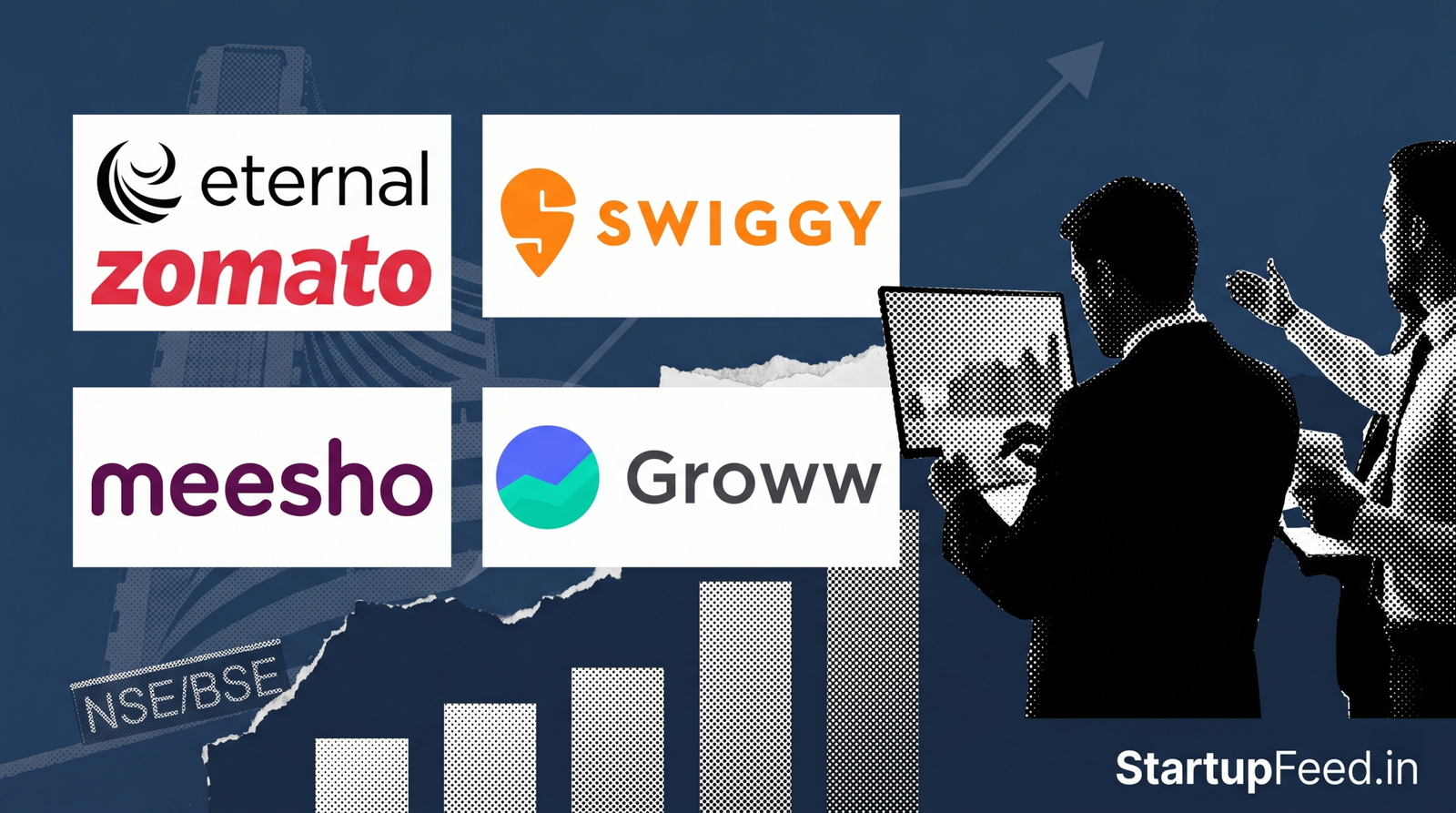
Quick Take
- 60+ Indian new-age tech companies are now listed on BSE and NSE with a combined market cap of $148 Bn as of April 25, 2026.
- 18 startups listed in 2025 — the highest in a single year — followed by 5 more already in 2026: Aye Finance, Fractal Analytics, Amagi, Shadowfax, and SEDEMAC.
- Profitable listed companies gained a median +31% since listing; loss-making ones fell a median -42% — a 73-percentage-point profitability premium.
India Listed New-Age Tech companies have crossed a landmark milestone: as of April 25, 2026, more than 60 Indian startups are listed on domestic bourses with a combined market capitalisation exceeding $148 Bn — up from $101 Bn at the end of 2024 and $40.6 Bn at the end of 2023. While enterprise tech dominates new-age tech IPOs with 12 listings so far, ecommerce and fintech account for 11 listings each. Five more are in active progression: Aye Finance, Fractal Analytics, Amagi, Shadowfax, and SEDEMAC have already made their public market debut in 2026.
The data tells a story of structural maturation — but also of sharply diverging outcomes between the profitable and the loss-making. Indian public market investors have now had five years to form a clear view of new-age tech companies, and their verdict is unambiguous: profitability is priced in at a premium, losses are penalised at scale. The median stock price gain for profitable listed new-age tech companies since their listing stands at +31%. The median loss for loss-making listed companies since listing is -42%. That 73-percentage-point spread is the single most important data point in this entire tracker.
StartupFeed Insight
The $148 Bn cumulative market cap of India’s listed new-age tech sector is a number worth contextualising carefully. India’s unicorn ecosystem is valued at approximately $297 Bn in aggregate. That means the publicly listed portion of the new-age tech sector represents roughly 50% of the total private unicorn value — but across only 60 companies, many of which are loss-making. The implication for the 23-plus startups filing DRHPs for 2026-27 is direct: the market has absorbed its first five years of new-age tech listings and has a clear pricing framework. Profitable companies with demonstrated cash flow — PhonePe, Zepto (if EBITDA-positive at filing), and potentially Flipkart — will get premium valuations.
How Did India Listed New-Age Tech Reach $148 Bn in Market Cap?
The journey from first listing to $148 Bn took roughly five years and required three distinct phases. The first phase — 2021 to 2022 — was a boom-and-bust. Zomato, Paytm, Nykaa, PB Fintech, and others listed at premium valuations driven by global liquidity and FOMO. The 11 Indian new-age tech stocks at the end of 2021 together shed over $30 Bn in total market capitalisation in 2022 as interest rates rose and the post-pandemic growth premium evaporated. The lesson the market learned was that revenue growth without a path to profitability would not sustain public market valuations.
The second phase — 2023 to 2024 — was a recovery and recalibration. Companies that demonstrated improving unit economics and eventual profitability were re-rated sharply upward. Zomato, which saw its valuation plummet by 60% to $6 Bn in 2022, staged a remarkable recovery in 2023. By posting profits in consecutive quarters from March to September 2024, Zomato further gained investor confidence. Its market capitalisation surged to $31.7 Bn by the end of 2024 from $12 Bn at the end of 2023. In parallel, 13 new startups listed in 2024, taking the cumulative count to 32 companies and the total market cap past the $101 Bn mark.
The third phase — 2025 to present — is the maturation wave. 2025 was the biggest year yet for startup IPOs, with 18 companies making their market debut including Meesho, Ather Energy, Urban Company, Lenskart, Groww, Pine Labs, and PhysicsWallah. The market absorbed all 18 with differentiated enthusiasm: companies with demonstrated profitability listed at premiums and maintained them; companies still burning cash listed at discounts or saw post-listing corrections. The cumulative market cap grew from $101 Bn to $148 Bn in under 18 months — a +47% jump reflecting both new listings and appreciation in existing stocks.



India Listed New-Age Tech: Sector and Geography Breakdown
| Sector | Number of Listings | Notable Companies | Profitability Profile |
|---|---|---|---|
| Enterprise Tech | 12 (leads all sectors) | Whatfix, Amagi, Fractal Analytics, RateGain, Zaggle | Mixed — SaaS companies tend toward profitability; newer listings still loss-making |
| Ecommerce | 11 (tied with fintech) | Meesho, Nykaa, FirstCry, Mamaearth, BlueStone, Lenskart | Nykaa and Mamaearth profitable; Meesho near-breakeven; others varied |
| Fintech | 11 (tied with ecommerce) | Paytm, PB Fintech, Groww, MobiKwik, Zaggle, Fino, Aye Finance | PB Fintech and Groww profitable; Paytm recovering; MobiKwik loss-making |
| Foodtech / Quick Commerce | 2 | Eternal (Zomato), Swiggy | Eternal profitable (FY25 PAT Rs 551 Cr); Swiggy loss-making (Rs 3,117 Cr FY25 loss) |
| Logistics | 5 | Delhivery, Shadowfax, Porter, Ecom Express, Xpressbees | Mostly loss-making or marginally positive; Delhivery improving |
| EV / Cleantech | 2 | Ola Electric, Ather Energy | Both loss-making; Ather FY25 loss Rs 1,060 Cr; Ola FY25 loss Rs 2,276 Cr |
| Edtech | 3 | PhysicsWallah, Simplilearn (acq.), Vedantu | PhysicsWallah profitable at listing; Vedantu not listed yet |
| Travel Tech | 3 | EaseMyTrip, Yatra, MapmyIndia | EaseMyTrip profitable; Yatra loss-making; MapmyIndia profitable |
| City / Region | Key Listed Companies | Market Cap Contribution |
|---|---|---|
| Gurugram | Eternal (Zomato), Delhivery, Lenskart, PB Fintech, IndiGrid | Largest single-city contributor — anchored by Eternal’s ~$30 Bn market cap |
| Delhi | Awfis, EaseMyTrip, MapmyIndia, E2E Networks | Moderate contribution — primarily SaaS and travel-tech |
| Noida | Paytm, IndiQube, Info Edge, PhysicsWallah | Significant — Paytm’s recovery and Info Edge’s scale contribute meaningfully |
| Delhi NCR Total | 13+ listed companies | $81.7 Bn — 55%+ of total $148 Bn sector market cap |
| Bengaluru | Nykaa (HQ moved), Swiggy, Ather Energy, Urban Company, Groww | Large contributor — but best companies (Flipkart, Zepto, CRED, Razorpay) not yet listed |
| Mumbai | Mamaearth, BlueStone, Shadowfax | Growing — D2C and beauty brands anchoring Mumbai’s new-age tech presence |
Delhi NCR contributes $81.7 Bn in the cumulative $148 Bn market cap of new-age tech companies — over 55% of the entire sector’s listed value. This is driven overwhelmingly by Eternal (Zomato’s parent company), which alone commands a market cap near $30 Bn and is one of India’s ten most valuable listed companies by any measure.
What Are the Notable 2025 and 2026 Listings?
The 2025 vintage was the richest in Indian startup listing history by both number and quality. Among the 18 companies that went public, the standouts were:
Meesho — social commerce platform, valued at approximately Rs 53,000 Cr (~$6 Bn) at IPO, making it one of the largest new-age tech listings of the year. Revenue Rs 9,900 Cr in FY25. Groww — investing platform, $5 Bn valuation at listing, profitable, backed by Sequoia and Ribbit Capital. Lenskart — eyewear D2C brand, ~$8 Bn valuation, posted FY25 PAT of Rs 297 Cr, listing at profitability was a significant signal. Ather Energy — EV maker, high-profile but loss-making; FY25 net loss of Rs 1,060 Cr weighed on post-listing performance. PhysicsWallah — edtech profitable at listing, rare among peers. Urban Company and Pine Labs also completed listings in the 2025 cohort.
The five 2026 listings so far present a varied picture. Amagi Media Labs listed in 2026, debuting at a market cap of Rs 7,544 Cr, now trading at Rs 8,162 Cr — a +8% gain since listing. Its current stock price of Rs 377 represents a +19% gain over its listing price of Rs 318. Revenue for FY25 was Rs 1,163 Cr, with a net loss of Rs 69 Cr. Fractal Analytics and Shadowfax represent the B2B AI and logistics ends of the 2026 cohort respectively.
The Profitability Verdict: What Public Markets Are Telling Founders
The 73-percentage-point spread between profitable and loss-making company stock performance is the most important signal for every pre-IPO startup in India. It has concrete implications for how founders should think about their IPO timing and pricing.
| Company | FY25 PAT / Loss | Stock Performance Since Listing | Investor Verdict |
|---|---|---|---|
| Eternal (Zomato) | PAT Rs 551 Cr | +180%+ from listing (2021 low to 2024-25 peak) | Rewarded — multi-year re-rating on profitability turn |
| PB Fintech | Profitable (FY25) | +160% YoY in 2024 alone | Rewarded — consistent bottom-line improvement |
| Groww | Profitable | Strong post-listing performance | Rewarded — listed with proof of profitability |
| Swiggy | Loss Rs 3,117 Cr | Market cap eroded ~$2 Bn post-listing | Penalised — largest net loss in FY25 among listed new-age tech |
| Ola Electric | Loss Rs 2,276 Cr | Volatile; up from listing initially, then corrected | Mixed — category excitement offset by loss scale |
| Ather Energy | Loss Rs 1,060 Cr | Underperformed relative to listing price | Penalised — EV losses without near-term profitability path |
| Paytm | Recovering post-RBI action | +80% from 2023 low; still below 2021 IPO price | Mixed — regulatory shock then partial recovery |
The median stock price increase for profitable companies has been 31% since their listing, while the loss-making ones have witnessed a decline of 42%. The cumulative loss of listed new-age tech companies for FY25 stood at Rs 7,542.3 Cr ($877 Mn), while the total profit stood at Rs 5,326 Cr ($619 Mn). The sector is net loss-making in aggregate in FY25 — but the trend is improving, and the profitable cohort is growing.
What’s Coming in the India Listed New-Age Tech Pipeline?
The next wave — 23-plus companies with active DRHP filings or confirmed IPO plans — will be the most consequential cohort in the tracker’s history. Currently, nearly 15 startups including Zepto, Shiprocket, and OYO are in various stages of their IPO journey. Adding Flipkart, PhonePe, and Zetwerk to the pipeline, the next three years could add $100-150 Bn in listed market cap to the tracker — potentially doubling the sector’s current total.

The profitability data above means each of these companies will be priced and received differently. Zepto — EBITDA-positive on 60%+ of its dark stores, Rs 11,000 Cr IPO target at $7-8 Bn valuation — will likely be received more warmly than OYO, which is still working toward consistent operating profitability. PhonePe — free cash flow positive, Rs 7,115 Cr FY25 revenue, Rs 630 Cr adjusted net profit — may command the strongest listing premium of the 2026-27 cohort if it files before market sentiment shifts.
What’s Next
Watch the Inc42 tracker update cadence — it refreshes with current market cap and stock price data periodically. The two metrics that matter most for the next six months are: (1) whether the FY26 full-year results, due from listed companies by July-August 2026, show a narrowing of the aggregate loss figure toward Rs 4,000-5,000 Cr or below, and (2) how Zepto’s SEBI observation letter and grey market premium develop ahead of its July-September 2026 listing window. Zepto’s listing will serve as the pricing benchmark for every new-age tech IPO that follows in 2026 and into 2027. Will the India listed new-age tech sector reach $200 Bn in cumulative market cap before the end of FY27
Frequently Asked Questions
How many Indian new-age tech companies are listed on stock exchanges in 2026?
As of April 25, 2026, more than 60 India Listed New-Age Tech companies trade on BSE and NSE, with a combined market capitalisation exceeding $148 Bn. This figure has grown from $101 Bn at the end of 2024 and $40.6 Bn at the end of 2023. The 2025 cohort — the largest single year with 18 IPOs, including Meesho, Groww, Lenskart, Ather Energy, Urban Company, Pine Labs, and PhysicsWallah — drove the biggest single-year addition to the tracker. Five more companies listed in the first four months of 2026: Aye Finance, Fractal Analytics, Amagi, Shadowfax, and SEDEMAC.
Which Indian new-age tech company has the highest market cap in 2026?
Eternal — formerly Zomato, which rebranded its holding company name in 2025 — is the highest-valued India Listed New-Age Tech company by market capitalisation as of April 2026, with a market cap approaching $30-31 Bn. It is also one of the ten most valuable listed companies in India across all sectors. Eternal reported a net profit of Rs 551 Cr in FY25, making it one of the few large new-age tech companies to achieve annual profitability, which has been the primary driver of its multi-year stock re-rating from the 2022 lows.
Do profitable Indian new-age tech companies perform better on the stock market?
Yes — significantly so. India’s public market data shows that profitable new-age tech companies have gained a median +31% in stock price since their listing, while loss-making ones have declined a median -42% — a 73-percentage-point spread. The FY25 aggregate data shows listed new-age tech companies recorded a cumulative net loss of Rs 7,542 Cr ($877 Mn) and a cumulative profit of Rs 5,326 Cr ($619 Mn). The sector is net loss-making, but the profitable cohort — Eternal, PB Fintech, Groww, Lenskart, PhysicsWallah — has consistently outperformed the broader benchmark since listing.
Disclaimer: This article is for informational purposes only and does not constitute investment advice. StartupFeed and its authors are not SEBI-registered investment advisors. The analysis above is based on publicly available information and should not be the sole basis for any investment decision. Please consult a SEBI-registered financial advisor before making investment decisions.
Written by Dr. Mayank Raj. Published: May 2, 2026. Updated: May 2, 2026. Have a tip? Write to us at editorial@startupfeed.in.
Liked this story? Follow StartupFeed on Google so our reporting reaches you first.