
Quick Take
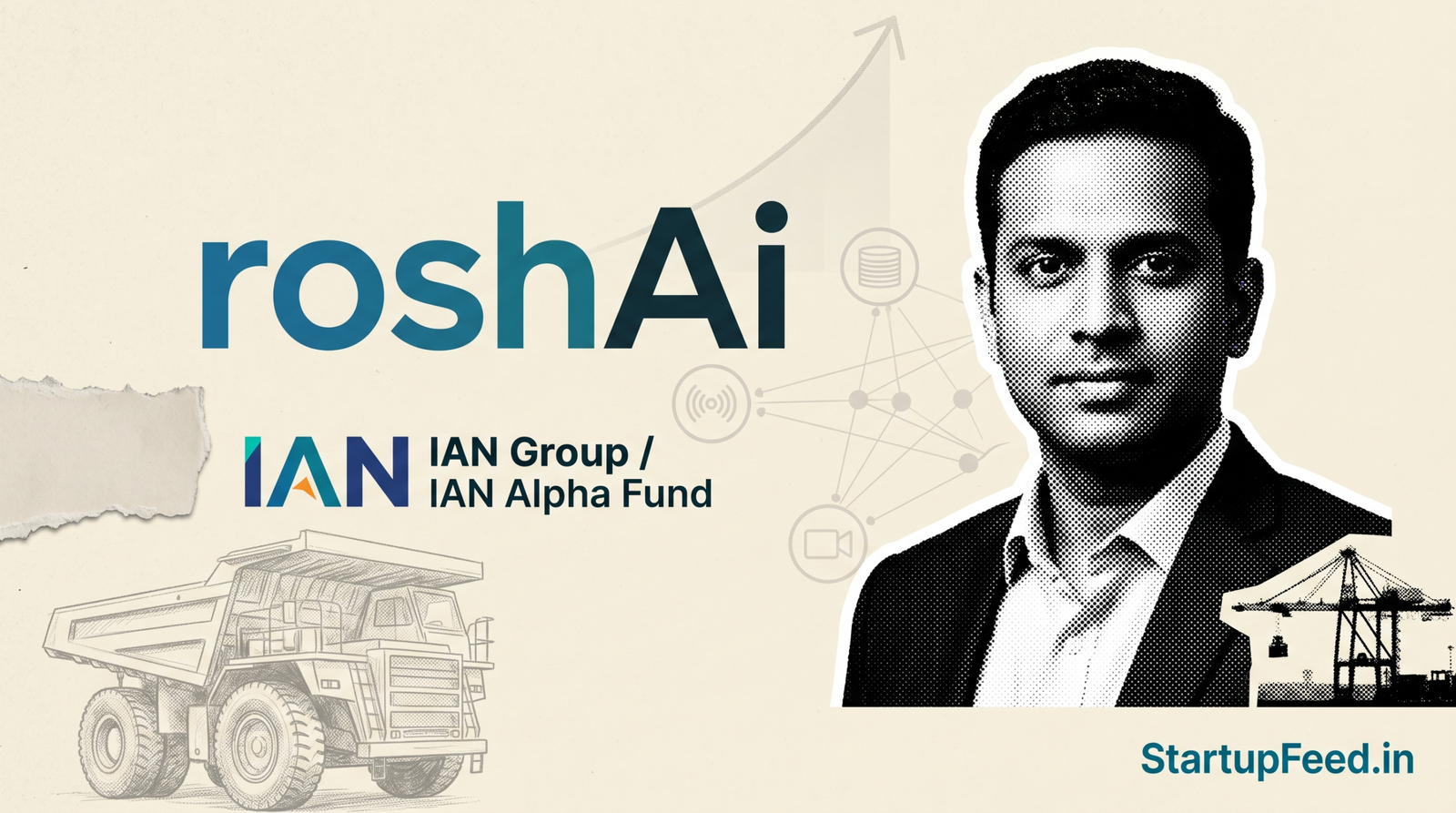
- RoshAi Raises Rs 22 Cr ($2.36 Mn) led by IAN Alpha Fund to scale Level 4 retrofit autonomy for industrial vehicles.
- The Kochi startup’s AI platform has been tested over 1 lakh km with zero safety incidents across ports and mining sites.
- RoshAi targets Rs 50 Cr operating revenue in FY27, a 3X jump from Rs 15 Cr generated in FY26.
RoshAi Raises Rs 22 Cr ($2.36 Mn) in a new funding round led by IAN Alpha Fund — the second VC fund in IAN Group’s series — as the Kochi-based deep-tech autonomy startup scales its retrofit-based driverless solutions for industrial vehicles operating in ports, mining sites, airports, and logistics hubs. The investment will support the company in strengthening its product, expanding deployments, and scaling its presence across global industrial markets. With this round, RoshAi’s total funding rises to approximately $4.07 Mn, including a prior seed round of $1.71 Mn from Ev2 Ventures, Caret Capital, and ThinKuvate.
Founded in 2021 by Dr. Roshy John and Rajaram Moorthy, RoshAi builds what it calls an “Android-for-autonomy” platform — a retrofit hardware and AI software stack that enables any existing industrial vehicle to operate at Level 4 autonomy without requiring operators to buy new fleets. The company generated Rs 15 Cr in operating revenue in FY26 and is targeting Rs 50 Cr in FY27, a trajectory that would represent a 3X jump in a single financial year.
StartupFeed Insight
RoshAi’s retrofit-first model is the correct answer to the real adoption barrier in industrial autonomy — and most Western competitors have missed it. The assumption baked into most autonomous vehicle programmes is that adoption requires new, purpose-built vehicles. That assumption fails in ports, mines, and industrial yards for a straightforward reason: operators have fleets of 5-year-old or 10-year-old heavy trucks that are fully depreciated and mechanically sound. Asking them to replace Rs 40-80 lakh vehicles with new autonomous ones has a capital payback period of 7-10 years. Asking them to retrofit their existing fleet for a fraction of that cost — while getting 80% of the safety and efficiency benefit.
RoshAi Raises Rs 22 Cr: Deal Breakdown
| Metric | Detail | Notes |
|---|---|---|
| Total Raise (This Round) | Rs 22 Cr ($2.36 Mn) | April 2026 |
| Lead Investor | IAN Alpha Fund (IAN Group) | IAN Group is India’s largest early-stage investment platform |
| Previous Round | $1.71 Mn seed round (2024) | Led by Ev2 Ventures, Caret Capital; ThinKuvate also participated |
| Total Funding to Date | ~$4.07 Mn across 3 rounds | Includes current round |
| Use of Funds | Product development, global expansion (US, Australia, SE Asia), team hiring, working capital | 9-12 months runway |
| FY26 Revenue | Rs 15 Cr | Operating revenue |
| FY27 Revenue Target | Rs 50 Cr | 3X YoY growth target |
| Team Size | 42 employees (as of Feb 2026) | Hiring planned post-round |
Sarika Saxena, Managing Partner of IAN Alpha Fund, said: “RoshAi is solving industrial autonomy through a retrofit-first approach, enabling operators to upgrade existing fleets rather than invest in new infrastructure. With strong early validation, repeat customer engagement, and a scalable autonomy platform, the company is well-positioned to build a globally relevant deep-tech business from India.”
About RoshAi
RoshAi is a Kochi-based deep-tech autonomy company founded in 2021 by Dr. Roshy John (CEO) and Rajaram Moorthy. The company builds retrofit-based driverless solutions for commercial vehicles operating in confined industrial environments — enabling existing heavy vehicles in ports, mining sites, airports, and logistics hubs to operate autonomously without requiring new fleet investments. Its platform combines an AI-powered autonomy stack, retrofit hardware kits, and a 5G-powered cloud fleet management system. The company is registered in Delaware, USA, with its primary R&D base in Infopark, Ernakulam, Kerala. Investors include IAN Alpha Fund, Ev2 Ventures, Caret Capital, ThinKuvate, and Kerala Angel Network. The company has 42 employees and a growing patent portfolio in autonomous mobility.
How Does RoshAi’s Technology Actually Work?
RoshAi’s platform has three integrated layers. The first is the retrofit autonomy kit — a vehicle-agnostic hardware stack that converts any existing industrial vehicle into an autonomous one. The system features a modular, retrofit-ready software and hardware stack enabling Level 4 autonomous driving for trucks, buses, and passenger cars, with end-to-end ML-driven decision-making, real-time perception, planning, and control, adaptable to both ICE and EV platforms. Level 4 autonomy means the vehicle can handle all driving tasks without human intervention — the human operator is fully removed from the loop for defined operational domains.
The second layer is the perception intelligence framework. An AI-powered vision and sensor fusion framework for industrial-grade perception integrates vision, LiDAR, radar, and polarized light with an ML pipeline for detection, classification, and decision-making — scalable from edge to cloud. The system is trained on data from controlled industrial environments, but critically, it also incorporates Indian-specific real-world chaos: stray animals and cattle, pedestrians cutting across vehicle paths, potholes, and uneven terrain that global autonomy datasets rarely include.
The third layer is the cloud-based fleet management platform. A 5G-powered fleet management system integrates real-time data from autonomous vehicles for predictive maintenance, route optimisation, and monitoring, with AI-driven diagnostics, real-time tracking, and scalability for fleets of all sizes. This SaaS layer generates recurring revenue on top of the one-time retrofit hardware sale — a dual-revenue model that the company describes as “Android-for-autonomy,” where the software stack is licensed to OEMs and fleet operators while hardware enables deployment.
Why Ports and Mining? The Industrial Autonomy Market Opportunity
The global industrial autonomous vehicles market is expanding rapidly, projected to grow from $47.6 billion in 2024 to $162.8 billion by 2030. Ports and mining sites are the most compelling initial beachhead for three structural reasons. First, they are geographically contained — a port is a defined perimeter, a mine is a defined zone. Unlike public roads, there are no unexpected pedestrians, no traffic signals, and no highway merges. The regulatory and safety complexity is an order of magnitude lower than on-road autonomy.
Second, the labour economics are severe. Port and mining operations in India run 24/7 across multiple shifts. Driver fatigue, human error, and high turnover create a safety and productivity problem that port operators and mining companies are actively willing to pay to solve. Third, India-specific: most traction for autonomous vehicles in India is concentrated in controlled environments such as ports, mining sites, and warehouses — making RoshAi’s focus precisely aligned with where Indian demand exists today, not where it is theoretically expected to be in five years.
How Does RoshAi Compare to Indian and Global Competitors?
| Company | Base | Focus | Model | Key Differentiator |
|---|---|---|---|---|
| RoshAi | Kochi, India | Ports, mining, logistics (industrial) | Retrofit hardware + AI SaaS + fleet mgmt | Retrofit-first; India-trained AI; 1 lakh km zero incidents |
| Minus Zero | Bengaluru, India | On-road passenger mobility | Purpose-built autonomous vehicle platform | India-specific on-road autonomy; raised $1.7 Mn seed |
| Ati Motors | Bengaluru, India | Factory and warehouse AMRs | Purpose-built ground robots | Material handling robots for manufacturing floors |
| Swaayatt Robots | IIT Bhopal, India | On-road autonomous vehicles | AI-based perception for chaotic Indian roads | Research-to-product, academic origin; unstructured road focus |
| Flo Mobility | India | Last-mile logistics | Autonomous delivery vehicles | Urban last-mile; lighter vehicle class than RoshAi |
| Mobileye (Intel) | Israel / Global | On-road ADAS and autonomy | Chip + software for OEM integration | Scale — 50 Mn vehicles; on-road focus; no India industrial focus |
RoshAi’s direct Indian competitors in the industrial autonomy segment are limited. Ati Motors focuses on lighter AMRs inside factories — not the heavy truck class RoshAi targets. Minus Zero and Swaayatt Robots are both on-road focused. RoshAi effectively has India’s industrial autonomous vehicles segment largely to itself at meaningful traction — which is both an opportunity and a validation risk: the market needs to develop alongside the company.
What Are RoshAi’s Global Expansion Plans?
RoshAi plans to expand into markets such as the United States, Australia, and Southeast Asia, where demand for industrial automation and driverless solutions is growing steadily. These three geographies are a considered strategic choice. Australia has the world’s most advanced autonomous mining operations — Rio Tinto and BHP both run fully autonomous haul truck fleets — making it a large, mature, paying customer base for retrofit solutions on their older vehicle cohorts. The United States is the largest single market and the highest-value sales target. Southeast Asia — particularly Indonesia and Malaysia, both major mining producers — offers volume.
The challenge of international expansion from India is go-to-market, not technology. IAN Alpha Fund continues to back deep-tech startups building practical and scalable solutions for real-world challenges, focused on supporting companies that solve problems from India, for India and the world. IAN’s network in the US through its Indo-American partner ecosystem is one of the clearest value-adds of this specific investor for RoshAi’s global ambition.
What’s Next
The Rs 50 Cr FY27 revenue target is RoshAi’s most important near-term milestone — and the data point that will determine whether the company files for a Series A at a meaningful valuation or needs to extend its runway. Watch for two signals over the next six months: the announcement of at least one Tier 1 Indian port operator deployment at scale (Adani Ports, JNPA, or DP World India would each represent a reference customer worth Rs 10-15 Cr), and the first international pilot — most likely in Australia, given its mature autonomous mining market.
Frequently Asked Questions
What does RoshAi do and how much has it raised?
RoshAi Raises Rs 22 Cr ($2.36 Mn) led by IAN Alpha Fund to scale its retrofit-based Level 4 autonomy platform for industrial vehicles. The Kochi-based deep-tech startup, founded in 2021 by Dr. Roshy John and Rajaram Moorthy, enables existing trucks, buses, and heavy vehicles operating in ports, mining sites, and logistics hubs to run driverlessly without requiring new fleet investments. Its total funding stands at approximately $4.07 Mn across three rounds. The company targets Rs 50 Cr in FY27 operating revenue, up from Rs 15 Cr in FY26.
What is RoshAi’s “Android-for-autonomy” model?
RoshAi’s “Android-for-autonomy” model means its AI software stack — including the autonomy operating system, perception intelligence, and fleet management platform — is licensed to original equipment manufacturers (OEMs) and fleet operators, while retrofit hardware kits are used to upgrade existing vehicles. This mirrors Android’s strategy of running on multiple hardware devices at lower cost than purpose-built alternatives. The result is a dual-revenue stream: a one-time hardware retrofit sale plus a recurring SaaS fee for the cloud-based fleet management and autonomy software layer.
What sectors does RoshAi target and who are its competitors in India?
RoshAi targets industrial autonomous vehicle applications in sea ports, mining sites, airports, and logistics yards — confined, regulated environments where Level 4 autonomy is technically feasible today. In India, its closest competitors in adjacent segments include Minus Zero (on-road mobility), Ati Motors (factory AMRs), Swaayatt Robots (on-road AI), and Flo Mobility (last-mile delivery). No Indian company is currently competing directly in the same industrial heavy-vehicle retrofit autonomy segment at comparable traction. Globally, RoshAi competes against established players like Mobileye, Cruise, and Black Sesame Technologies, though these firms primarily target on-road or consumer mobility markets.
Written by Dr. Mayank Raj. Published: May 2, 2026. Updated: May 2, 2026. Have a tip? Write to us at editorial@startupfeed.in.
Liked this story? Follow StartupFeed on Google so our reporting reaches you first.