


Quick Take
- India-made electric car exports jumped 14 times to 15,641 units in Q1 FY27 (April to June 2026).
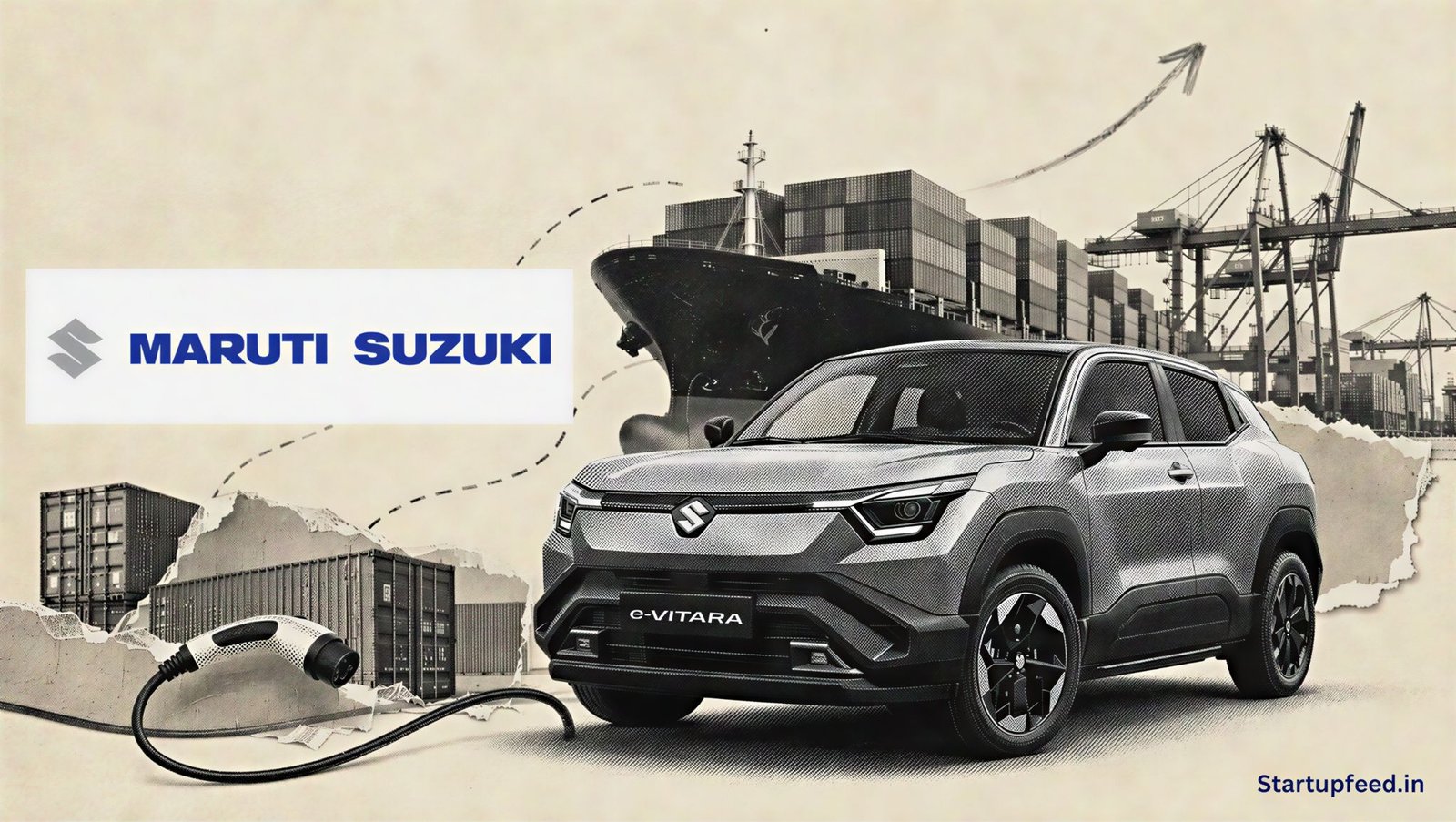
- Maruti Suzuki e-Vitara led with 15,210 units shipped to 67 countries, over half of total EV exports.
- The UK was the top export destination, followed by South Africa, as pricey fuel lifts green mobility abroad.
In This Article
India EV exports jumped 14 times to 15,641 units in the first quarter of FY27 (April to June 2026), up from just 1,122 units a year earlier, according to SIAM data. The Maruti Suzuki e-Vitara drove almost the entire surge.
The sharp rise marks a turning point for India as a global maker of electric cars, not just a buyer. Higher fuel prices abroad, worsened by the US-Iran war, pushed overseas buyers toward cheaper electric options. India-made electric SUVs are now filling that gap in Europe, Africa and beyond, shipped mainly from Gujarat’s Pipavav and Mundra ports.
StartupFeed Insight
One number tells the real story: the e-Vitara reached 67 countries this quarter, up from 29 in calendar 2025. That speed of market entry, not the unit count, is what should worry rival exporters. Maruti built a single global production hub at Hansalpur and is filling ships before domestic launch even scales. Watch Tata Motors and Mahindra here, both strong at home but thin on exports. StartupFeed expects India’s quarterly EV exports to cross 40,000 units by Q4 FY27 (January to March 2027) as e-Vitara volumes climb toward Maruti’s 50,000 to 100,000 annual target. By Avinash.
India EV Exports: The Q1 FY27 Numbers
India EV exports reached 15,641 units in Q1 FY27, a 14-times rise over the 1,122 units shipped in the same quarter last year, per SIAM industry data. This accounted for more than half of the 28,652 electric cars India exported in all of FY26. The bulk left from Gujarat, home to Maruti Suzuki’s export-focused plants.
| Metric | Detail | Notes |
|---|---|---|
| Q1 FY27 EV exports | 15,641 units | Up 14x YoY |
| Year-ago figure | 1,122 units | Q1 FY26 |
| e-Vitara exports | 15,210 units | To 67 countries |
| Full-year FY26 EV exports | 28,652 units | Q1 FY27 tops half of this |
| Top destination | United Kingdom | South Africa second |
The standout figure is the gap between old and new. A base of 1,122 units means the e-Vitara alone rewrote India’s electric export map in under a year. Full segment data sits with the Society of Indian Automobile Manufacturers (SIAM), the industry body that tracks these shipments.
About Maruti Suzuki India
Maruti Suzuki India, founded in 1981 and headquartered in New Delhi, is India’s largest carmaker and a subsidiary of Japan’s Suzuki Motor Corporation. It builds and sells passenger vehicles, spare parts and offers car financing. The company exports 18 models to nearly 100 countries and holds about 47% of India’s total car exports, its highest-ever share.


Why did India EV exports surge 14 times?
India EV exports surged because higher fuel prices worldwide, pushed up by the US-Iran war, made cheaper electric cars more attractive to overseas buyers. SIAM linked the wider export gain to strong demand from Latin America plus rising orders from Europe and Japan. India’s cost edge in manufacturing did the rest.
The made-in-India Maruti e-Vitara will be exported to more than 100 countries, including Japan, Prime Minister Narendra Modi said while flagging off the first shipment from the Hansalpur plant in Gujarat.
The strategy is clear. Global carmakers such as Suzuki now place India at the centre of their electric plans. Suzuki has committed Rs 67,478 Cr to expand its Indian capacity to four million units by 2031. That scale lets India ship electric SUVs at prices Europe struggles to match locally, turning a cost story into an export engine.
How did the Maruti e-Vitara lead the charge?
The Maruti e-Vitara led India EV exports by shipping 15,210 units to 67 countries in Q1 FY27, up from 29 countries in calendar 2025. Built only at the Hansalpur factory in Gujarat, the electric SUV serves Europe, Africa, Japan and India from a single global hub. Exports began in August 2025.
Maruti chairman R C Bhargava has said between 50,000 and 100,000 e-Vitaras will ship every year. The Hansalpur plant currently makes up to 750,000 vehicles a year across three lines, with a planned ceiling of one million units. Full model details sit on the Maruti Suzuki official website. The e-Vitara offers 49kWh and 61kWh battery packs, with the larger option rated for over 500 km of range.
Where do rival carmakers stand?
India EV exports remain a near one-company story so far, but rivals lead the home market. Tata Motors and Mahindra & Mahindra dominate domestic electric sales, yet neither matches Maruti’s export scale on electric cars. The table below shows the split between home strength and overseas reach.
| Carmaker | Domestic EV share, Q1 FY27 | EV export focus |
|---|---|---|
| Maruti Suzuki | Smaller domestic share | Leads exports, 67 countries |
| Tata Motors | 39% (32,283 units) | Home-focused |
| Mahindra & Mahindra | 24.3% (20,112 units) | Home-focused |
What sets Maruti apart is its head start on overseas scale. While Tata and Mahindra fight for domestic buyers, Maruti built a plant designed to export first, giving it a structural lead that will be hard to close quickly.
What’s Next
Maruti Suzuki targets 50,000 to 100,000 e-Vitara exports a year, so quarterly numbers should climb through FY27 as new markets open. The UK and South Africa now anchor demand, with Europe and Japan set to add volume. Suzuki’s Rs 67,478 Cr capacity plan runs to 2031. Can any Indian rival build an export machine to match it before then?



Frequently Asked Questions
Frequently Asked Questions
Written by Avinash. Have a tip? Write to us at editorial@startupfeed.in.