
Quick Take
- India’s Economic Survey 2025-26 flagged digital addiction as a public health risk for 970 million users.
- The global wellness app market is projected to reach $34.2 Bn by 2033, growing at 15.1% CAGR.
- Australia, France, China, Karnataka, and Andhra Pradesh now restrict minors’ screen time by law.
The brain fog crisis is no longer a wellness trend. It is a measurable public health problem that governments are now writing into economic policy documents and startups are turning into billion-dollar markets.
India’s Economic Survey 2025-26, tabled in Parliament in January 2026, called digital addiction a threat to academic performance, workplace productivity, and social capital. It noted that internet connections in India jumped from 250 million in 2014 to 970 million in 2024. The question is no longer about access. It is about what constant digital stimulation does to human brains at that scale.
StartupFeed Insight
The brain fog crisis sits at the intersection of public health policy and consumer tech. That makes it rare and valuable territory for startups. Governments are creating demand through regulation (social media bans, gaming time limits, digital wellness curricula), and startups are building the supply (focus apps, AI therapy tools, screen-time managers). The wellness apps market is growing at 15.1% CAGR (Compound Annual Growth Rate, the average yearly growth rate over a period). Watch for Indian startups like Wysa and Amaha to raise larger rounds by Q1 FY28 as corporate wellness budgets shift from physical fitness perks to cognitive health tools. The category winner will be whoever makes “dopamine management” feel as routine as step-counting, by StartupFeed Desk.
What Is the Brain Fog Crisis?
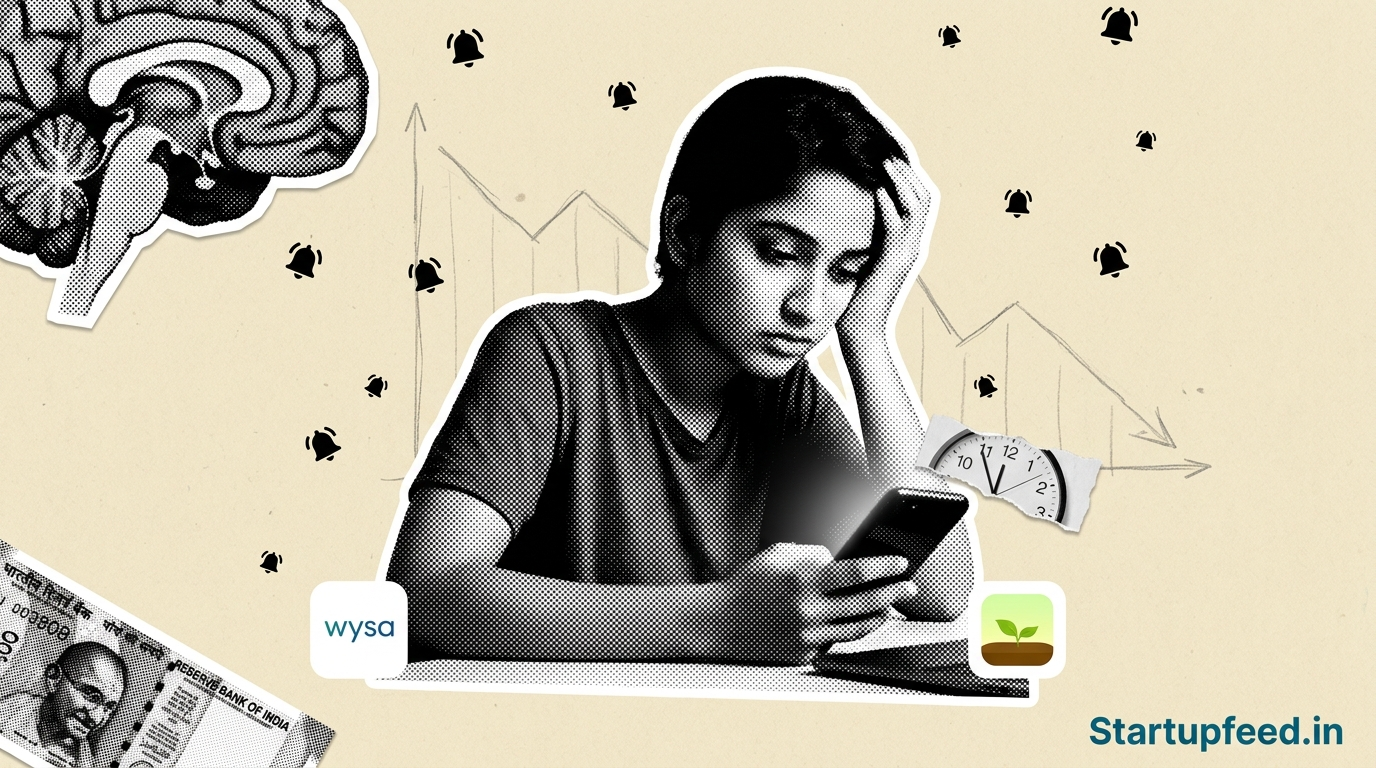
Dopamine (the brain’s reward chemical) drives motivation and pleasure. Every notification, like, and scroll triggers a small dopamine release. Over time, the brain adapts. It needs more stimulation to feel the same reward. Scientists call this “dopamine resistance.” The result is brain fog: difficulty focusing, mental fatigue, poor memory, and a constant craving for digital stimulation.
The numbers tell the story. The average human attention span has dropped from 12 seconds in 2000 to roughly 8 seconds by 2013. Microsoft’s 2025 Work Trend Index found that employees face interruptions every 2 minutes during core work hours. That adds up to about 275 interruptions per day. Around 80% of workers said they lack the time or energy to do their jobs well.
In India, the problem is acute. Indians spent an estimated 1 lakh crore hours on smartphones in 2024, according to data cited in the Economic Survey. About 85.5% of Indian households owned at least one smartphone in 2025. Average monthly data consumption stood at 36 GB per person.

How Are Governments Responding to the Brain Fog Crisis?
Governments across the world are no longer treating screen addiction as a personal choice. They are writing it into law.
Australia became the first country to ban social media for users under 16 in December 2025. France followed with an under-15 ban. China has limited minors to one hour of online gaming on Fridays, Saturdays, and Sundays since 2021. However, enforcement has been uneven. A Chinese survey found that 77% of minors used other people’s identities to bypass the rules.
India’s Multi-Pronged Response
India is taking a layered approach. The Economic Survey 2025-26 recommended age-based access limits, simpler digital devices for children, phone-free zones, and a Digital Wellness Curriculum in schools. Several states have moved faster than the central government.
Karnataka announced a social media ban for children under 16 in its 2026-27 state budget. Chief Minister Siddaramaiah framed it as a preventive health measure. Andhra Pradesh announced restrictions for children under 13 within a 90-day timeframe. Maharashtra formed a task force. Goa and Kerala are also examining options.
At the national level, India’s Tele-MANAS (Tele Mental Health Assistance and Networking Across States) helpline has handled over 32 lakh calls since its launch in October 2022. NIMHANS in Bengaluru runs the SHUT (Service for Healthy Use of Technology) Clinic for technology addiction in adolescents. The Online Gaming (Regulation) Act, 2025, banned real-money wagering games and restricted addictive game design.
Which Startups Are Fighting Dopamine Resistance?
While governments regulate, startups are building tools. The global wellness apps market stood at $14.71 Bn in 2026, according to Coherent Market Insights. It is projected to reach $34.20 Bn by 2033 at a 15.1% CAGR. The digital mental health market, a subset, is expected to grow from $27.55 Bn in 2025 to $58.67 Bn by 2030.
Two categories of startups dominate: focus tools and therapy platforms.

| Company | Category | Key Metric | Origin |
|---|---|---|---|
| Opal | Screen-time blocker | $10 Mn ARR (Annual Recurring Revenue) with just 11 employees | US (2020) |
| Forest (Seekrtech) | Gamified focus timer | 48 Mn downloads, 2 Mn+ paying users, 2 Mn+ real trees planted | Taiwan (2014) |
| Calm | Meditation and sleep | $300 Mn annual revenue, 4.5 Mn paying subscribers | US (2012) |
| Wysa | AI therapy | $20 Mn raised, FDA Breakthrough Device designation | India (2016) |
| Amaha | Hybrid therapy platform | Rs 22.76 Cr FY24 revenue | India (2016) |
| YourDOST | Online counselling | Rs 19.46 Cr FY24 revenue, 204 competitors tracked | India (2014) |
Opal is the clearest example of the business opportunity in dopamine resistance. The company hit $10 Mn in ARR with just 11 people. Forest gamified the problem differently. Users plant a virtual tree when they start a focus session. If they leave the app, the tree dies. The app has been downloaded 48 million times. Its partnership with Trees for the Future has resulted in over 2 million real trees being planted by users.
India’s Homegrown Players
India’s digital mental health startups are still early-stage but growing fast. Wysa, built in India and marketed globally, uses AI (Artificial Intelligence) to guide users through CBT (Cognitive Behavioral Therapy, a structured approach to changing unhelpful thought patterns) exercises. It raised $20 Mn in 2022 from HealthQuad and British International Investment. In February 2026, Wellcome awarded Wysa a £5.3 Mn grant to adapt its platform for adolescent girls in rural India.
Amaha (formerly InnerHour), founded by psychiatrist Dr. Amit Malik, combines online therapy with in-person care. YourDOST, one of the earliest Indian platforms (founded 2014), focuses on emotional wellness for students and working professionals. Five of India’s top ten mental health startups are based in Bengaluru.
Why Should Founders and Investors Care?
The brain fog crisis creates a rare alignment. Government regulation pushes demand. Consumer awareness pulls it. Corporate budgets fund it. Fewer than 8% of connected adults globally used any structured screen-time management tool as of 2025, according to DataIntelo. That gap is the market.
India’s specific position is even more interesting. The country has 970 million internet users, most of them young. It has a government actively pushing digital wellness policy. And it has a startup ecosystem (Wysa, Amaha, YourDOST) already building in the category. The missing piece is scale capital. Most Indian digital wellness startups are still pre-Series B.
What’s Next
Three trends to watch. First, India’s central government is considering a nationwide social media age limit, possibly 16, following the Australia model. A private member’s bill is already in Parliament. Second, corporate wellness budgets in India are expected to shift toward cognitive health tools over the next 12 to 18 months, creating a B2B channel for startups like Wysa and YourDOST. Third, the focus app category (Opal, Forest) will likely see its first $100 Mn revenue player by 2028. Will it be global or Indian? That depends on who moves first.
Frequently Asked Questions
What is the brain fog crisis and why does it matter?
The brain fog crisis refers to a growing pattern of cognitive symptoms (poor focus, mental fatigue, weak memory) linked to excessive screen time and dopamine overstimulation. India’s Economic Survey 2025-26 flagged it as a public health risk. The country’s 970 million internet users now face rising rates of digital addiction, reduced attention spans, and lower workplace productivity.
Which startups are building solutions for dopamine resistance?
Several startups target dopamine resistance and digital wellness. Opal ($10 Mn ARR, US) blocks distracting apps. Forest (48 Mn downloads, Taiwan) gamifies focus sessions. Calm ($300 Mn revenue, US) offers meditation and sleep tools. Indian startups Wysa ($20 Mn raised), Amaha, and YourDOST provide AI therapy and online counselling for screen-related mental health issues.
Has India banned social media for children?
India has not yet passed a nationwide social media ban for children. However, Karnataka announced a ban for users under 16 in its March 2026 state budget. Andhra Pradesh plans restrictions for users under 13. A private member’s bill in Parliament proposes an under-16 ban nationally. India’s Digital Personal Data Protection Act, 2023, already requires parental consent for minors’ data.
Liked this story? Follow StartupFeed on Google so our reporting reaches you first.