

Quick Take
- OpenAI launched Codex Micro on July 15, 2026, priced at $230 (Rs 22,262).
- Built with Work Louder, it has 13 mechanical switches, a joystick and a reasoning dial.
- Stock sold out within a day, signalling demand for physical AI agent controls.
In This Article
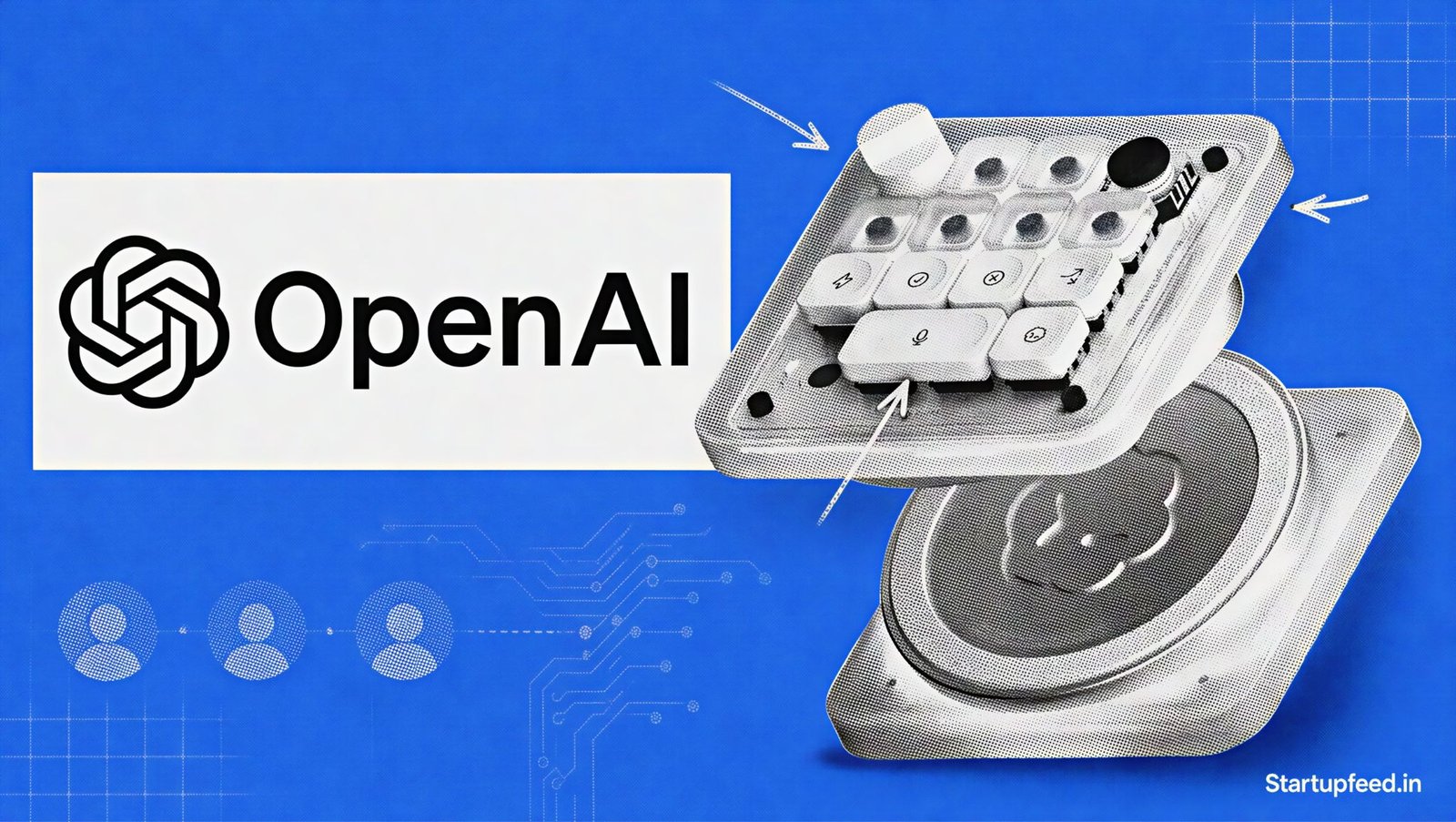
OpenAI launched Codex Micro on July 15, 2026, a $230 (Rs 22,262) desktop control pad built with keyboard maker Work Louder to manage AI coding agents.
The device is OpenAI’s first branded hardware product. It sells through the company’s Supply Co. storefront in limited quantity. OpenAI calls it a command center for agentic work. The listing marked it out of stock within roughly 24 hours of pre-orders opening, according to eWeek.
StartupFeed Insight
The interesting number here is not $230, it is six. Six Agent Keys means OpenAI expects a developer to supervise six parallel agents at once, and that is a workflow claim, not a hardware claim. Indian engineering teams should watch this closely. India crossed 27 million GitHub developers in April 2026 and is projected to reach 57.5 million by 2030, per Microsoft. StartupFeed expects at least two Indian developer tool startups to ship agent supervision dashboards or hardware add-ons by March 2027, because the orchestration layer is now the bottleneck, not code generation. By Avinash.
Codex Micro Specs and Price Breakdown
Codex Micro is a programmable macropad, formally named kbd-1.0-codex-micro, built on Work Louder’s Creator Micro 2 chassis. The full specification comes from OpenAI’s own product listing.
| Metric | Detail | Notes |
|---|---|---|
| Price | $230 (Rs 22,262) | OpenAI product page, at Rs 96.36 per USD |
| Launch Date | July 15, 2026 | Sold via OpenAI Supply Co. |
| Manufacturing Partner | Work Louder | Warranty and support handled by Work Louder |
| Inputs | 13 mechanical switches, 1 touch sensor, 1 rotary encoder, 1 planar joystick | OpenAI spec sheet |
| Connectivity | Bluetooth and USB-C | Works on Mac and Windows |
| Included Keyset | 32 custom icon caps, 11 solid colour caps | Codex Icon Keyset bundled |
The most telling detail is the switch choice. Buyers pick clicky or silent, which suggests OpenAI is targeting shared office desks and not just solo home setups.
About OpenAI and Work Louder
OpenAI, founded in 2015 and headquartered in San Francisco, builds ChatGPT and the Codex agentic coding platform. Work Louder is a boutique keyboard maker known for compact macropads aimed at creators, and it has previously built co-branded units for Figma and Framer. Codex Micro is a Co-Lab product, so Work Louder handles manufacturing, warranty and customer support.



What does Codex Micro actually do?
Codex Micro turns agent supervision into a physical task by putting live status lights and one-tap controls on the desk. Six illuminated Agent Keys carry live RGB feedback from Codex, showing whether a task is thinking, running, waiting for input, or finished, according to OpenAI’s product page.
A rotary dial adjusts the reasoning level for a task in the moment. A planar joystick launches common workflows such as reviewing a PR (Pull Request, a proposed code change), debugging an error, or refactoring code. Command keys map frequent actions including accept, reject, push-to-talk and starting a new chat.
The Agent Keys give you a live view of your Codex threads, with different colours indicating the status of each task, said Mike Di Genova, cofounder, Work Louder.
The device adds no computing power. It removes the mouse and menu hops that pile up when several agents run at once. That is a user interface fix, not a model upgrade.
Why did OpenAI build hardware now?
OpenAI shipped Codex Micro because multi-agent coding has created a supervision problem that software menus handle poorly. The Codex desktop app already runs several agents in parallel across threads, and OpenAI’s Codex user base is approaching 9 million, as reported by The New Stack.
Timing matters here. The launch arrived days after Apple filed a lawsuit accusing OpenAI and io Products of taking trade secrets tied to unreleased Apple hardware, per reporting on the filing. Codex Micro is not the long-rumoured Jony Ive device. It is a limited-run developer accessory sold through a storefront that began life carrying employee merchandise.
Positioning the product as a Co-Lab item lets OpenAI test physical form factors without owning manufacturing, retail or after-sales support.
How does Codex Micro compare to rivals?
Codex Micro sits in a crowded macropad category where the hardware is familiar and only the software integration is new.



| Device | Indicative Price | Key Difference |
|---|---|---|
| Codex Micro | $230 (Rs 22,262) | Native live agent status from Codex, reasoning dial |
| Elgato Stream Deck | Roughly $150 (Rs 14,454) | General macro control, no native agent status feedback |
| Work Louder Creator Micro 2 | Lower than the Codex edition | Same chassis, no Codex icon keyset or branding |
Critics have called it a reskinned Stream Deck, as OC3D noted in its review. A DIY build using an ESP32-based M5Stack Core2 already replicates the agent status workflow at a fraction of the cost, per community documentation. What separates Codex Micro is the first-party integration: the status colours come straight from Codex rather than a third-party script.
What’s Next
Work Louder describes stock as limited quantity, so restocks will decide whether Codex Micro stays a collector item or becomes a real developer tool. Watch for a Windows-side compatibility confirmation and any India shipping option before the end of 2026. OpenAI has not disclosed unit volumes. Would you pay Rs 22,262 for a dedicated agent control pad, or build one yourself for a tenth of that?
Frequently Asked Questions
Written by Avinash. Have a tip? Write to us at editorial@startupfeed.in.
Liked this story? Follow StartupFeed on Google so our reporting reaches you first.