Quick Take
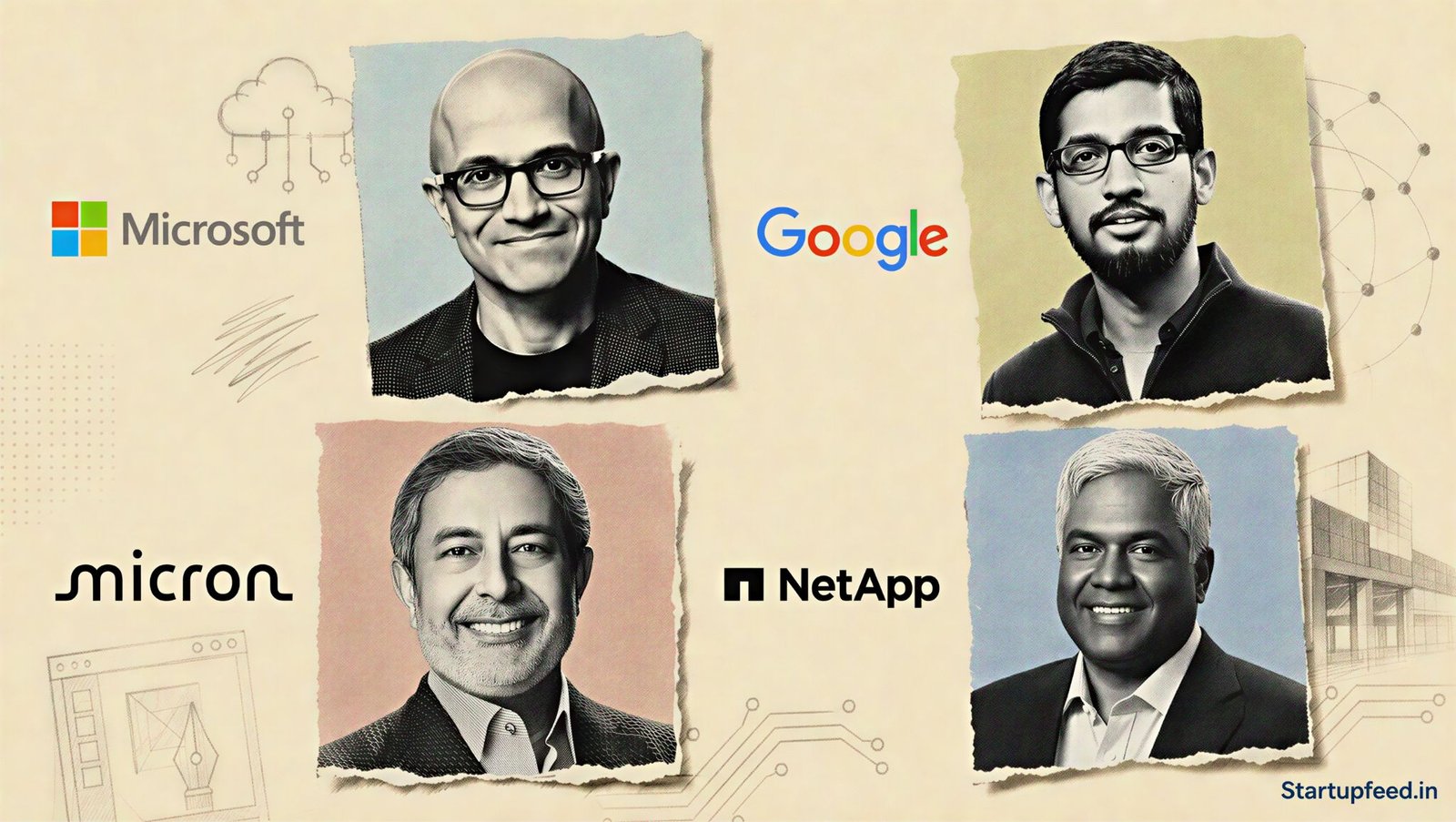
- Indian origin CEOs now lead Microsoft, Alphabet, Adobe, IBM, Palo Alto and, since June 2026, WhatsApp.
- This cohort is about 1.5% of the world yet runs firms worth over $8.5 Tn (Rs 8.14 Lakh Cr Cr combined).
- Kunal Shah of CRED taking WhatsApp marks a new phase: Indian founders, not just career managers, going global.
In This Article
Indian origin CEOs now run a striking share of the world’s biggest technology and consumer firms, and in June 2026 the list grew again when Kunal Shah of CRED took charge of WhatsApp. This is no longer a novelty. It is a settled pattern at the very top of global business.
Roughly 10% of the world’s tech company chief executives trace their roots to India, a country that holds about 1.5% of the global population, according to industry analyses. From Satya Nadella at Microsoft to Sundar Pichai at Alphabet, these leaders now shape products used by billions every single day.
StartupFeed Insight
The old story was the humble Indian engineer climbing a US corporate ladder over 30 years. Kunal Shah rewrites it. A founder who built CRED at home now runs the world’s largest messaging app, and Meta paid $900 Mn (Rs 8,622 Cr) into CRED to make it happen. Watch for two more India-built founders to land global CEO or president roles at $50 Bn-plus firms before December 2027. The pipeline is shifting from managers who were trained in India to builders who proved themselves in India. That is a bigger deal for StartupFeed readers than any single funding round this year. By StartupFeed Desk.
Who Are the Indian Origin CEOs Today?
Indian origin CEOs currently head a remarkable set of global companies across software, hardware, cybersecurity and consumer goods. The roster spans decades of steady promotion inside these firms. Each name below is confirmed as of July 2026.
| Leader | Company | In Role Since |
|---|---|---|
| Satya Nadella | Microsoft | 2014 |
| Sundar Pichai | Alphabet / Google | 2015 / 2019 |
| Shantanu Narayen | Adobe | 2007 |
| Arvind Krishna | IBM | 2020 |
| Sanjay Mehrotra | Micron Technology | 2017 |
| Nikesh Arora | Palo Alto Networks | 2018 |
| Thomas Kurian | Google Cloud | 2019 |
| George Kurian | NetApp | 2015 |
| Leena Nair | Chanel | 2022 |
| Kunal Shah | WhatsApp (Meta) | June 2026 |
The combined market value of the technology firms on this list crosses $8.5 Tn, per an April 2026 analysis, a figure that equals close to 40% of the S&P 500 technology sector. Nadella has held Microsoft steady as a $3.2 Tn giant, while Pichai’s Alphabet has passed $4.2 Tn in value.
About This Trend
The rise of Indian origin CEOs is tracked closely by business schools, diaspora groups and recruiters. It stretches beyond Silicon Valley into consumer goods (P&G’s Shailesh Jejurikar, from January 2026), luxury fashion (Chanel) and global finance (Ajay Banga now heads the World Bank Group after leading Mastercard). The common thread is deep operating experience, long tenures, and a calm, low-ego leadership style noted by observers such as academic Vivek Wadhwa.



Why Do Indian Origin CEOs Succeed Abroad?
Indian origin CEOs succeed through a mix of hard education, cultural adaptability and a US system that rewards merit over background. No single factor explains it. Together they form a strong pipeline that keeps producing top leaders.
The first driver is schooling. Institutions like the Indian Institutes of Technology and the IIMs run on brutal, elimination-style entry exams. Around 3.5 Lakh people sit the CAT each year for roughly 10,000 IIM seats. That pressure builds analytical skill and resilience early.
“No other nation in the world trains so many citizens in such a gladiatorial manner as India does,” said R Gopalakrishnan, former executive director of Tata Sons, in the book The Made-in-India Manager.
The second driver is the United States itself. Forbes has described the rise of these leaders as a reaffirmation of American meritocracy, a system that lets the best talent rise regardless of accent or nationality. The H-1B visa route and STEM study programs brought waves of skilled Indians west from the 1960s onward. The third driver is the network effect: as more Indians reached the top, they mentored the next batch, a point made by many diaspora accounts.
The Kunal Shah Shift
Kunal Shah becoming WhatsApp CEO in June 2026 marks a turning point for Indian origin CEOs, because he is a homegrown founder, not a career manager who climbed a US firm. He built CRED in Bengaluru into a fintech processing more than 40% of India’s credit card bill payments.
His move came alongside a $900 Mn (Rs 8,622 Cr) Series H round in CRED overseen by Meta, valuing the fintech above $4 Bn (Rs 38,320 Cr) and giving Meta a minority stake. Shah succeeds Will Cathcart, who led WhatsApp for over seven years.
“Kunal built CRED into one of India’s most important technology companies, and he brings the kind of builder mentality and global perspective that will serve him well in running the world’s biggest messaging app,” said Meta CEO Mark Zuckerberg, per company statements.
The task ahead is large. WhatsApp has more than three billion users but earns little from commerce and payments. Turning it into a WeChat-style platform is Shah’s core challenge, and his CRED payments background is exactly why Meta picked him.
How India Compares to Other Talent Pools
India leads the world in supplying global tech CEOs, but it is not the only source of immigrant executive talent. A 2020 Boardroom Insiders study found roughly 56 Fortune 500 CEOs were immigrants, drawn from 28 countries, with India providing the single largest group.


| Talent Source | Signature Strength | Example Leader |
|---|---|---|
| India | STEM depth, English fluency, long tenures | Satya Nadella, Microsoft |
| China | Strong domestic tech, fewer US corner offices | Fewer Fortune 500 CEOs |
| Europe | Established, but a smaller immigrant pipeline | Varied |
What sets the Indian cohort apart is the sheer consistency across sectors and the recent jump from managers to founders. No other single origin group currently matches both the breadth and the depth of India’s presence at the top of global business.
What’s Next
The next test is whether India-built founders keep breaking into global corner offices at pace. Watch for another Indian-origin appointment at a $50 Bn-plus firm within the next 18 months, and watch how Shah reshapes WhatsApp commerce through 2027. Will the founder wave prove bigger than the manager wave that came before it?
Frequently Asked Questions
Written by Avinash. Have a tip? Write to us at editorial@startupfeed.in.
Liked this story? Follow StartupFeed on Google so our reporting reaches you first.