

Quick Take
- Indian IT stocks held firm on July 15, 2026, after IBM crashed 25.21% to $217.07 (Rs 20,905) overnight.
- The Nifty IT index dipped only 0.1% to 0.7%, far less than IBM’s 25% single-day fall in the US.
- Analysts credit a strong Q1 show, better earnings and a valuation reset for the sector’s calm reaction.
In This Article
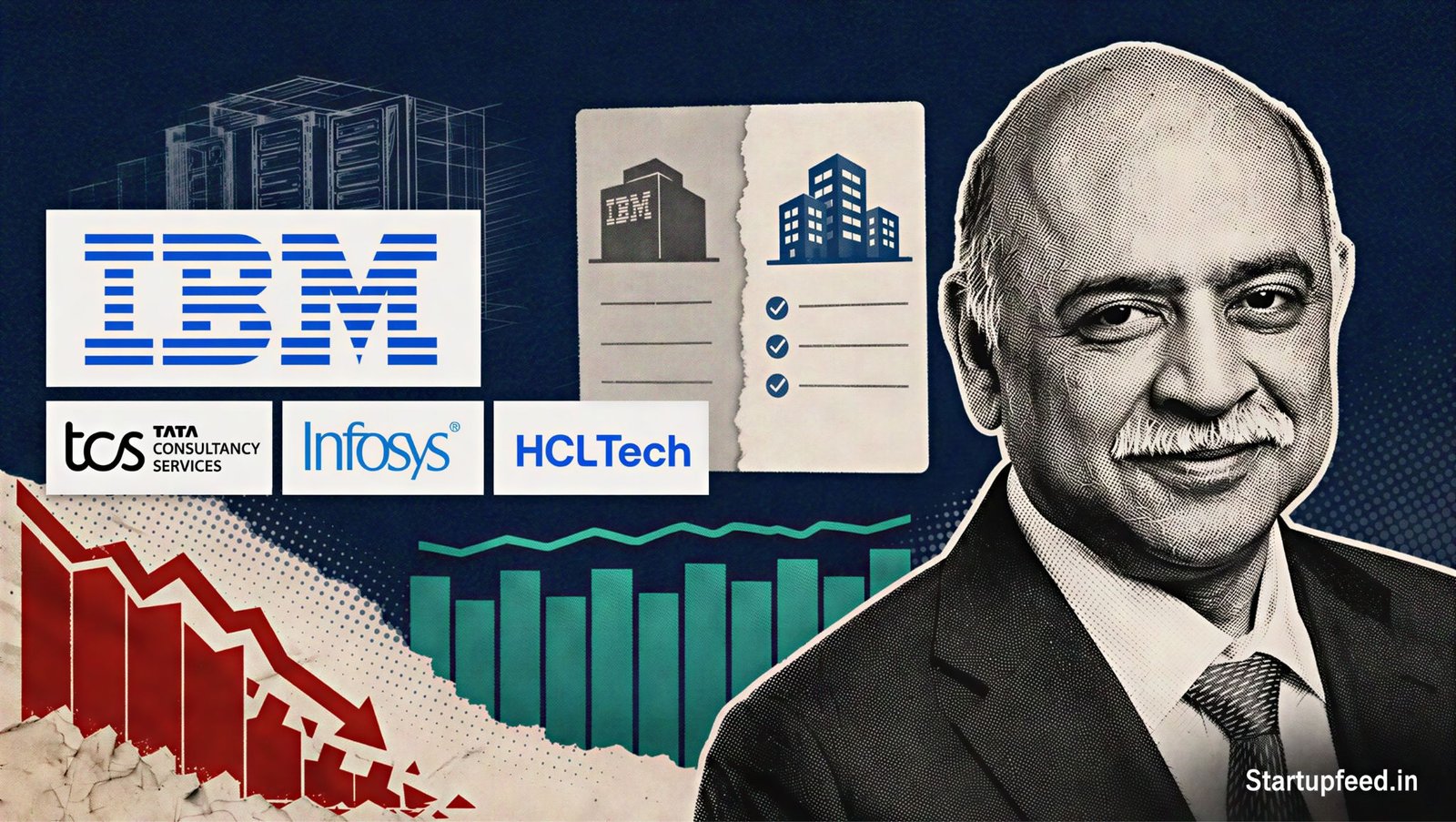
Indian IT stocks shook off a heavy overnight blow on Wednesday, July 15, 2026, after US technology giant IBM crashed 25.21% to $217.07 (Rs 20,905) on weak preliminary quarterly results. The Nifty IT index slipped just 0.1% to 0.7%, a small drop against the scale of the shock.
The muted fall surprised many. Indian IT counters usually track US software sentiment closely, since they earn a large share of revenue from overseas clients. This time, a strong first-quarter earnings season, an earlier valuation reset and reset growth hopes cushioned the blow, according to market analysts.
StartupFeed Insight
The real signal here is not the small dip, it is what the market chose to ignore. IBM’s miss came from mainframe hardware and its software stack, not from the IT services demand that TCS, Infosys and HCL depend on. Investors read that difference correctly, which is why the Nifty IT index barely moved. Anyone tracking Indian IT stocks should watch the June-quarter deal pipelines and FY27 guidance in the next two to three weeks. StartupFeed expects at least two large-cap IT firms to lift or hold full-year revenue guidance by early August 2026, confirming the sector’s defensive strength. By Avinash.
How Indian IT Stocks Held Their Ground
Indian IT stocks fell far less than the overnight US selloff suggested they might. The Nifty IT index traded down 173.60 points, or 0.60%, at 28,551.15 around 9:45 AM, and the broad drop stayed within 0.1% to 0.7% through the session, according to market data. Some counters dipped up to 2% intraday before recovering ground.
The wider market stayed green. The BSE Sensex and the NSE Nifty50 (National Stock Exchange benchmark) both gained around 0.1% to 0.5% on the day, showing that the IBM shock stayed largely boxed inside the technology pack rather than dragging the full market lower.
The IBM Shock in Numbers
IBM’s fall was its worst single-day drop in decades, and the trigger was a preliminary second-quarter update that missed on both revenue and the market’s read of demand. In his letter to IBM investors, CEO Arvind Krishna detailed the shortfall. The table below sets out the key figures.



| Metric | Detail | Notes |
|---|---|---|
| IBM stock move | Down 25.21% to $217.07 (Rs 20,905) | Worst single-day fall in decades |
| Q2 2026 revenue | $17.2 Bn (Rs 1,65,660 Cr), up 1% | Below the $17.9 Bn estimate |
| Operating EPS | $2.93, up 5% | Below the $3.01 estimate |
| Infrastructure revenue | Down 7% | Weak mainframe (Z) and software stack |
| Nifty IT index | Down 0.1% to 0.7% | Far milder than IBM’s US drop |
| Event date | July 15, 2026 | IBM full results due July 22, 2026 |
The most telling number is the gap itself. IBM lost a quarter of its value in one session, yet the Nifty IT index gave up less than 1%, a sign that investors saw IBM’s problem as company-specific rather than sector-wide.
About IBM’s Quarter
IBM (NYSE: IBM) is a US technology firm in software, consulting and infrastructure. In its preliminary second-quarter 2026 update, CEO Arvind Krishna reported revenue of $17.2 Bn (Rs 1,65,660 Cr), up 1%, with software up 5% and infrastructure down 7%. IBM said clients shifted late-June capex toward servers, storage and memory to secure supply-constrained hardware, hitting its mainframe-linked software sales.
Why Did Indian IT Stocks Stay Calm?
Indian IT stocks stayed calm because the market judged IBM’s weakness to be about its own products, not about outsourcing demand. IBM’s shortfall sat in mainframe hardware and the software tied to it, a segment with little overlap with the services work that Indian firms sell.
“IBM’s weak results aren’t directly correlated to Indian IT services, as the company saw a de-growth in the infrastructure segment after a period of high growth,” said George Thomas, Fund Manager, Equity, at Quantum AMC. He added the segment is more comparable to Indian IT firms, which is relatively limited.
The point matters because it separates a hardware cycle from a services cycle. Devarsh Vakil, Head of Prime Research at HDFC Securities, said Indian IT stocks were relatively resilient, as much of the sector’s weakness had already been priced in, with sector valuations correcting sharply from around 30 times to below 17 times one-year-forward earnings over the past few months.
How Do the Big IT Names Compare?
Indian IT majors moved in a tight band on the day, with Infosys, Persistent Systems and TCS leading the mild losses. The comparison below shows early-trade moves reported by market data.
| Company | Early-Trade Move | Note |
|---|---|---|
| TCS | Down about 2.5% to Rs 2,144 | Also traded ex-dividend that day |
| Infosys | Down nearly 2% | ADR fell 3.91% in US trade |
| HCLTech, Tech Mahindra | Down around 2% | Recovered part of losses intraday |
| Wipro | Down more than 1% | June-quarter results due July 16, 2026 |
What sets the Indian pack apart is timing. These firms had already re-rated lower and were entering their own Q1 FY27 results season with better numbers, so the IBM shock met a sector that had cheapened rather than one priced for perfection.
What’s Next
The near-term test comes fast. Wipro reports June-quarter results on July 16, 2026, and IBM releases full second-quarter numbers on July 22, 2026. Together they will show whether IBM’s miss was a one-firm hardware issue or an early demand warning. Management commentary on deal pipelines and FY27 spending will set the tone. Will strong guidance keep Indian IT stocks in the green through earnings season?


Frequently Asked Questions
Disclaimer: This article is for informational purposes only and does not constitute investment advice. StartupFeed and its authors are not SEBI-registered investment advisors. The analysis above is based on publicly available information and should not be the sole basis for any investment decision. Please consult a SEBI-registered financial advisor before making investment decisions.
Have a tip? Write to us at editorial@startupfeed.in.