
Quick Take
- Myntra founder Mukesh Bansal wrote Skyroot’s first cheque, $756K (Rs 7.3 Cr), in July 2018.
- He still holds close to 6% of Skyroot, a stake valued above Rs 600 Cr today.
- Total return nears 60x on Rs 12 Cr invested, after Rs 100 Cr in partial exits already booked.
In This Article
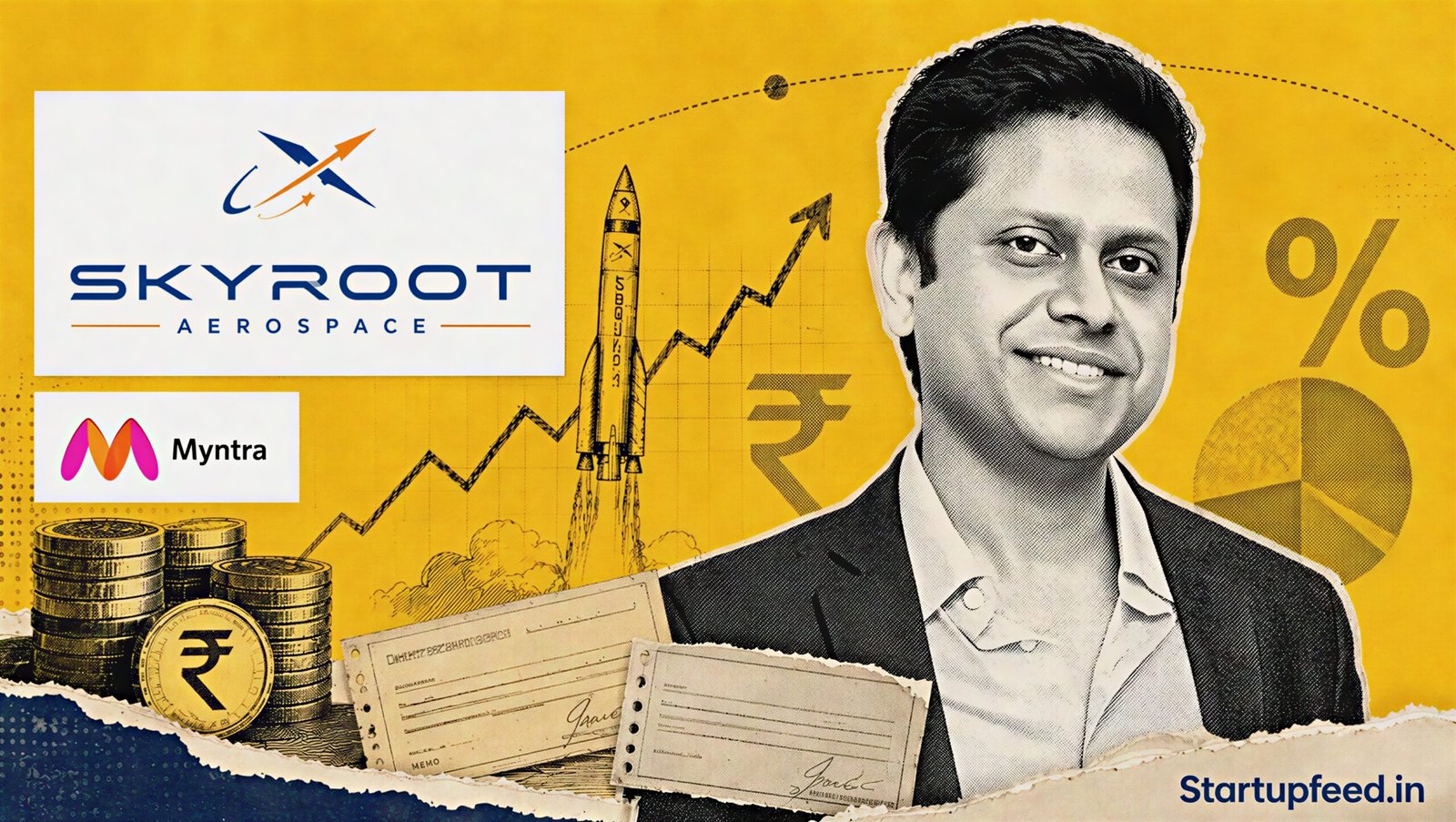
Mukesh Bansal Skyroot holdings now sit near 6% of India’s first space-tech unicorn, a stake worth over Rs 600 Cr after he first invested $756K (Rs 7.3 Cr) in July 2018, according to Tracxn data.
The Myntra and Cultfit founder wrote Skyroot’s earliest cheque when the Hyderabad company was two ex-ISRO (Indian Space Research Organisation) engineers in a small Kondapur office. On July 18, 2026, that bet paid off publicly when Skyroot’s Vikram-1 rocket reached a 450-kilometre orbit, per the company’s own mission update.
StartupFeed Insight
The number that matters is not the 60x, it is the 6%. Angel investors almost never hold that much of a Series C company, because eight years of institutional rounds normally crush early cheques down to 1% or less. Bansal kept his position by re-investing in Series A, both Series B rounds, and beyond, treating pro-rata rights as the actual asset. Indian family offices weighing deep-tech should study this specific mechanic, not the headline return. StartupFeed expects at least three more consumer-internet founders to run identical follow-on strategies in Indian space and defence startups before March 2027. By Soumya Verma.
The Mukesh Bansal Skyroot Stake, By The Numbers
Bansal invested across three separate early rounds between July 2018 and June 2020, totalling over Rs 12 Cr, Tracxn reported. For nearly two years he was Skyroot’s only outside backer.
| Metric | Detail | Notes |
|---|---|---|
| First cheque | $756K (Rs 7.3 Cr), July 2018 | Angel round, company valued under Rs 5 Cr (Tracxn) |
| Second cheque | $747K (Rs 7.2 Cr), April 2019 | Follow-on, still sole outside investor |
| Seed round led | $369K (Rs 3.6 Cr), June 2020 | Brought in Vedanshu and two co-investors |
| Current stake | Close to 6% | Valued above Rs 600 Cr (Tracxn) |
| Partial exits booked | Over Rs 100 Cr | Secondary sales across later rounds |
| Skyroot valuation | $1.1 Bn (Rs 10,600 Cr) | Post May 2026 Series C, per Tracxn |
Total angel capital deployed was Rs 12 Cr. Combined value of exits plus the remaining stake sits near Rs 700 Cr, close to a 60x return over eight years.
About Skyroot Aerospace
Skyroot Aerospace builds orbital launch vehicles for small satellite missions. Former ISRO scientists Pawan Kumar Chandana and Naga Bharath Daka founded it in June 2018 in Hyderabad, Telangana. The company sells dedicated launch slots to satellite operators. It has raised $160 Mn (Rs 1,540 Cr) to date and employs over 1,000 people, per the official Skyroot company profile. Backers include GIC, Temasek, Sherpalo Ventures and BlackRock-managed funds.



Why did a fashion founder back a rocket company?
Bansal had no deep-tech track record when he funded Skyroot in 2018. His wealth came from Myntra in fashion e-commerce and Cultfit in fitness, sectors with nothing in common with rocket propulsion. India had not yet opened space to private firms, so the two founders were legally barred from launching anything.
I’ve believed in the Skyroot team since the early days, and that conviction has only deepened as the team marches forward to the launchpad with Vikram-1, India’s first private orbital-class rocket, Mukesh Bansal said in May 2026.
The founders had quit ISRO after reading a draft of India’s Space Activities Bill in 2017. Their bet was that policy would follow. Finance Minister Nirmala Sitharaman liberalised the sector in May 2020, and IN-SPACe was created that June. Bansal now sits on Skyroot’s board alongside Chandana, Daka and GIC’s Mayank Rawat.
How does Skyroot compare with rival launch startups?
Skyroot is the only Indian launch company to reach orbit. Its Vikram-1 flight made India the third country where a private firm, not a state agency, has placed payloads in orbit, after the United States and China.
| Company | Valuation | Orbital status |
|---|---|---|
| Skyroot | $1.1 Bn (Rs 10,600 Cr) | Orbit reached, July 18, 2026 |
| Agnikul Cosmos | Undisclosed, pre-unicorn | Sub-orbital test flight only |
| Pixxel | Undisclosed, pre-unicorn | Satellites, not a launch provider |
Skyroot separates itself on cadence. Its Infinity Campus, inaugurated by Prime Minister Narendra Modi in November 2025, is designed to build one orbital rocket every month.
What’s Next
Skyroot has said Mission Aagaman was a test flight and that it will fly a few more before routine commercial operations begin. The Series C proceeds fund Vikram-2, a heavier cryogenic-stage vehicle. Watch the second Vikram-1 flight, expected within twelve months, for the cadence proof that justifies a Rs 10,600 Cr valuation. Full mission updates run on the Skyroot newsroom. Would you have written that first cheque in 2018?
Frequently Asked Questions
Have a tip? Write to us at editorial@startupfeed.in.


Liked this story? Follow StartupFeed on Google so our reporting reaches you first.