Quick Take
- SEMICON India 2026 closed on September 19, 2026 with 15 announcements from its final session.
- Three student teams shared Rs 60 lakh for products built on India’s SHAKTI and VEGA chips.
- An EY-ISEA report tips India’s chip market to grow from about $64 billion in 2026 to $200 billion by 2035.
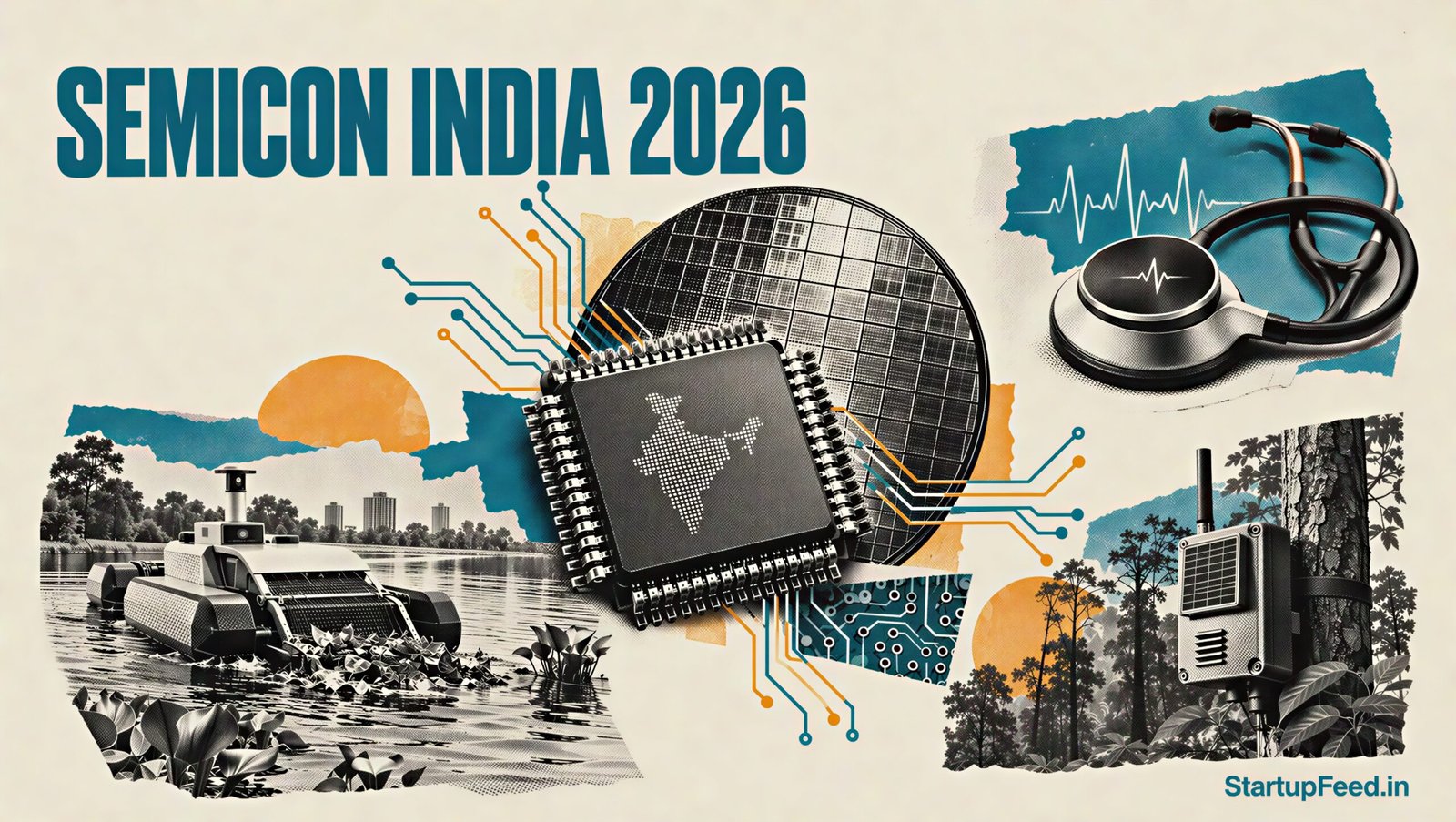
SEMICON India 2026 ended in New Delhi on September 19, 2026 with a closing session that carried 15 announcements. The Ministry of Electronics and Information Technology said the day ran on startups and student teams building on home-grown chips.
The fifth edition ran from September 17 to 19 at the Yashobhoomi convention centre. It was organised by the India Semiconductor Mission and SEMI on the theme “Silicon to Systems”. Prime Minister Narendra Modi opened it on day one.
The final day also carried 41 MoUs and initiatives from the first two days. That is the backdrop. The winners are the story.
Who won the DIR-V Grand Challenge?
Three teams won the Digital India RISC-V Grand Challenge and shared Rs 60 lakh. Maker Village ran the contest under MeitY’s Chips to Startup Programme. It drew 1,236 teams and 5,045 participants.
First prize and Rs 30 lakh went to Meevisai Technologies, a SASTRA University team from Thanjavur. Their product is an autonomous robot that cleans water surfaces. It runs on the SHAKTI processor from IIT Madras and is built for ponds and temple tanks.
Second prize and Rs 20 lakh went to Digiscope LLP, a team from the ER&DCI Institute of Technology in Thiruvananthapuram. Their product is VEGA Chikitsa, a digital stethoscope. It records heart and lung sounds and uses machine learning to screen for murmurs.
Third prize and Rs 10 lakh went to Zetawave Technologies, a team from IISc Bengaluru. Their product is a forest-environment monitoring system. It also runs on the VEGA processor from CDAC.
| Team | Prize | Product |
|---|---|---|
| Meevisai Technologies (SASTRA University) | Rs 30 Lakh, first | Water-surface cleaning robot on SHAKTI |
| Digiscope LLP (ER&DCI Institute) | Rs 20 Lakh, second | VEGA Chikitsa digital stethoscope |
| Zetawave Technologies (IISc Bengaluru) | Rs 10 Lakh, third | Forest-monitoring system on VEGA |
What did startups get out of the day?
Startups got investor time. Under the Startup Mitra track, 11 startups pitched to more than 20 venture capital investors. Elphins Technologies placed first. Meukron Technologies came second.
Multi Nano Sense Technologies and CraftifAI shared third place in that pitch track.
A separate SEMICON India Hackathon drew 3,808 team registrations from 881 colleges, with 1,053 ideas. Ten teams reached the grand finale. Teams from VIT Vellore and IIT Madras won.
The session also carried sovereign computing moves. CDAC launched PARAM Vidya, a plug-and-play AI lab-in-a-box for universities and MSMEs. It also launched PARAM Shavak-QS, a compact quantum simulation platform.
CDAC signed two more partnerships. One is with NLC India. The other is with Bharat Electronics Limited. Both target sovereign data-centre and computing infrastructure.
How big could India’s chip market get by 2035?
India’s semiconductor market could reach $200 billion by 2035. That is the headline estimate from a new report by EY and the India Semiconductor and Electronics Association. The report is titled “Semicon India 2.0: From Capacity Creation to Ecosystem Leadership”.
The report puts the 2026 market at nearly $64 billion. So the projection is a jump of more than three times in nine years. It lays out a path to turn domestic demand and design talent into a lead in manufacturing and packaging.
This matters for founders reading the numbers. The market thesis now has a date and a figure attached to it.
What is RISC-V and why does India back it?
RISC-V is an open, royalty-free processor architecture. Any company or research group can design chips on it without paying licence fees to a proprietary chip-design firm. India has long depended on foreign architectures.
That is why SHAKTI from IIT Madras and VEGA from CDAC carry weight. Every winning product on these chips is a small proof point. It shows Indian teams can design and ship usable hardware on home-grown silicon, not just assemble around imported chips.
The order book is the honest test, not the prize money. A hackathon prototype is not a product on a shelf.
What this means for you: If you build deep-tech hardware, the DIR-V and Startup Mitra tracks are now a live route to investor time and non-dilutive prize money on Indian chip platforms.
StartupFeed Insight
The winners tell you more than the MoUs do. Three of the four flagship products run on VEGA or SHAKTI, which means the C2S pipeline is producing working hardware, not slideware. The gap is still deployment. India has crossed 30 DLI tape-outs, yet few reach a shelf. Watch whether Meevisai and Digiscope raise a priced round in the next six months. If a DIR-V winner closes external funding before March 2027, the challenge stops being a student contest and becomes a genuine feeder for chip startups. The $200 billion figure is the ceiling. The order book is the floor.
— Harshvardhan Kothari, Technology and Policy Correspondent
Frequently Asked Questions
What this means for you: The winners list is a shortlist of Indian teams shipping hardware on home-grown chips. It is worth watching for deal flow, not just as a policy headline.
Have a tip? Write to us at editorial@startupfeed.in.
Liked this story? Follow StartupFeed on Google so our reporting reaches you first.