
Quick Take
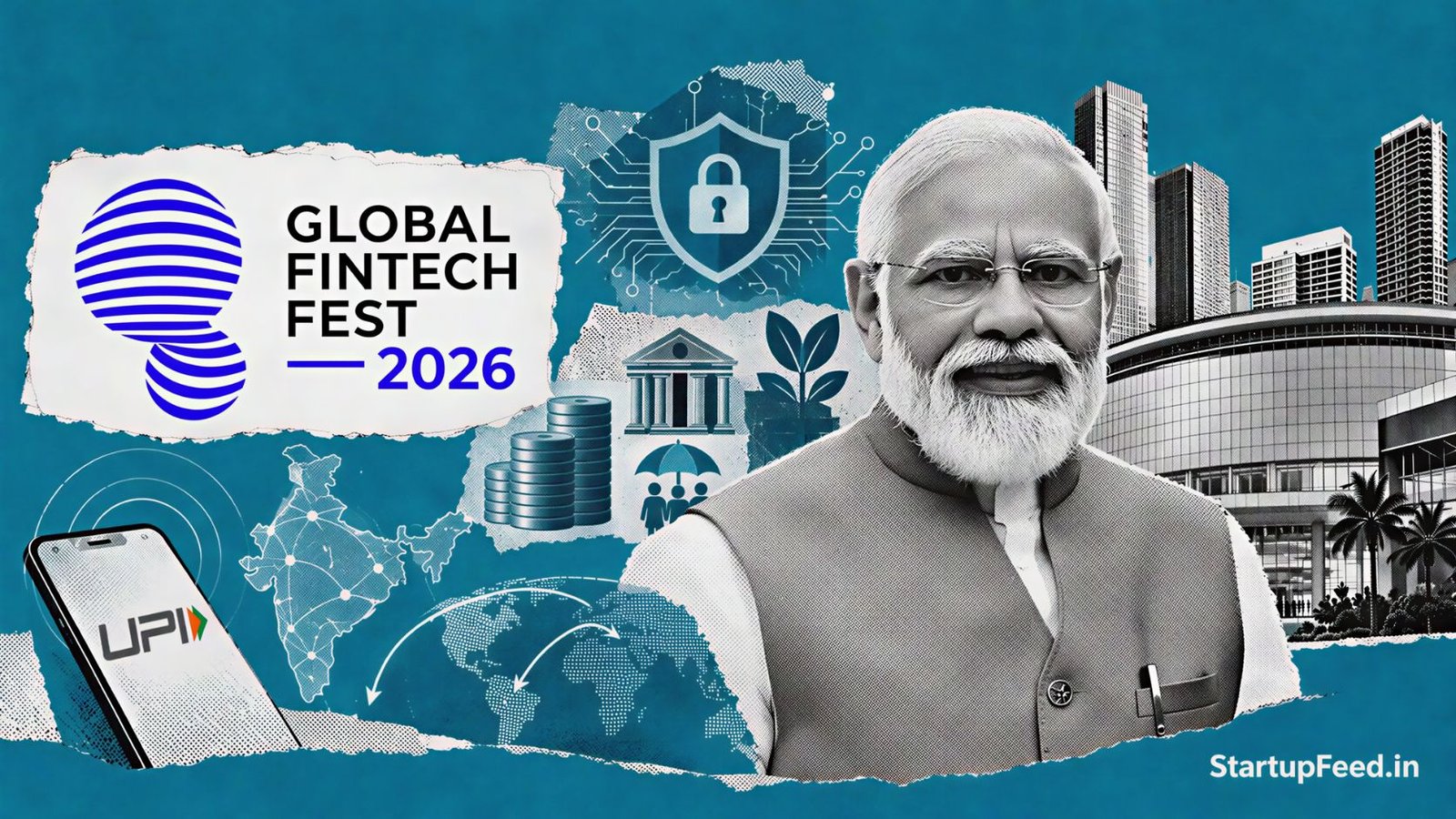
- PM Narendra Modi opened the 7th Global Fintech Fest in Mumbai on September 8, 2026.
- He gave fintech founders four tasks: cybersecurity, data ethics, consumer protection and closer work with regulators.
- UPI ran 2,451 crore transactions in August 2026 and is now live in 11 countries.
Prime Minister Narendra Modi asked Indian fintech founders to move beyond payments and build for credit, insurance and pensions. He was speaking at the Global Fintech Fest 2026 in Mumbai on September 8, 2026.
The message was direct. The payments phase is done. The next phase is products.
Modi told founders that the first wave of Indian fintech was built on payments and digital rails. He said the next opportunity sits in credit, insurance and pensions, according to his address at the event. He also pushed founders to reach people who still have little access to formal banking.
This was Modi’s third appearance at the Global Fintech Fest, Storyboard18 reported. He inaugurated the four-day event at around 5:45 pm at the Jio World Centre in the Bandra Kurla Complex.
What did Modi ask fintech founders to do?
Modi set out four priorities for the sector. They were stronger cybersecurity, ethical data protection, better consumer protection, and closer work between industry and regulators. Inc42 reported these four tasks from his address.



He tied the tasks to new technology. Modi said the fast adoption of tools like agentic AI and quantum must come with stronger security and trust. He called for “top-notch cybersecurity” as finance leans harder on digital systems and AI.
“Agentic AI, tokenisation, quantum, such technologies are opening new possibilities in the financial sector,” Modi said. He asked fintech companies to come together and set tasks for themselves.
His point on data was blunt. New products must be built around data, fraud control, cybersecurity and consumer safety. Trust, he argued, is what keeps users on a platform as it grows.
There is a real reason for the caution. The government recently set up an inter-ministerial group to write a cybersecurity strategy for the financial sector, Inc42 reported. The sector is expanding fast, and so is its attack surface.
Why does Modi want fintechs to move beyond payments?
Because payments alone do not build a full financial system. Modi said the rails created by UPI should now carry a wider set of services.
The scale of those rails is large. UPI grew from 1.78 crore transactions in FY17 to more than 24,162 crore transactions in FY26. That is close to a 13,000-fold rise in nine years, per government data cited by Inc42.
The value figure is bigger still. Transaction value rose from around Rs 7,000 crore to about Rs 314 lakh crore over the same span. The base was tiny. The top line is national.


Growth has not slowed in 2026. UPI processed a record 2,451 crore transactions worth Rs 29.82 lakh crore in August 2026. The Indian fintech economy behind it is projected to cross $250 Bn in revenue by 2030.
Modi’s case is simple. The hard part, the infrastructure, is already built. The open ground is the products that ride on top of it.
What did Modi say about UPI going global?
Modi said the next goal is to connect UPI with the payment systems of other countries. The homegrown network is already live in 11 countries as of September 2026.
He used one link as proof. India and Singapore connected their systems through the UPI-PayNow linkage. Cross-border transfers between the two are now nearly as easy as a transfer between two Indian cities, Modi said.
The reason he cares is remittances. Indians send more money home from abroad than any other group in the world. A slice of that money is lost to transaction fees on the way.
“UPI can help Indians save on these costs and the money can also reach Indian families faster,” Modi said. He asked the sector to prioritise countries with large Indian diasporas and strong trade ties.
The plumbing to make this work is coming from NPCI. The UPI operator is expected to launch a framework that lets AI agents make small-ticket payments without a user approving every single one, Inc42 reported. NPCI piloted this agentic payments idea at GFF 2025.
What is the theme of GFF 2026?
The theme of GFF 2026 is “Potential to Impact: Agentic AI, Tokenisation, Quantum, Trusted, Connected, Global Systems for Inclusive Finance.” The event runs from September 8 to 11 in Mumbai.
Three technologies sit at the centre. Agentic AI points to systems that can run financial tasks with more independence. Tokenisation turns assets into programmable digital units that allow fractional ownership and faster settlement.
Quantum is the third pillar. The Hans India reported that quantum tools cover quantum-safe cryptography and risk optimisation, both aimed at long-term security of financial systems.
GFF has run every year since 2020. It is organised by the Payments Council of India, the National Payments Corporation of India, and the Fintech Convergence Council. It brings together regulators, banks, fintech firms, investors and academics.
UPI in numbers: FY17 to FY26
| Measure | FY17 | FY26 |
|---|---|---|
| Transactions | 1.78 crore | 24,162 crore |
| Transaction value | Rs 7,000 crore | Rs 314 lakh crore |
| Countries live (Sep 2026) | India only | 11 countries |
| Peak monthly volume | Not applicable | 2,451 crore (Aug 2026) |
| Peak monthly value | Not applicable | Rs 29.82 lakh crore (Aug 2026) |
What this means for you: If you run a fintech, the signal from the top is to build lending, insurance or pension products with fraud and data safeguards baked in, not bolted on later.
StartupFeed Insight
The UPI numbers are the story, and one comparison is doing quiet work. Transactions rose about 13,000-fold from FY17 to FY26, but value rose only about 4,485-fold, from Rs 7,000 crore to Rs 314 lakh crore. That gap is the point. UPI won on tiny, everyday payments, not big-ticket ones. This is exactly why Modi is pushing credit, insurance and pensions, where the rupee value per user is far higher. Watch NPCI’s agentic payments framework closely. If it ships in the next two quarters, the founders who already built fraud controls for autonomous transactions will move first, and the rest will spend 2027 catching up.
— Avinash Mishra, Business Correspondent
Frequently Asked Questions
Have a tip? Write to us at editorial@startupfeed.in.
Liked this story? Follow StartupFeed on Google so our reporting reaches you first.