Quick Take
- Agnikul Cosmos opened two new units at its Chennai facility on September 8, 2026.
- One unit, PROOF, can build more than 10 pressure vessels a month, up to 3,500 litres and 350 bar.
- The units support Mission-02, the company’s next flight after its May 30, 2024 debut.
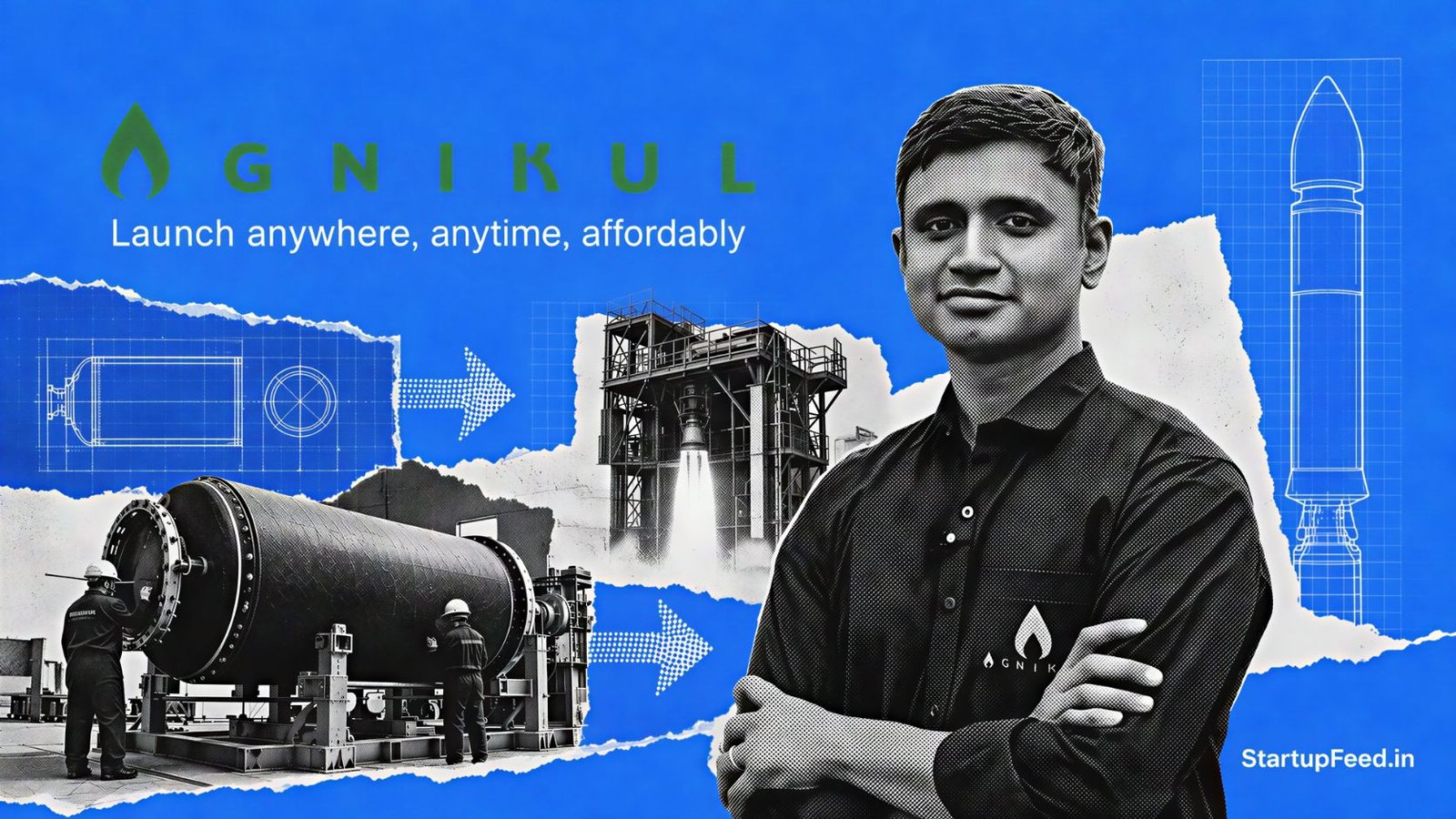
Space startup Agnikul Cosmos has opened two new units at its assembly and testing facility in Chennai. They let the company test reusable rocket stages under flight-like conditions and build key parts in-house.
The two units are the Stage Testing and Inspection Facility, called STIF, and the Pressurant Tank Realization, Over-wrapping and Outfitting Facility, called PROOF. Group Captain Shubhanshu Shukla, the Gaganyaan astronaut, opened them.
Agnikul says the units make it the only Indian private space company with in-house post-flight requalification. That means checking a used rocket stage and clearing it to fly again.
The company built and designed STIF fully in-house. It tests full rocket stages with the propulsion and avionics working together.
What do STIF and PROOF do?
STIF tests a complete stage for the full length of its mission. It also inspects and requalifies stages that come back after a flight.



This supports a repeatable cycle for reusable rockets: build, test, fly, recover, inspect, requalify and fly again. That loop is the core of any reusable launch system.
PROOF handles manufacturing. It brings the making of high-pressure composite overwrapped pressure vessels in-house.
The unit can produce more than 10 vessels a month. These include vessels of up to 3,500 litres and 350 bar. Building them in-house cuts outside dependencies and speeds up production.
“STIF gives us the ability to test complete stages for the duration of their mission and inspect and requalify recovered stages,” said Srinath Ravichandran, cofounder and chief executive of Agnikul Cosmos.
How does this fit Agnikul’s plans?
The units help Agnikul move from single-mission launches to a higher launch rate. That shift is what a working reusable rocket needs.
Agnikul already designs and builds its own engines. These are single-piece, 3D-printed, semi-cryogenic engines. The company also builds its own avionics and other vehicle systems.
The startup flew Mission-01 on May 30, 2024. That flight showed a controlled ascent using its 3D-printed engine and in-house autopilot. STIF and PROOF now extend that in-house approach to stage testing and recovery.


Moin SPM, cofounder and chief operating officer, said the vessel unit gives Agnikul more control over quality and turnaround. He tied both units to a higher launch cadence.
Who else is building reusable rockets?
Reusability is the big cost lever in the launch business. SpaceX proved it by landing and reflying its Falcon 9 boosters. Rocket Lab is working on the same for its Neutron rocket.
Agnikul says the two units place it among a small set of global firms working on full-stack reusable launch. In India, Skyroot Aerospace is the other well-funded private launch startup racing on this front.
The order of work here is worth watching. Agnikul is building the recovery and requalification plant before it has recovered a stage from flight. That is the honest sign of a company planning for reuse, not just talking about it.
What this means for you: If you supply or invest in Indian spacetech, in-house testing and recovery infrastructure is now a real yardstick for how launch-ready a startup is.
StartupFeed Insight
Agnikul has not put a rupee figure on STIF and PROOF, and that is telling. This is capital going into ground infrastructure, not a flashy launch. The number that matters is PROOF’s output: more than 10 pressure vessels a month. That is a production line, not a lab bench. It signals Agnikul expects to fly often enough to need parts at scale. Watch for Mission-02 to carry a recoverable stage, and watch whether a used stage passes back through STIF within twelve months of that flight. If it does, Agnikul moves from a launch startup to a reuse startup. That is a different and far bigger business.
— Avinash Mishra, Business Correspondent
Frequently Asked Questions
Have a tip? Write to us at editorial@startupfeed.in.
Liked this story? Follow StartupFeed on Google so our reporting reaches you first.