Quick Take
- Skyroot plans one Vikram rocket a month, with commercial service targeted for 2027.
- Agnikul Mission-02 will attempt India’s first sea recovery of an orbital-class booster.
- Both firms now chase reusability, the cost lever that decides who wins global contracts.
In This Article
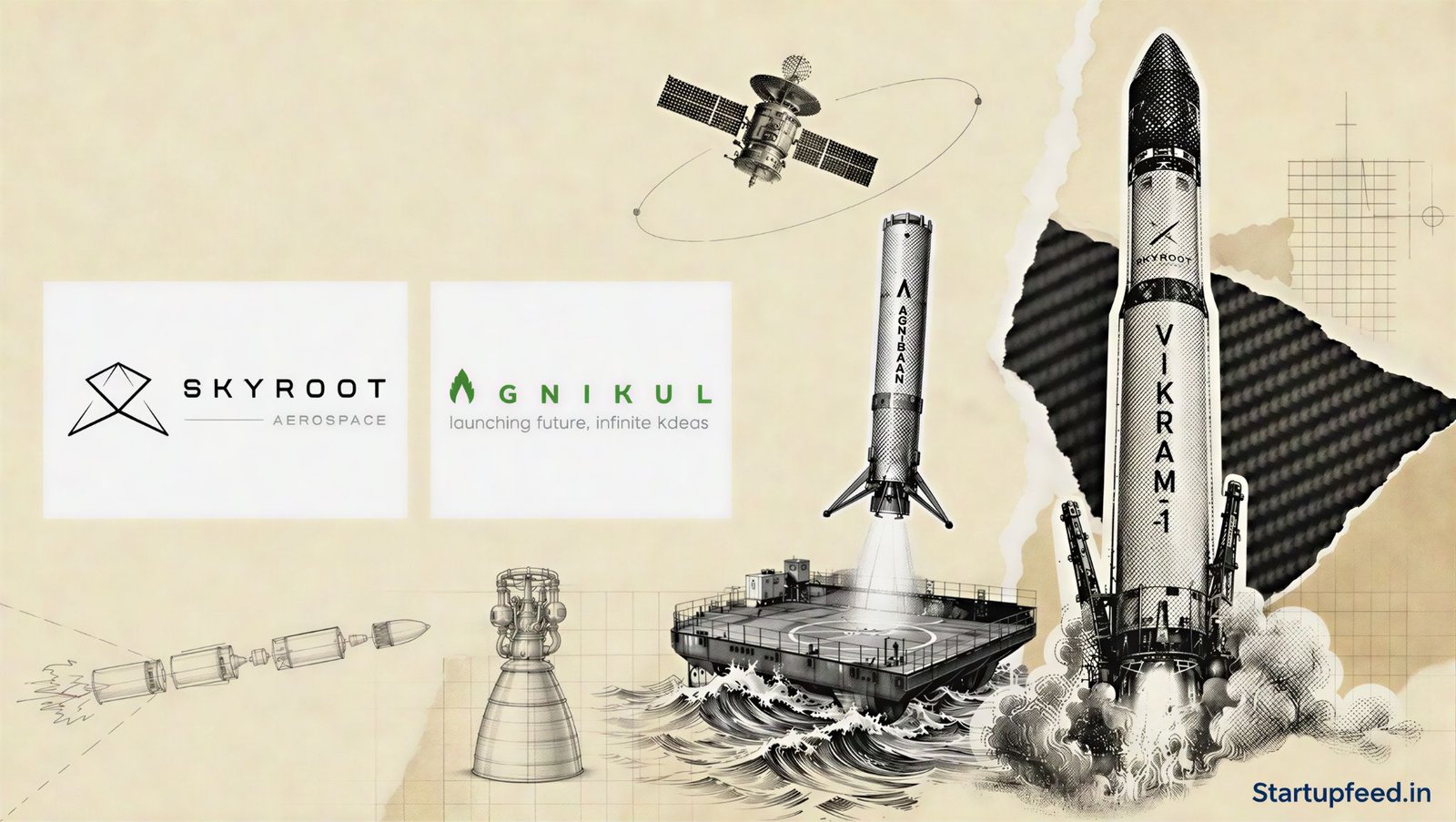
The India private space race shifted gear on July 18, 2026, when Skyroot Aerospace put Vikram-1 into a 450 km low Earth orbit (LEO) from Sriharikota and Agnikul Cosmos set out a booster recovery plan the same weekend.
Skyroot now targets one rocket a month and commercial flights from 2027. Chennai-based Agnikul is preparing Mission-02, an attempt to bring an orbital-class booster back to a sea platform. Two Indian firms, two very different bets on cost.
StartupFeed Insight
The real signal is not the launch, it is the manufacturing rate. A rocket every month means Skyroot has already solved the boring problems: supply chain, tooling, and stage qualification at volume. Agnikul is attacking the same cost curve from the opposite end, recovering hardware instead of building more of it. Founders selling into space should watch which model attracts anchor customers first, because launch pricing will reset around it. StartupFeed expects at least one Indian firm to publish a per-kg price under $20,000 to LEO before December 2027, and international operators will drive that demand. By Avinash.
Skyroot and Agnikul: The Roadmap Numbers
Vikram-1 is a four-stage small satellite launcher standing about 20 metres tall, built with carbon composite airframes and a 3D-printed liquid engine. It lifted off from the First Launch Pad at Satish Dhawan Space Centre at 12:05:30 PM on July 18, 2026, according to the ISRO mission statement on the first private orbital launch. Two satellites, SCOPE and Grahaa, were injected into LEO (ISRO).
| Metric | Detail | Notes |
|---|---|---|
| Skyroot production target | One rocket per month | Across Hyderabad campuses (Chandana) |
| Commercial readiness | 2027 | At least two more test flights first |
| Vikram-2 payload | Up to 1,000 kg to LEO | Maiden flight targeted 2027 |
| Skyroot valuation | $1.1 Bn (Rs 9,504 Cr) | After $60 Mn (Rs 518 Cr) round, May 2026 |
| Agnikul Mission-02 | Sea recovery of first stage | Two-stage Agnibaan configuration |
| Agnikul upper stage | Convertible in-orbit platform | Patents in India, US, Europe |
Conversions use the July 20, 2026 rate of about Rs 86.4 to the dollar. The most striking number is the monthly build rate, because it implies Skyroot solved factory throughput before it solved flight heritage.
About Skyroot Aerospace
Skyroot Aerospace is a Hyderabad-based launch company founded in 2018 by Pawan Kumar Chandana and Bharath Dhaka, both former ISRO scientists and IIT alumni. It sells dedicated and rideshare small satellite launches on the Vikram vehicle family. The firm became India’s first spacetech unicorn in May 2026 and operates the Infinity Campus, a 2 lakh square feet integration facility.



Why does the India private space race now turn on reusability?
Reusability is the practice of recovering and reflying rocket hardware instead of discarding it after one flight. It is the single largest lever on launch cost. SpaceX has flown recovered Falcon 9 boosters more than 650 times, with individual boosters completing up to 35 missions.
One-time-use rockets were originally developed when reaching space was about accomplishing one-off goals, said Srinath Ravichandran, Co-founder and CEO, Agnikul Cosmos.
That framing explains the timing. China recovered a reusable booster days before Agnikul unveiled Mission-02, which narrowed the window for India to claim an early position. Skyroot has answered with volume manufacturing, while also listing a fully reusable vehicle with both booster and upper stage designed for recovery on its longer roadmap.
What does a sea barge landing mean for Agnikul?
A sea recovery means the first-stage booster performs a controlled descent after stage separation and is retrieved from the ocean rather than left to break up. Agnikul will fly a two-stage Agnibaan configuration detailed on its missions page for the attempt. The booster is the costliest part of the vehicle, so recovering it changes the unit economics of every subsequent flight.
Mission-02 carries a second, rarer goal. Instead of letting the upper stage become debris, Agnikul wants it to keep working in orbit as a hosting platform for experiments. Former ISRO chairman Dr S Somanath has joined the board as an observer ahead of the flight, adding stage-recovery experience to the table. Agnikul flew Mission-01, the Agnibaan SOrTeD suborbital demonstrator, on May 30, 2024 from India’s first private launchpad.
How do these rockets compare with global rivals?
| Vehicle | Payload to LEO | Reusability status |
|---|---|---|
| Vikram-1 (Skyroot) | Up to 350 kg | Expendable today |
| Agnibaan (Agnikul) | Up to 300 kg | Sea recovery planned |
| Falcon 9 (SpaceX) | Over 17,000 kg | Routine booster reuse |
The Indian vehicles are not competing with Falcon 9 on mass. They compete on schedule control, the ability to place a small satellite in a customised orbit without waiting for a rideshare slot. Chandana has compared it to booking a cab instead of catching a train. Around 80% of Skyroot’s anticipated demand is expected from international satellite operators, which makes this a global sales race, not a domestic one.
What’s Next
Skyroot plans at least two more Vikram-1 development flights before declaring commercial readiness, with Vikram-1U and its strap-on boosters targeted for the first quarter of 2027. Agnikul has not confirmed a Mission-02 launch date. The next verifiable milestone is Skyroot’s second Vikram-1 flight, with the vehicle already in production. Which model will price Indian launches lower first, volume or reuse?
Frequently Asked Questions
Written by Avinash. Have a tip? Write to us at editorial@startupfeed.in.


Liked this story? Follow StartupFeed on Google so our reporting reaches you first.