
Quick Take
- The 1-Person Unicorn idea went mainstream in 2026, driven by AI agents doing full-department work.
- Medvi hit $401 Mn (Rs 3,839 Cr) in 2025 sales with only two people, per the New York Times.
- No verified single-founder firm has crossed $1 Bn yet, so the label stays a target, not a fact.
In This Article
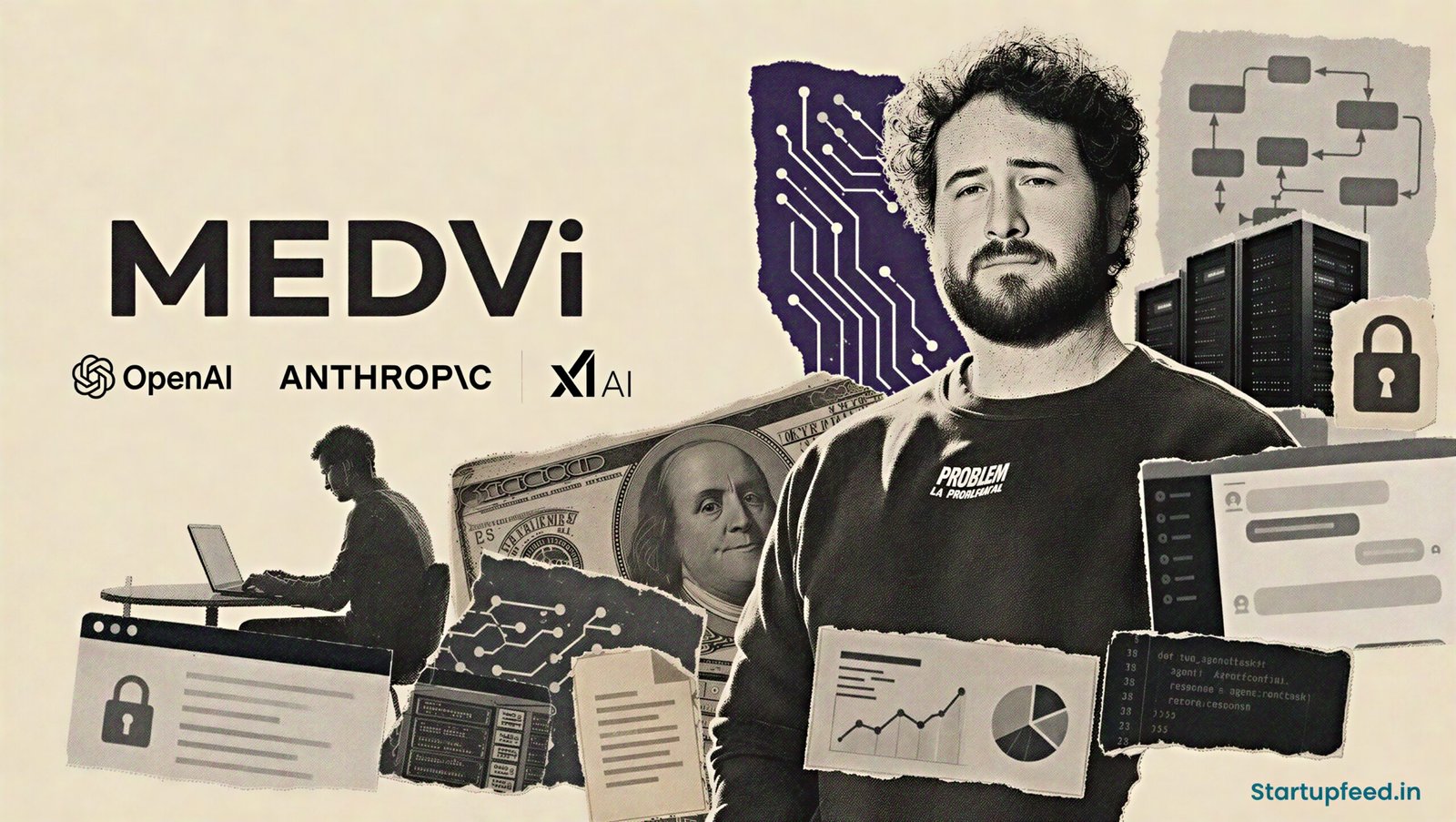
The 1-Person Unicorn is a startup worth $1 Bn (Rs 9,573 Cr) built and run mostly by one founder who uses AI agents to do the work of whole teams. In 2026 the idea moved from a Silicon Valley bet to a live race, after a two-person telehealth firm called Medvi posted $401 Mn (Rs 3,839 Cr) in first-year sales in 2025, verified by the New York Times in its April 2, 2026 profile. (Conversions use the live rate of 1 USD = Rs 95.73 on July 30, 2026.)
The term took off after OpenAI chief Sam Altman predicted, back in 2024, that AI would soon let a single person build a billion-dollar company. Anthropic chief Dario Amodei went further, putting a 70 to 80 percent chance on the first such firm arriving by the end of 2026. The question for founders is no longer whether this is possible. It is whether the proof holds up, and what it means for a lean builder in Bengaluru or Pune.
StartupFeed Insight
The real signal in the 1-Person Unicorn story is not headcount, it is margin. Medvi reported a 16.2 percent net margin against Hims and Hers at 5.5 percent, per the NYT, while running on two people instead of 2,400. That gap is what VCs are actually buying. Watch Indian SaaS and single-vertical fintech founders here, not consumer health, because clean digital products scale on agents far better than regulated medicine. StartupFeed predicts India sees its first sub-10-person startup cross $50 Mn ARR (Annual Recurring Revenue) before December 2027, though a true one-person billion-dollar firm stays unproven well past that. By Harshvardhan Jain.
What Is a 1-Person Unicorn?
A 1-Person Unicorn is a company valued at $1 Bn (Rs 9,573 Cr) or more that is founded and mainly operated by a single person who uses AI as a workforce multiplier. The founder owns strategy, product direction, and key relationships, while AI agents and a few contractors handle execution across coding, design, marketing, and support.
The phrase does not mean zero staff forever. It means one strategic operator instead of the fifty-person org a similar company needed five years ago. The core shift, as several 2026 founder guides note, is that output no longer scales with headcount. One clear founder plus a stack of agents can now match a full department on speed and reach.
Is the 1-Person Unicorn Real Yet?
No single-founder company has been verified at a $1 Bn valuation as of July 2026, so the 1-Person Unicorn remains a target rather than a confirmed fact. The closest real example is Medvi, a Los Angeles GLP-1 (a drug class that includes Ozempic and Wegovy) telehealth firm founded by Matthew Gallagher in September 2024 with $20,000 in starting capital.


“A one-person business worth $1 billion would have been unimaginable without AI, and now it will happen,” Matthew Gallagher told the New York Times.
Medvi grew from 300 customers in month one to over 250,000, and recorded $401 Mn (Rs 3,839 Cr) in 2025 sales with a 16.2 percent net margin, per the NYT. The important caveat: the firm has two employees, Gallagher and his brother Elliot, not one, and its growth leans heavily on the GLP-1 boom. Midjourney, the AI image firm, is the other marker, reaching a reported $200 Mn (Rs 1,915 Cr) run rate with around 11 staff.
The Formula: What Actually Powers It
The 1-Person Unicorn formula rests on treating AI as infrastructure, not as a helper tool. Gallagher built Medvi using ChatGPT, Claude, and Grok to write code, produce ad copy, generate media, and run customer service, then outsourced doctors, pharmacy, and compliance to partners. He kept only branding, marketing, and customer acquisition in-house.
| Metric | Detail | Notes |
|---|---|---|
| Starting capital | $20,000 (Rs 19.1 Lakh) | Founder’s own money, per NYT |
| 2025 sales | $401 Mn (Rs 3,839 Cr) | First full year, NYT-verified |
| Net margin | 16.2 percent | Roughly $65 Mn (Rs 622 Cr) profit |
| Team size | 2 people | Founder plus one, not one |
| 2026 projection | $1.8 Bn (Rs 17,231 Cr) | Company projection, unaudited |
The most striking fact is the profit per head. Medvi generated around $65 Mn (Rs 622 Cr) in profit split across two people, a ratio traditional consumer health firms cannot touch because payroll erodes their margins.
About the Trend
The 1-Person Unicorn narrative sits inside a wider 2026 shift toward AI-native, ultra-lean startups. It gained force after Sam Altman’s 2024 prediction, was pushed by Dario Amodei’s public bet at Anthropic, and drew a stage endorsement from Nvidia chief Jensen Huang, who declared at GTC Taipei on June 1, 2026 that “useful AI has arrived.” Backers include tools from OpenAI, Anthropic, and a growing set of agent platforms, with Sequoia now modelling what it calls “agentic leverage.”
Can India Build One?f
India has strong structural odds of producing a very lean AI-native winner, driven by deep engineering talent, low-cost operations, and cheap compute. Under the IndiaAI Mission, over 38,000 GPUs have been onboarded for startups and academia at subsidised rates, backed by a Rs 10,372 Cr outlay, per MeitY.
“AI has replaced scale with smarts. Small teams can now out-execute giants,” Jaspreet Bindra, CEO of AI&Beyond, told a startup publication.
Analysts see a former Stripe engineer in Bengaluru running a payment infrastructure startup for hundreds of merchants alone, as an early signal of this model. High-end India compute has dropped to under Rs 100 per GPU hour with full subsidy, per PIB, a cost edge San Francisco founders cannot match. What sets India apart is capital efficiency by necessity, not choice.
The Risks Nobody Puts on the Slide
The 1-Person Unicorn story carries real risks that the viral headlines skip, and Medvi shows them clearly. Within 24 hours of its NYT profile, the firm faced an FDA warning letter, a class-action lawsuit, and reporting on allegedly fake before-and-after images on its site.

| Firm | Team | Reported result |
|---|---|---|
| Medvi | 2 people | $401 Mn 2025 sales, plus FDA warning |
| Midjourney | ~11 people | ~$200 Mn run rate, no outside capital |
| Hims and Hers | 2,400+ people | 5.5 percent net margin, same market |
A separate report described a data exposure where a Medvi user changed a URL digit and saw another patient’s full record, with no login required. Thin teams can move fast, but they also strip out the compliance, security, and review layers that larger firms build. That is the trade the slide never shows.
What’s Next
The next test is whether any solo or two-person firm crosses the $1 Bn (Rs 9,573 Cr) valuation line, not just the revenue line, before Amodei’s end-of-2026 deadline. For India, watch the first sub-10-person SaaS or fintech startup to report $50 Mn ARR, likely within the next 18 to 24 months. Would you bet on a one-person firm surviving its first regulator, or is a small trusted team still the safer path?
Frequently Asked Questions
Have a tip? Write to us at editorial@startupfeed.in.
Liked this story? Follow StartupFeed on Google so our reporting reaches you first.