
Quick Take
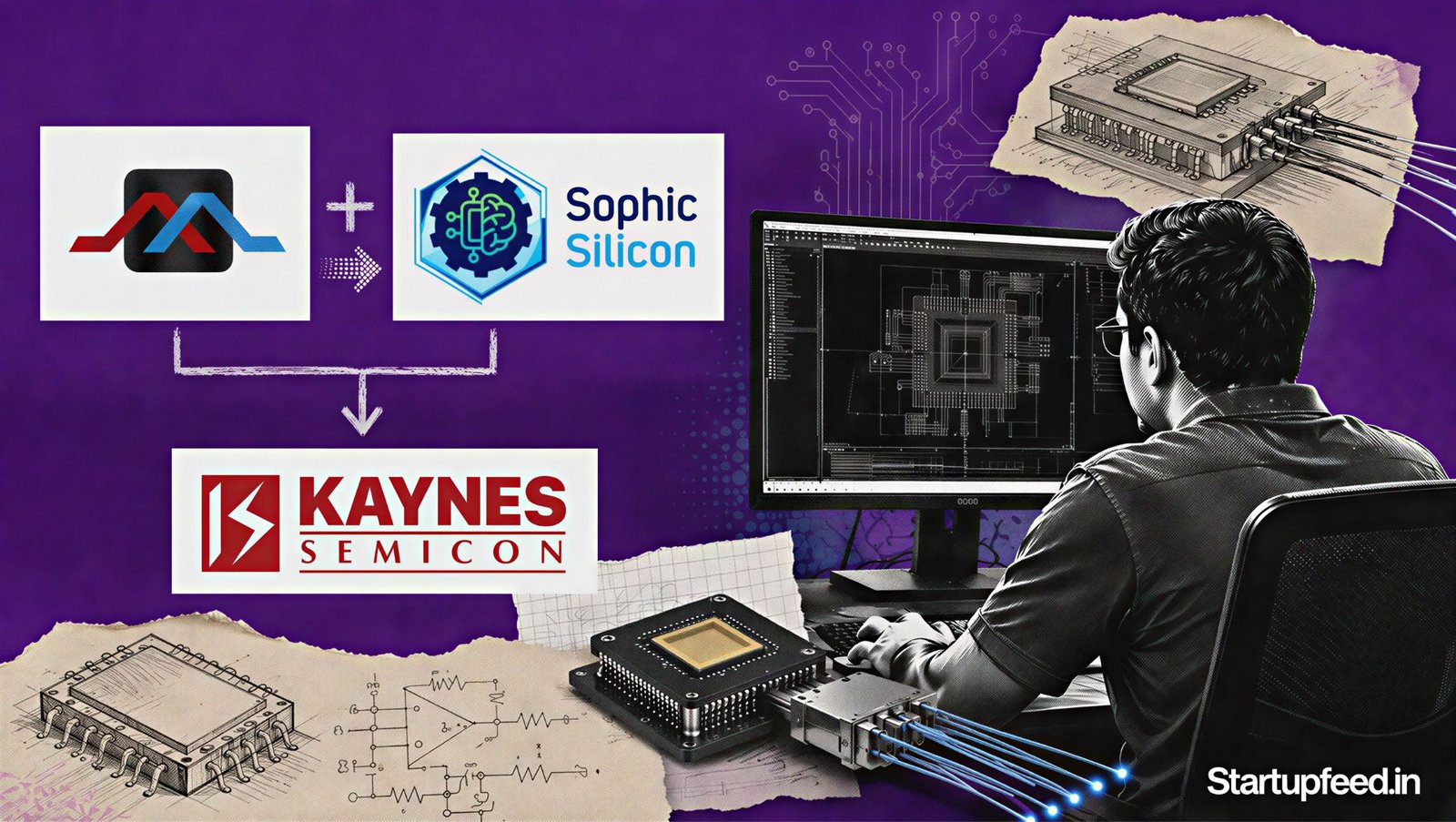
- San Jose deeptech firm Mixx Technologies has acquired Bengaluru chip-IP startup Sophic Silicon Technologies.
- Mixx signed a three-year collaboration with Kaynes Semicon for advanced optical packaging and test.
- Both firms target a market expected to top $30 Bn (Rs 2,89,251 Cr) by 2030.
In This Article
Mixx buys Sophic Silicon Technologies, the Bengaluru chip-IP firm, and has signed a three-year collaboration with Kaynes Semicon, the two companies confirmed in July 2026. Financial terms were not disclosed.
The deal hands Mixx Technologies critical mixed-signal design resources for its silicon photonics and co-packaged optics (CPO) roadmap. Kaynes Semicon, the outsourced semiconductor assembly and testing (OSAT) arm of Kaynes Technology India, will run advanced optical integrated circuit assembly and test for Mixx products. Sophic founder Deepak Pancholi joins Mixx as vice president of integrated circuit design, per company statements.
StartupFeed Insight
The quiet signal here is not the acquisition size, it is the sequencing. Mixx buys Sophic Silicon for design IP, then locks packaging capacity in the same breath, which means it wants a full India stack rather than a cost-arbitrage design centre. Kaynes Technology investors and Indian semiconductor policy watchers should track this closely, because it tests whether an Indian OSAT can qualify for optical assembly, a step above the wirebond work most Indian lines run today. StartupFeed expects Mixx to announce first India-packaged optical engine samples by mid-2027, ahead of any volume ramp. By Avinash.
Deal Breakdown: Mixx buys Sophic Silicon and adds Kaynes capacity
An acquisition plus a manufacturing pact is a two-part transaction, and each part solves a different bottleneck. The table below sets out the confirmed facts as reported.
| Metric | Detail | Notes |
|---|---|---|
| Acquirer | Mixx Technologies Inc, San Jose, California | Founded 2023, per company website |
| Target | Sophic Silicon Technologies Pvt Ltd, Bengaluru | Incorporated April 16, 2024 (MCA) |
| Deal value | Not disclosed | Both companies declined to share terms |
| Manufacturing pact | 24-month collaboration with Kaynes Semicon | Advanced optical IC assembly and test |
| Market target | Above $30 Bn (Rs 2,89,251 Cr) by 2030 | Company estimate, converted at Rs 96.42 per dollar |
| Prior Kaynes link | 13.2% stake for $3 Mn (Rs 2,49 Cr equivalent) | Kaynes Technology stock exchange filing, January 2024 |
The most striking number is the volume ambition. Kaynes is working toward 4 to 5 million units a year, with capacity for about 5 million units within four years, according to Mixx chief executive Vivek Raghuraman.
About Mixx Technologies
Mixx Technologies builds silicon-integrated optical interconnects for AI data centres. Founded in 2023 by Vivek Raghuraman and Rebecca K Schaevitz, it is headquartered in San Jose with offices in Bengaluru and Hsinchu, Taiwan. Its HBxIO optical engine moves data between GPUs using light instead of copper. The firm raised a $33 Mn (Rs 318 Cr) Series A in December 2025, backed by ICM HPQC Fund, TDK Ventures and Systemiq Capital.



Why did Mixx buy Sophic Silicon?
Sophic Silicon supplies analog and mixed-signal semiconductor IP, the circuit blocks that convert between electrical and optical domains. That skill sits at the heart of any co-packaged optics design, and hiring it from scratch takes years. Sophic was incorporated in Bengaluru in April 2024 and reported revenue of Rs 2.66 Lakh for the year ended March 31, 2025, per MCA filings, so this is a talent and IP purchase rather than a revenue play.
“The market opportunity Mixx and Kaynes are targeting is expected to exceed $30 billion by 2030,” said Vivek Raghuraman, chief executive officer, Mixx Technologies.
The purchase also gives Mixx a second India anchor. Sophic already held EDA (Electronic Design Automation) tool support from MeitY (Ministry of Electronics and Information Technology) under the government’s chip design push. That access lowers the running cost of a Bengaluru design centre materially, since EDA licences are among the heaviest fixed costs in chip design.
What does the Kaynes pact deliver for India?
The Kaynes agreement covers advanced optical integrated circuit assembly and test, a packaging tier India has not yet run at scale. Kaynes Semicon, established in 2023 as a wholly owned subsidiary of Kaynes Technology India, operates an OSAT facility at Sanand, Gujarat. Its existing work centres on conventional assembly, so optical and co-packaged optics assembly would extend the plant into a higher-value tier.
“If you look at the challenges being faced in data centres, data transfer, latency and the time taken, these can be addressed when data flows through optics,” said Raghu Panicker, chief executive officer, Kaynes Semicon.
For India, the pact matters more than the acquisition. It creates a domestic demand anchor for optical packaging, which is exactly the capability gap the India Semiconductor Mission has struggled to close. Mixx handles connectivity design, Kaynes handles manufacturing, and both sides avoid the Taiwan and Malaysia packaging queue that constrains most startups. Kaynes Technology stock exchange disclosures remain the source to watch for any binding capacity commitment.
Who else is chasing co-packaged optics?
Co-packaged optics is a contested market with entrenched incumbents. Mixx is competing against firms that already ship at hyperscaler volume, which is why the India packaging route is a differentiator rather than a cost decision.
| Company | Position | India manufacturing link |
|---|---|---|
| Broadcom | First commercial CPO switch platform | None announced for optical assembly |
| Marvell | Optical DSP and interconnect portfolio | India design centres, no OSAT tie-up |
| Mixx Technologies | HBxIO optical engine, 25 to 75 staff scaling | Kaynes Semicon three-year pact |
What separates Mixx is founder pedigree paired with a captive packaging partner: its team came out of Intel’s silicon photonics transceiver programme and Broadcom‘s co-packaged optics work, per the company’s official investor and leadership page.
What’s Next
Watch for a formal Kaynes Technology exchange filing quantifying the capacity commitment, which would convert this from an announcement into a bookable order. Mixx targets Taiwan operations alongside India, so the split of assembly volume between Hsinchu and Sanand is the number that will decide how much of this stays in India. Can an Indian OSAT qualify for optical assembly inside three years?

Frequently Asked Questions
Written by Avinash. Have a tip? Write to us at editorial@startupfeed.in.
Liked this story? Follow StartupFeed on Google so our reporting reaches you first.