

Quick Take
- Bengaluru startup raised $5 Mn (Rs 48 Cr) in Series A led by Accel in January 2026
- Fifth Indian patent granted for its magnet-free Virtual Magnet Synchronous Motor platform
- Technology targets China, which controls roughly 90% of global rare earth processing
In This Article
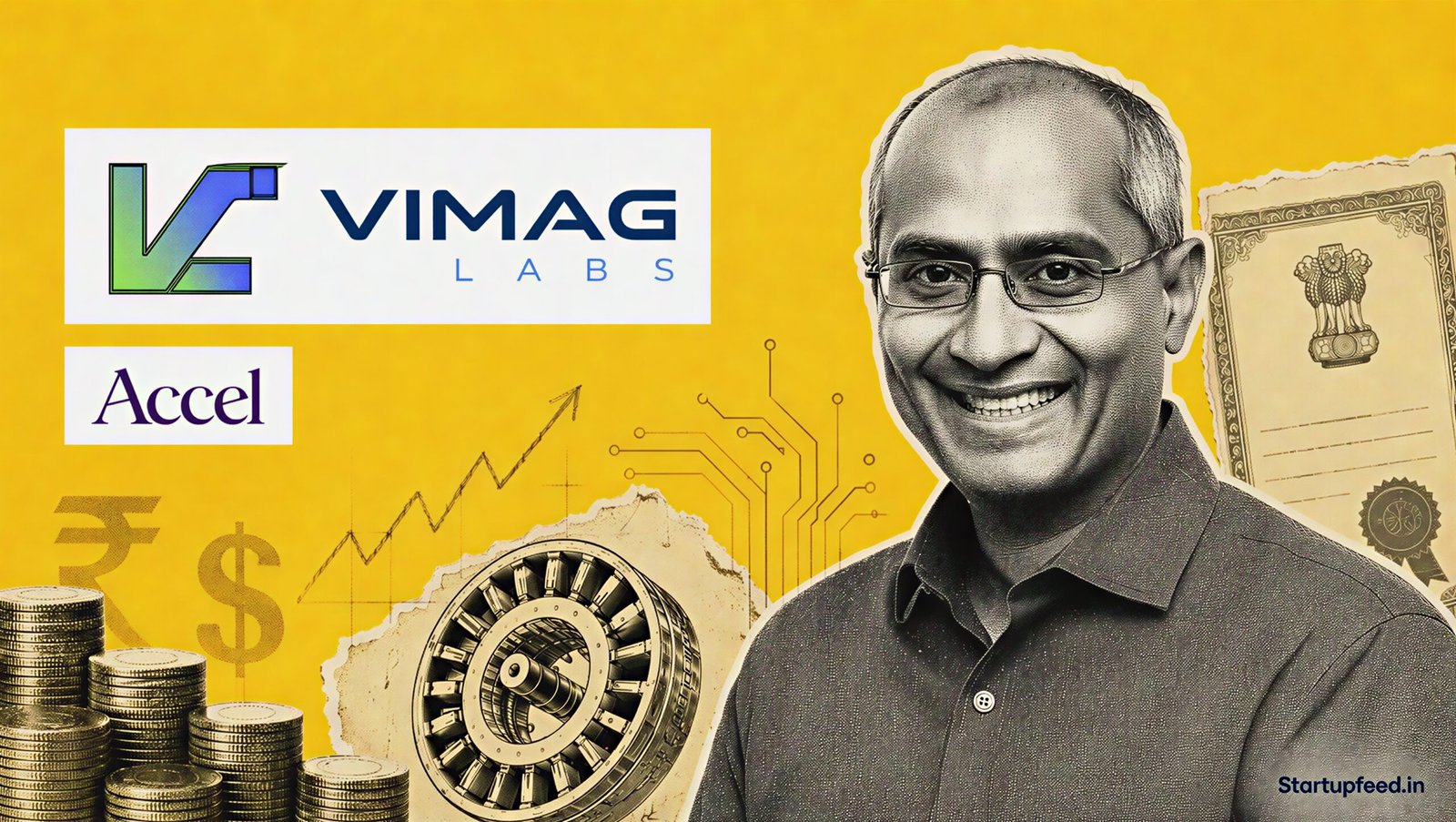
Vimag Labs, a Bengaluru deep-tech startup, raised $5 Mn (Rs 48 Cr) in a Series A round led by Accel in January 2026, and has now been granted its fifth Indian patent for a magnet-free electric motor. The patent covers the core architecture of its Virtual Magnet Synchronous Motor platform, company statement.
The round also drew Chakra Growth Fund and Thinkuvate, company statement. The pitch is simple and hard to build: an electric motor that matches permanent magnet performance without a single gram of rare earth material. Elon Musk announced the same goal for Tesla at Investor Day in March 2023. Three years on, Tesla has no confirmed rare-earth-free drive unit in commercial production.
StartupFeed Insight
The interesting number here is not $5 Mn, it is five patents from a company founded in September 2025. That ratio tells you the intellectual property came first and the funding followed, which is rare in Indian hardware. Auto component makers and defence procurement officers should watch this closely, because motor architecture is the one layer of the electric drivetrain India does not yet own. The honest constraint is validation, not invention. StartupFeed expects the first credible signal to be a named OEM pilot converting into a supply agreement by mid-2027. Anything short of that keeps this a laboratory result. By Harshvardhan Jain.
Vimag Labs Funding and Patent Breakdown
Vimag Labs closed a $5 Mn (Rs 48 Cr) Series A in January 2026, its first institutional round. The table below sets out the deal and the company’s intellectual property position.
| Metric | Detail | Notes |
|---|---|---|
| Total Raise | $5 Mn (Rs 48 Cr) | Series A, January 2026 |
| Lead Investor | Accel | Partner Barath Subramanian on the deal |
| Other Investors | Chakra Growth Fund, Thinkuvate | Participating investors |
| Previous Round | None disclosed | First institutional capital |
| Patents Granted | 5 in India | Fifth granted July 2026 |
| Founded | September 2025 | Bengaluru, Karnataka |
The striking detail is the timeline. Five granted Indian patents inside roughly ten months of incorporation is unusual for a hardware company, and it suggests the underlying research predates the entity itself.
About Vimag Labs
Vimag Labs is a Bengaluru deep-tech company building rare-earth-free electric motors and control systems. Founded in September 2025 by Manish Seth and Dr Piyush Desai, it develops the patented Virtual Magnet Synchronous Motor platform for electric vehicles, industrial machines, HVAC and defence. Desai holds over 50 patents in motor and drive systems, company statement. The firm commercialises globally under the Volektra brand. Accel leads its investor base.


How does a magnet-free electric motor work?
A magnet-free electric motor generates its magnetic field electronically instead of using fixed rare earth magnets bolted into the rotor. Conventional Permanent Magnet Synchronous Motors (PMSMs) depend on neodymium, dysprosium and terbium, all sourced overwhelmingly from China. The Virtual Magnet Synchronous Motor platform replaces that physical hardware with power electronics and control software that create and steer the field in real time.
The company describes the design as largely software-defined, company statement. That framing matters commercially. Software-defined fields can be tuned after manufacture, while a sintered magnet is fixed at the moment it is pressed. The fifth patent, titled “A Robust Rotating Transformer Excited Synchronous Motor and Its Control”, protects this core architecture. The company reports over 87,600 engineering hours invested in the platform.
Why did Accel back this deep-tech bet?
Accel led the round on a supply chain thesis rather than a pure performance thesis. Rare earth prices swing hard, and access is a political decision made in Beijing rather than a market outcome.
Vimag Labs is redefining electric drivetrains with their magnet-free architecture and deep integration of power electronics and control software. Their platform addresses real constraints around cost, materials, and supply chain resilience, Barath Subramanian, Partner at Accel.
Founder and CEO Manish Seth has said the architecture represents a shift in how the industry approaches electrification at scale, company statement. The origin story supports the thesis. Seth hit prolonged magnet shipment delays from China during the pandemic while building prototypes, and the alternative grew out of that blockage. Vimag Labs has also signed a manufacturing MoU with Jendamark India to set up production lines.
Can Vimag Labs actually beat China here?
Not on volume, and not soon. China accounts for roughly 90% of global rare earth separation and processing and about 93% of magnet manufacturing, Australian Institute of International Affairs. India imported close to 54,000 tonnes of rare earth permanent magnets in FY2024-25, with about 93% sourced from China.
| Player | Approach | Status |
|---|---|---|
| Vimag Labs | Software-defined field, zero magnets | 5 patents, pilots underway |
| Tesla | Permanent magnet, no rare earths | Announced 2023, not shipping |
| Niron Magnetics | Iron nitride magnet substitute | Prototypes shown at CES 2026 |
New Delhi is attacking the same problem with capital. The Union Cabinet approved a Rs 7,280 Cr scheme for sintered rare earth permanent magnets in November 2025, targeting 6,000 MTPA of domestic capacity. That scheme still buys Indian magnets. What separates Vimag Labs is that it removes the magnet from the bill of materials entirely, so the supply question stops applying.
What’s Next
The company is running pilots with two-wheeler and passenger vehicle manufacturers, and is developing higher-power variants between 200 kW and 600 kW for commercial and industrial use. The test is durability data from a real fleet, not bench results. A named OEM converting a pilot into a purchase order would settle the argument. Which Indian automaker moves first on a motor with no magnets inside?


Frequently Asked Questions
Have a tip? Write to us at editorial@startupfeed.in.