Quick Take
- Pralhad Joshi is India’s new Education Minister after Dharmendra Pradhan resigned on July 25, 2026.
- Joshi holds additional charge alongside his Consumer Affairs and New and Renewable Energy portfolios.
- Edtech startups face continued exam reform, tighter coaching rules, and new data compliance through 2026.
In This Article
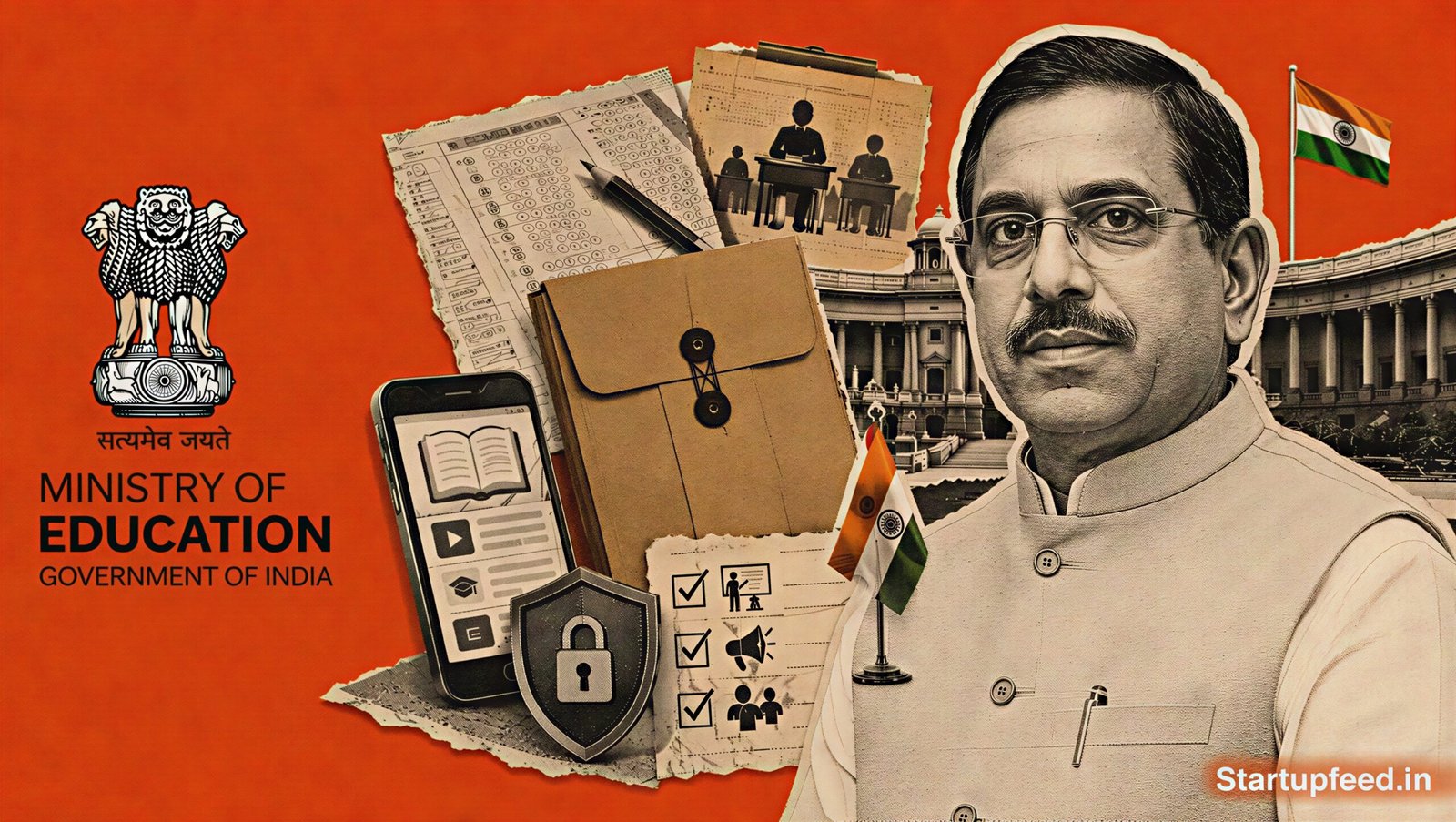
India’s new Education Minister is Pralhad Joshi, who took additional charge of the Ministry of Education on July 25, 2026, after Dharmendra Pradhan resigned amid nationwide student protests over exam paper leaks.
The change puts a familiar face atop a ministry under pressure. Joshi already runs Consumer Affairs, Food and Public Distribution, and New and Renewable Energy. President Droupadi Murmu accepted Pradhan’s exit and handed Joshi additional charge of the Ministry of Education. For India’s edtech startups, his arrival signals continuity on exam reform and coaching regulation rather than a clean reset.
StartupFeed Insight
The real signal is continuity, not a reset. A minister on additional charge rarely launches sweeping new policy, so the reform push built under Pradhan stays in motion: the entrance-exam reform panel, the 2024 coaching rules, and tighter advertising norms. Founders in test-prep and NEET (National Eligibility cum Entrance Test) or JEE (Joint Entrance Examination) coaching should track the next National Testing Agency (NTA) overhaul closely. StartupFeed expects the Ministry of Education to notify at least one fresh coaching or edtech advisory before the end of 2026, and a wider cabinet reshuffle by Q4 2026 that could name a permanent Education Minister. Either way, compliance costs climb for smaller edtech players. By Soumya Verma.
New Education Minister: The Key Facts At A Glance
The new Education Minister, Pralhad Joshi, holds additional charge of the Ministry of Education alongside three existing portfolios. The table below sets out who moved, why, and what stays the same.
| Detail | What Happened | Notes |
|---|---|---|
| New Education Minister | Pralhad Joshi | Additional charge, effective July 25, 2026 |
| Outgoing Minister | Dharmendra Pradhan | Resignation accepted by President Droupadi Murmu |
| Trigger | Student protests over exam paper leaks | NEET-UG leak and NTA scrutiny |
| Joshi’s other portfolios | Consumer Affairs, Food and Public Distribution; New and Renewable Energy | Retained in full |
| Arrangement | Interim additional charge | Full reshuffle possible later in 2026 |
The most telling fact is the interim nature of the role. Additional charge usually means a holding arrangement, so edtech founders should read this as steady pressure, not a fresh policy direction.
Who Is Pralhad Joshi?
Pralhad Venkatesh Joshi is a five-time Lok Sabha MP from Dharwad, Karnataka, born in November 1962. A long-time Rashtriya Swayamsevak Sangh (RSS) member, he entered Parliament in 2004. He served as Minister of Parliamentary Affairs, Coal and Mines from 2019 to 2024, and since June 2024 has held Consumer Affairs, Food and Public Distribution, and New and Renewable Energy in the Modi cabinet.

What Does This Mean For Edtech Startups?
For now, it means steady pressure rather than a sudden shift. The Ministry of Education has spent two years tightening rules on coaching centres, and that agenda does not pause during a leadership change. Test-prep platforms, K-12 tutoring apps, and exam-coaching firms remain the most exposed.
Students should “focus on their studies and their career,” Dharmendra Pradhan said in his resignation statement.
That student-first framing is likely to guide Joshi too. Expect continued scrutiny of misleading advertisements, fee practices, and children’s data. Edtech startups that already meet these norms gain a clear edge over rivals still catching up.
How Will Edtech Rules Shift Now?
Edtech rules are set by three existing frameworks, and the new Education Minister inherits all of them. None depends on who holds the chair, so the compliance load stays firmly in place.
| Rule | Year | What It Means For Edtech |
|---|---|---|
| Coaching Centre Guidelines | 2024 | No enrolment under 16, registration, fair fees and refunds |
| CCPA advertising norms | 2024 | Bans “100% selection” and job-guarantee claims |
| DPDP Act | 2023 | Parental consent needed to process children’s data |
The stakes are large. Industry estimates put India’s coaching and test-prep market near Rs 58,088 Cr (around $6 Bn), heading toward Rs 1,33,995 Cr by 2028. The Central Consumer Protection Authority (CCPA) and the Digital Personal Data Protection (DPDP) Act add compliance layers on top of the coaching rules. Startups that treat compliance as a product feature, not a cost, will separate from the pack.
Which Edtech Startups Should Watch Closely?
Test-prep and competitive-exam platforms sit closest to the action, because NEET, JEE, and NTA reform touch their core users directly. K-12 tutoring apps face the data-consent and advertising rules most sharply. Upskilling and higher-education platforms feel lighter pressure, since the coaching guidelines target school-age students.
The sector is already cautious after high-profile governance and funding troubles reset valuations across Indian edtech. Government platforms such as DIKSHA, SWAYAM, and PM eVIDYA keep expanding in the mass market, adding low-cost competition. Firms that blend online and offline models look better placed for whatever the new Education Minister decides next.
What’s Next
The immediate question is whether Joshi keeps Education long-term or hands it to a dedicated minister in a wider reshuffle. Watch for the next update on the entrance-exam reform panel and any fresh coaching advisory in the coming months. A permanent appointment could arrive by late 2026. Will edtech founders get a policy voice in that transition, or only new rules to follow?

Frequently Asked Questions
Have a tip? Write to us at editorial@startupfeed.in.
Liked this story? Follow StartupFeed on Google so our reporting reaches you first.