
Quick Take
- Eruditus leads Indian edtech with Rs 3,733 Cr FY24 revenue from global university-linked programs.
- PhysicsWallah posted Rs 2,887 Cr FY25 revenue and went public via IPO at a $4.1 Bn valuation.
- upGrad is acquiring Unacademy in an all-stock deal as the subscription-only edtech model collapses in 2026.
In This Article
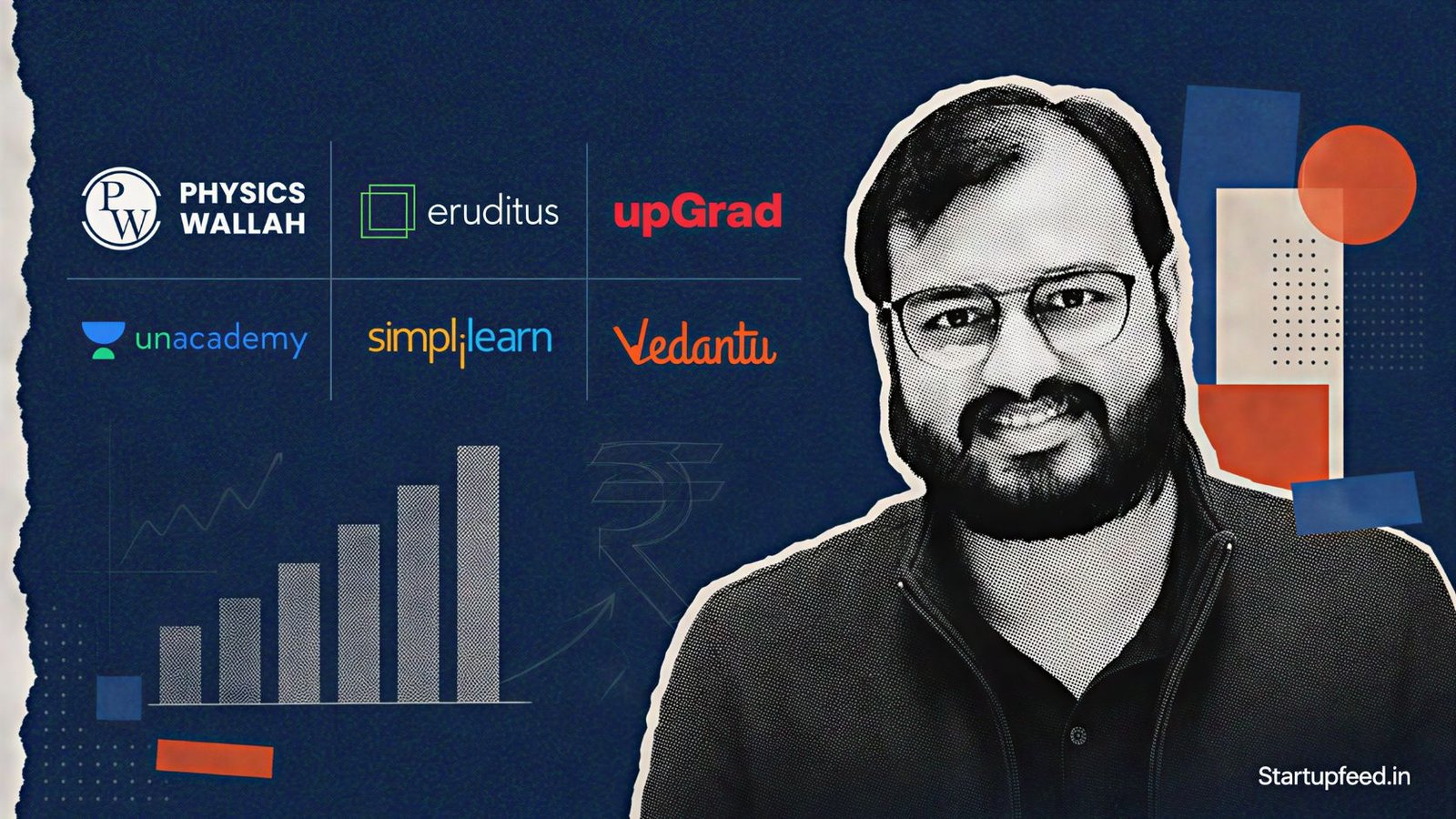
India’s seven biggest edtech companies run five distinct edtech business models, each built for a different customer, a different price point, and a different answer to the same question: what should education cost? The seven companies are PhysicsWallah, Eruditus, upGrad, Unacademy, Simplilearn, Vedantu, and BYJU’S.
The gap across these edtech business models is stark. PhysicsWallah charges Rs 4,500 for a one-year JEE (Joint Entrance Examination, the national test for engineering college admissions) course. Eruditus charges Rs 15 Lakh for an MIT Sloan executive program. Companies thriving in 2026 sit at one extreme or the other. Those that built edtech business models targeting the Rs 15,000 to Rs 60,000 per year range without a verifiable outcome are being acquired, restructuring, or facing insolvency. The barbell is real, and the data across seven companies confirms it.
StartupFeed Insight
The data across India’s seven biggest edtech business models reveals three survival traits: near-zero CAC (Customer Acquisition Cost, how much you spend to acquire one paying student) via organic platforms like YouTube, institutional credibility through global university brands, or provable placement outcomes. Every company that charged Rs 15,000 to Rs 60,000 per year without verifiable results is being acquired (Unacademy), contracting (Simplilearn’s self-paced arm), or in insolvency (BYJU’S). The edtech business models that win long-term make education either undeniably affordable or outcome-guaranteed. By Q4 FY27, StartupFeed expects the combined upGrad-Unacademy entity to post its first EBITDA-positive quarter, but only if product integration stays on schedule through the remainder of FY26. By StartupFeed Desk.
Seven Companies, Five Edtech Business Models
India’s seven largest edtech companies are home to five distinct edtech business models, running across seven companies that collectively raised over $8 Bn from global investors between 2015 and 2025, per Tracxn data and company disclosures. They serve customers from a Class 8 student paying Rs 4,500 annually to a corporate vice-president paying Rs 15 Lakh for a program from MIT. The table below maps each company’s primary model, latest available revenue, and current financial status.
| Company | Revenue Model | Latest Revenue | Key Metric | Profit Status |
|---|---|---|---|---|
| Eruditus | University brand licensing | Rs 3,733 Cr (FY24) | 1 Mn+ learners, 80+ countries | Adj. EBITDA loss: 2% of revenue |
| PhysicsWallah | Freemium app + offline centers | Rs 2,887 Cr (FY25) | 5 Mn paid users, 200+ centers | EBITDA positive: Rs 193 Cr |
| upGrad | Online degrees + corporate B2B | ~Rs 1,574 Cr (FY25 est.) | Acquiring Unacademy (2026) | Loss: Rs 273 Cr (down 51%) |
| Unacademy | Online subscription (being acquired) | Rs 826 Cr (FY25) | Valuation: from $3.5 Bn to ~$218 Mn | Loss: Rs 436 Cr |
| Simplilearn | Live certifications + bootcamps | Rs 556 Cr (FY25) | Live learning revenue up +65% YoY | Loss: Rs 43 Cr (down 60%) |
| Vedantu | Live online tutoring | Rs 227 Cr (FY25) | Q4 FY25 collections profitable | Annual loss: Rs 200 Cr+ |
| BYJU’S | App subscription + acquisitions | N/A (insolvency) | $22 Bn peak valuation (2022) | NCLT insolvency proceedings |
upGrad FY25 revenue estimated from combined figure of Rs 2,400 Cr (upGrad + Unacademy) per Inc42’s March 2026 analysis, minus Unacademy’s standalone Rs 826 Cr. Eruditus reports on a calendar-year basis; FY25 figures not yet published. BYJU’S has no audited financials available since FY22.
About These Seven Companies
These seven companies span Bengaluru (Unacademy, Vedantu, BYJU’S, Simplilearn), Mumbai (upGrad, Eruditus), and Noida, NCR (PhysicsWallah). Founding years range from 2010 (Eruditus, Simplilearn) to 2020 (PhysicsWallah as a registered entity). Together they serve customers from a Class 6 student to a Fortune 500 executive, across three distinct segments of the Indian and global education market, funded by SoftBank, Tiger Global, Sequoia Capital India (now Peak XV), General Atlantic, and Blackstone, among others.



How PhysicsWallah Makes Money: The Freemium-to-Hybrid Machine
The freemium subscription is one of the oldest digital edtech business models: attract students with free content, then convert them to paid. PhysicsWallah has taken this further than any other Indian company. Founder Alakh Pandey built the brand on a free physics YouTube channel that now counts 11.93 crore total subscribers across all channels, per the company’s RHP (Red Herring Prospectus, the document filed before listing on a stock exchange). Students sample the free content, trust the teaching style, and then buy structured courses on the PW app.
The pricing is the core competitive weapon in PW’s edtech business models. Its one-year JEE preparation course costs approximately Rs 4,500, per the RHP, compared to Rs 75,000 to Rs 80,000 at large offline coaching institutes, per INDmoney’s IPO analysis. Because the YouTube channel handles discovery and trust-building, marketing spend stays below 10 percent of revenue. In FY25, PhysicsWallah posted Rs 2,887 Cr in total revenue. EBITDA (Earnings Before Interest, Taxes, Depreciation, and Amortization, a standard measure of operating profit) turned positive at Rs 193 Cr. Net losses narrowed 79 percent to Rs 243 Cr, down from Rs 1,131 Cr in FY24, per Business Standard and the company’s RHP filed with SEBI (Securities and Exchange Board of India).
The biggest shift in PW’s edtech business models is the offline push. Vidyapeeth centers now number over 200 locations across India. In FY25, offline revenue reached Rs 1,352 Cr, which is 45 percent of total revenue, per the RHP. The company listed via IPO (Initial Public Offering, the first sale of shares to the public) in November 2025, raising Rs 3,480 Cr at a post-IPO market valuation of approximately $4.1 Bn. It is debt-free and holds over Rs 2,000 Cr in treasury, according to company disclosures cited by Business Standard in December 2025.
How Eruditus and upGrad Make Money: Premium Edtech Business Models That Charge Lakhs
University brand licensing is one of the highest-margin edtech business models when run at scale. Eruditus, founded in 2010 by Ashwin Damera and Chaitanya Kalipatnapu in Mumbai, does not build new universities. It licenses the brands of existing institutions, MIT Sloan, Columbia Business School, INSEAD, Harvard, and over 80 more global partners, then builds, markets, and teaches executive programs on their behalf. Eruditus handles all student acquisition and delivery. The university provides its brand name and curriculum input. Eruditus takes the larger share of program fees; the university receives a royalty. Programs cost Rs 2 Lakh to Rs 15 Lakh per participant.
Eruditus posted Rs 3,733 Cr in revenue for FY24, a 12 percent rise year-on-year, per the company’s April 2025 financial announcement. Its adjusted EBITDA loss came in at just Rs 69 Cr, or 2 percent of revenue, per the same announcement, signaling near-breakeven operations at significant scale. The company raised $814 Mn in total funding from SoftBank Vision Fund 2, Accel, Prosus, and the Chan Zuckerberg Initiative, per Tracxn. Eruditus also deferred recognition of Rs 800 Cr in collected revenue into FY25, per its own disclosure, suggesting FY25 published figures will be materially higher.
upGrad runs a different version of premium edtech business models. Founded in 2015 by Ronnie Screwvala, Mayank Kumar, and Phalgun Kompalli in Mumbai, upGrad sells formal online degree programs (Rs 3 Lakh to Rs 10 Lakh per program, lasting 12 to 18 months) in partnership with universities like IIT Bombay and Manipal. It also earns from B2B (business-to-business) corporate training contracts with large enterprises. upGrad’s FY25 revenue is estimated at approximately Rs 1,574 Cr, derived from the combined upGrad and Unacademy figure of Rs 2,400 Cr reported by Inc42 in March 2026, minus Unacademy’s standalone Rs 826 Cr. Losses narrowed to Rs 273 Cr in FY25 from Rs 559 Cr in FY24, per Business Standard. In March 2026, upGrad signed a term sheet to acquire Unacademy in a 100 percent share-swap deal, confirmed publicly by Gaurav Munjal, Unacademy’s CEO.
Vedantu and Simplilearn: Why Live Instruction Beat Self-Paced Edtech Business Models
Live instruction has proven itself as the most durable format across competing edtech business models in India. Both Vedantu and Simplilearn show exactly why, from opposite directions.



Vedantu, founded in 2014 by Vamsi Krishna, Pulkit Jain, Anand Prakash, and Saurabh Saxena in Bengaluru, focuses on live online tutoring for Classes 6 to 12. Revenue grew 23 percent in FY25 to Rs 227 Cr from Rs 185 Cr in FY24, per its RoC (Registrar of Companies) filings sourced by Entrackr. Online tutoring accounts for 87 percent of Vedantu’s total operating revenue. In Q4 FY25, the company turned profitable on a collections basis, reaching Rs 90 Cr in quarterly collections, a 67 percent year-on-year rise, per CEO Vamsi Krishna’s LinkedIn post in May 2025. FY25 cash burn dropped 30 percent to Rs 70 Cr for the full year, per the same disclosure.
Simplilearn’s FY25 data makes the case even more starkly for live edtech business models. The PE (private equity) backed certification platform, backed by Blackstone and GSV Ventures with $118 Mn raised in total per Entrackr, saw its self-paced online course revenue collapse 95 percent in FY25, from Rs 451 Cr in FY24 to just Rs 23 Cr. At the same time, revenue from live learning programs surged 65 percent to Rs 565 Cr, per its RoC filings sourced by Entrackr. Total revenue fell 26 percent to Rs 556 Cr, but losses narrowed 60 percent to Rs 43 Cr. The data is unambiguous: self-paced online courses in professional certification are effectively dead. Live bootcamps with a cohort, a mentor, and a structured outcome still sell.
Which Edtech Business Models Are Winning in 2026?
BYJU’S is the clearest case study for what happens when edtech business models charge premium prices without a provable outcome. Founded in 2011 by Byju Raveendran in Bengaluru, the company charged Rs 20,000 to Rs 75,000 per year for app subscriptions. It spent approximately $950 Mn to acquire Aakash Educational Services and approximately $300 Mn to acquire WhiteHat Jr, a kids’ coding platform, in a rapid expansion spree. At its 2022 peak, investors valued BYJU’S at $22 Bn, making it India’s most valuable startup. By 2026, the company is in NCLT (National Company Law Tribunal, the court that handles corporate insolvency) proceedings, per multiple reports, with no audited financials since FY22.
The sector data points to exactly two viable edtech business models. The first is ultra-affordable with organic CAC: PhysicsWallah’s YouTube-to-Rs 4,500 funnel keeps costs structurally low and scales with content, not cash. Its EBITDA turned positive at Rs 193 Cr in FY25 with marketing below 10 percent of revenue. The second is institutional-grade premium: Eruditus’s Rs 2 to 15 Lakh executive programs carry the trust of MIT and Columbia, justifying a fee that students pay because employers recognize the credential. Both models deliver a specific, nameable outcome.
The middle market, Rs 15,000 to Rs 60,000 per year for undifferentiated content subscriptions, has no winner. Unacademy is being acquired at a 90 percent valuation discount from its 2021 peak, per Outlook Business and TechCrunch. BYJU’S is in insolvency. Simplilearn’s old self-paced arm is nearly gone. The lesson from all seven edtech business models runs in one direction: charge very little with organic reach, or charge a lot with a provable outcome. Everything in between has failed.
What’s Next
The upGrad-Unacademy merger is the most important edtech event to track through FY26. If two loss-making companies can integrate quickly enough to cut overlapping costs, the combined entity may post its first EBITDA-positive quarter by Q2 FY27. Watch for their first consolidated results. Meanwhile, PhysicsWallah’s Rs 2,000 Cr-plus war chest from its IPO gives it room to expand internationally. Will a Rs 4,500 JEE course model travel to Southeast Asia or the Middle East? That is the defining question for PW’s next chapter. Let us know what you think in the comments.
Frequently Asked Questions
Have a tip? Write to us at editorial@startupfeed.in.
Liked this story? Follow StartupFeed on Google so our reporting reaches you first.