
Quick Take
- Nvidia became the first chip firm to cross $100 Bn in annual revenue, with FY2026 hitting $215.9 Bn.
- Global semiconductor revenue reached $793 Bn in 2025, a +21% jump powered entirely by AI demand.
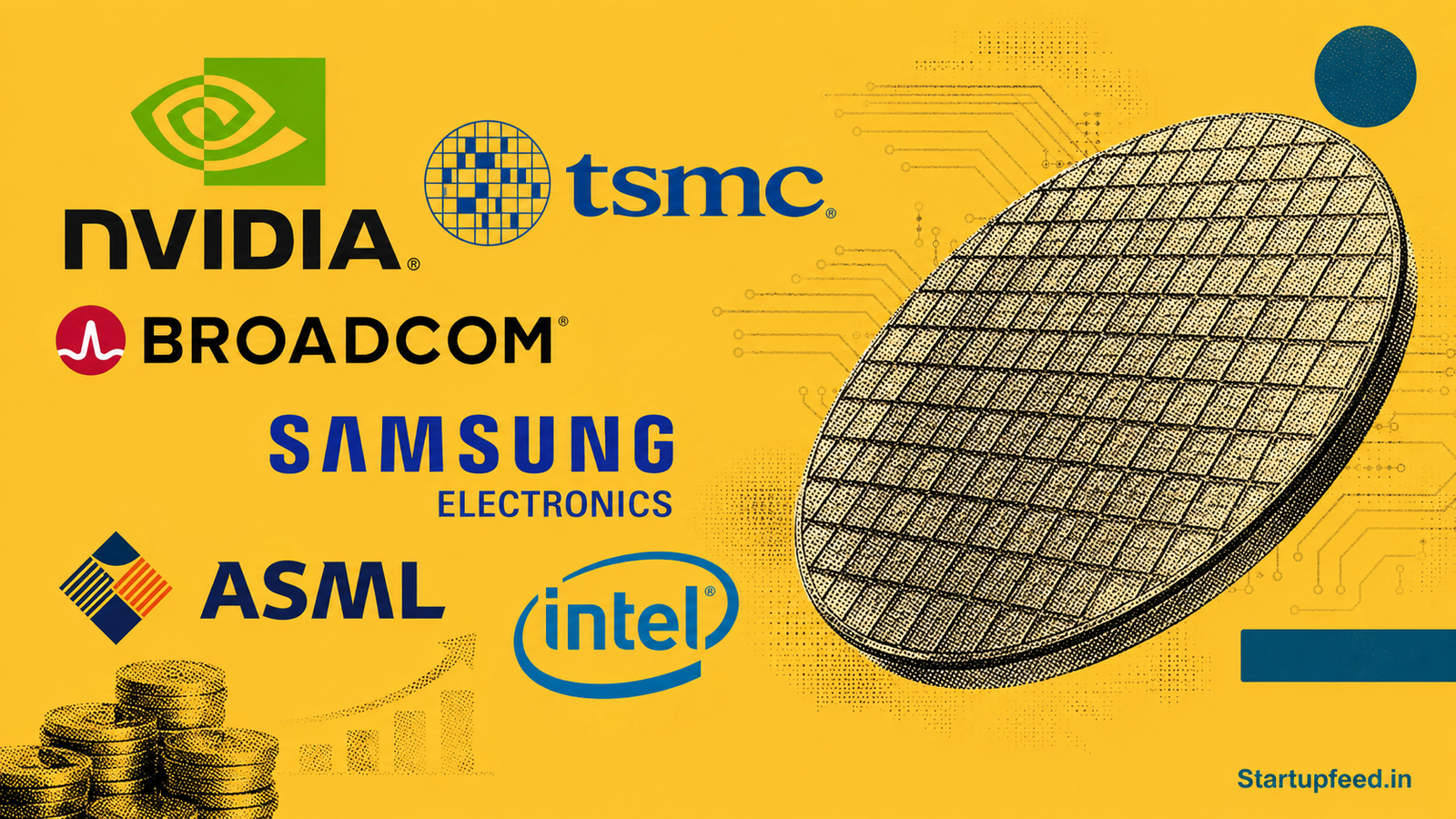
- These 12 companies power every AI model, data center, smartphone, and car sold on earth today.
The world’s biggest semiconductor companies generated $793 Bn in combined industry revenue in 2025, up +21% from the year before, the fastest growth the sector has seen in a decade. Artificial intelligence (AI) spending drove almost all of it.
This list covers all three layers of the semiconductor supply chain: the fabless designers who draw the blueprints, the manufacturers who build the chips, and the equipment makers whose machines make it physically possible. These 12 companies set the tempo for the entire global technology economy in 2026.
StartupFeed Insight
The number that reveals the most about 2026 is not Nvidia’s $4.8 Tn market cap. It is TSMC’s position in the middle of every product on this list. Nvidia designs the chip. AMD designs the chip. Apple designs its own chip. All of them wait in TSMC’s queue. When TSMC announces a CoWoS advanced packaging bottleneck, the entire AI buildout slows. For founders building AI-native products in India and anywhere outside the US, Taiwan, and South Korea, supply chain concentration is the single largest systemic risk to watch through 2028, by the StartupFeed Desk.
Why Are the Biggest Semiconductor Companies Worth Trillions?
Two forces reshuffled the biggest semiconductor companies rankings in the last three years. First, the AI boom created sudden, massive demand for specialized chips that only a handful of firms can supply. Second, chips moved from supporting technology to being the technology. Every dollar spent on AI infrastructure flows through at least one company on this list.
According to Gartner, a technology research firm, AI semiconductors including AI processors, HBM (High Bandwidth Memory, a type of fast chip memory stacked in 3D layers), and networking components accounted for nearly one-third of total global chip sales in 2025. AI infrastructure spending is forecast to surpass $1.3 Tn in 2026 alone.
The Biggest Semiconductor Companies Ranked: Full Data Table
The table below ranks companies by market capitalisation (the total stock market value of a company) as of May 2026. Revenue figures use the most recently reported full fiscal year. All figures are in USD.

| # | Company | HQ Country | Type | Latest Revenue | Market Cap (May 2026) |
|---|---|---|---|---|---|
| 1 | Nvidia | USA | Fabless | $215.9 Bn (FY2026) | ~$4.8 Tn |
| 2 | TSMC | Taiwan | Foundry | $122.9 Bn (2025) | ~$2.0 Tn |
| 3 | Broadcom | USA | Fabless + Software | $63.9 Bn (FY2025) | ~$1.9 Tn |
| 4 | SK Hynix | South Korea | Memory | $61 Bn (2025, Gartner) | ~$909 Bn |
| 5 | ASML | Netherlands | Equipment | $35.5 Bn (2025) | ~$500 Bn |
| 6 | Micron | USA | Memory | $37.4 Bn (FY2025) | ~$120 Bn |
| 7 | AMD | USA | Fabless | ~$29 Bn (estimated 2025) | ~$350 Bn |
| 8 | Samsung | South Korea | IDM + Memory | ~$73 Bn semi (2025, Gartner) | Part of Samsung Electronics conglomerate |
| 9 | Applied Materials | USA | Equipment | $28.4 Bn (FY2025) | ~$200 Bn |
| 10 | Intel | USA | IDM + Foundry | ~$53 Bn (estimated 2025) | ~$110 Bn |
| 11 | Texas Instruments | USA | IDM (Analog) | $17.7 Bn (FY2025) | ~$170 Bn |
| 12 | Lam Research | USA | Equipment | $18.4 Bn (FY2025) | ~$100 Bn |
Note: Samsung’s market cap reflects the full Samsung Electronics conglomerate (consumer electronics, displays, and semiconductors combined). AMD and Intel 2025 revenues are estimated from quarterly filings; full-year results pending disclosure at time of publication.
How does the global semiconductor supply chain work?
These 12 companies fall into four types. Understanding each type explains why some companies are worth more than others despite lower revenues.
Chip Designers: Nvidia, Broadcom, AMD
Nvidia (NASDAQ: NVDA) is the world’s most valuable semiconductor company. Its GPU (Graphics Processing Unit) chips power virtually all large AI model training. FY2026 revenue hit a record $215.9 Bn (up +65% from FY2025), with data centre revenue alone reaching $193.7 Bn. Jensen Huang co-founded Nvidia in 1993 in Santa Clara. The company does not manufacture its own chips. It designs them and sends the blueprints to TSMC. CEO: Jensen Huang.
Broadcom (NASDAQ: AVGO) designs custom AI accelerators and Ethernet networking chips for hyperscalers (very large cloud companies like Google, Meta, and Apple). FY2025 revenue was $63.9 Bn (semiconductor plus infrastructure software). AI semiconductor revenue grew +74% in the final quarter of FY2025 to $18 Bn for the quarter alone. CEO: Hock Tan. Founded: 1991 (as Avago; merged with original Broadcom in 2016). HQ: Palo Alto, California.
AMD (NASDAQ: AMD) designs EPYC (pronounced “epic”) server CPUs and Instinct AI accelerator GPUs. Its market cap of approximately $350 Bn reflects its position as Nvidia’s nearest competitor in AI chips. AMD signed major AI supply deals with OpenAI in 2025. CEO: Lisa Su. Founded: 1969. HQ: Santa Clara, California.
Memory Makers: Samsung, SK Hynix, Micron
Samsung Electronics is the world’s largest producer of memory chips by volume. Its semiconductor segment generated approximately $73 Bn in revenue in 2025 (Gartner), driven by DRAM (Dynamic Random-Access Memory, the main working memory inside a computer) up +13% and offset by a -8% decline in non-memory chip revenue. Samsung is also one of the few companies that both designs and manufactures its own advanced chips, making it an IDM (Integrated Device Manufacturer). HQ: Suwon, South Korea.
SK Hynix moved to the global number 3 semiconductor revenue position in 2025 with $61 Bn, up +37% year on year. The driver is HBM. HBM is the specialised memory that sits on the same chip package as Nvidia’s H100 and H200 GPUs, enabling the very fast data transfer speeds that AI training demands. SK Hynix is the leading HBM supplier globally. Market cap: approximately $909 Bn as of May 2026. HQ: Icheon, South Korea.


Micron Technology (NASDAQ: MU) is the only US-based memory manufacturer. FY2025 (ending August 2025) revenue was $37.4 Bn. HBM revenue within Micron grew nearly +50% sequentially in Q3 FY2025 alone. Micron announced a $200 Bn US domestic investment plan, the largest in American semiconductor history. CEO: Sanjay Mehrotra. Founded: 1978. HQ: Boise, Idaho.
Manufacturers and IDMs: TSMC, Intel
TSMC (NYSE: TSM, Taiwan Stock Exchange: 2330) is the world’s largest contract chipmaker. It manufactures chips for Nvidia, Apple, AMD, Qualcomm, and hundreds of others. Revenue in 2025 was $122.9 Bn (up +31.6%). TSMC’s 2nm (N2) node entered volume production in 2026, using Gate-All-Around (GAA, a new transistor architecture that reduces power consumption by about 30%) technology. Its CoWoS advanced packaging is currently the bottleneck for the AI chip industry. Founded: 1987 by Morris Chang. HQ: Hsinchu, Taiwan.
Intel (NASDAQ: INTC) held the number 1 semiconductor revenue position for most of the 2010s. By 2025, its global market share had fallen to 6%, half of what it was in 2021, according to Gartner. Estimated full-year 2025 revenue stands at approximately $53 Bn (based on quarterly filings; Q1 $12.7 Bn, Q2 $12.9 Bn, Q3 $13.7 Bn). New CEO Lip-Bu Tan, who joined in March 2025, is rebuilding Intel around its foundry business and a tighter product focus. Founded: 1968 by Gordon Moore and Robert Noyce. HQ: Santa Clara, California.
Equipment Makers: ASML, Applied Materials, Lam Research, Texas Instruments
ASML (NASDAQ: ASML) is the sole manufacturer of EUV (Extreme Ultraviolet) lithography machines, the equipment that prints the tiniest chip patterns. Without ASML’s machines, TSMC, Samsung, and Intel cannot make advanced chips at 3nm or below. Each machine costs approximately $200 Mn and contains over 100,000 components. Full-year 2025 revenue was €32.7 Bn (about $35.5 Bn), up +16%. CEO: Christophe Fouquet. Founded: 1984. HQ: Veldhoven, Netherlands. Market cap: approximately $500 Bn.
Applied Materials (NASDAQ: AMAT) is the largest semiconductor equipment company by revenue, supplying deposition, etching, and materials engineering tools to chipmakers globally. FY2025 revenue was $28.4 Bn. HQ: Santa Clara, California. CEO: Gary Dickerson. Founded: 1967.
Lam Research (NASDAQ: LRCX), founded in 1980 by David K. Lam, specialises in etch and deposition equipment used across every chip manufacturing step. FY2025 revenue was $18.4 Bn. CEO: Tim Archer. HQ: Fremont, California.
Texas Instruments (NASDAQ: TXN) is the world’s largest maker of analog chips, the simpler but critical semiconductors that convert real-world signals (temperature, pressure, sound) into digital data. FY2025 revenue was $17.7 Bn, up from $15.6 Bn in FY2024 (+13%). Its chips go into every industrial machine, electric vehicle, and home appliance. CEO: Haviv Ilan. Founded: 1951. HQ: Dallas, Texas.
What’s Next
Four milestones will reshape this ranking by end-2026. First, TSMC’s 2nm yield rates will determine how fast Nvidia’s next-generation Rubin GPU launches at scale. Second, SK Hynix’s HBM4 ramp will test whether it can hold its lead over Samsung in AI memory. Third, Intel’s foundry business must win at least one major external customer beyond Nvidia to prove its turnaround. Fourth, ASML’s first high-NA (next-generation EUV) machine deliveries will set the pace for 2nm-and-below chip production globally. Will any company outside the US, Taiwan, and South Korea break into this list by 2027?
Frequently Asked Questions
Which are the biggest semiconductor companies in the world in 2026?
The biggest semiconductor companies by market cap in 2026 are Nvidia ($4.8 Tn), TSMC ($2.0 Tn), Broadcom ($1.9 Tn), SK Hynix ($909 Bn), and ASML ($500 Bn). By semiconductor revenue in 2025 (Gartner), the top three are Nvidia, Samsung, and SK Hynix. Nvidia was the first chip company to cross $100 Bn in annual semiconductor revenue.
Why is Nvidia the most valuable semiconductor company?
Nvidia’s GPU chips are the primary hardware used to train and run large AI models. FY2026 revenue reached $215.9 Bn, up +65% from the year before, driven entirely by data centre demand. Its H100, H200, and Blackwell GPU families are used by every major cloud provider and AI lab. The company is fabless, meaning it designs chips but outsources manufacturing entirely to TSMC.
What is the difference between a fabless company and a foundry?
A fabless company (like Nvidia, AMD, and Broadcom) designs chips but does not own manufacturing factories. A foundry (like TSMC) owns the factories and manufactures chips for others. An IDM (Integrated Device Manufacturer, like Intel and Samsung) both designs and manufactures its own chips. Equipment makers (ASML, Applied Materials, Lam Research) supply the machines that foundries and IDMs use to build chips.
Disclaimer: This article is for informational purposes only and does not constitute investment advice. StartupFeed and its authors are not SEBI-registered investment advisors. Market capitalisation figures are approximate and change daily. Revenue figures are sourced from company filings and Gartner research. Please consult a SEBI-registered financial advisor before making investment decisions.
Liked this story? Follow StartupFeed on Google so our reporting reaches you first.