
Quick Take
- Modi named seven strength streams, called Saptadhara, in his 80th Independence Day speech on August 15, 2026.
- Three of the seven map to deeptech: technology, defence and green energy.
- The Centre will train 1 crore youth in AI over the next year.
Prime Minister Narendra Modi named seven strength streams for India’s future on August 15, 2026, and three of them point straight at India’s deeptech startups.
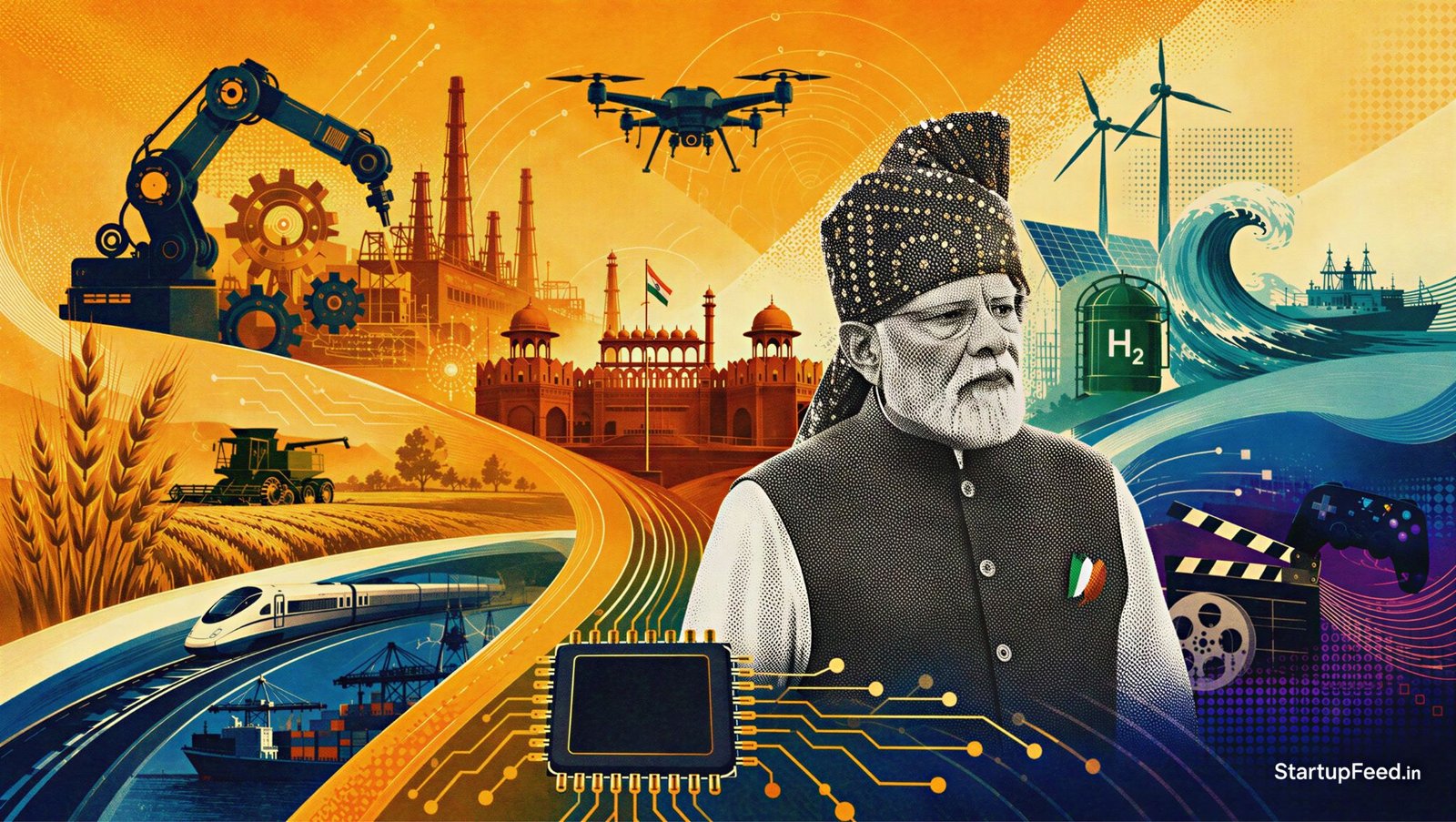
He called the framework Shakti Ki Saptadhara in his 80th Independence Day speech from the Red Fort. According to ANI, the seven streams cover manufacturing, agriculture, technology, connectivity, defence, green energy and soft power.
The speech set direction, not new schemes. For founders, its value is the signal it sends about where the government wants private builders to move next.
India already runs the world’s third-largest startup ecosystem, with over 2.1 lakh DPIIT-recognised startups and more than 100 unicorns. Recognised startups now span every state and Union Territory, not just Bengaluru, Delhi and Mumbai. Saptadhara tells those founders which doors the government wants opened next.
What are the seven streams of Modi Saptadhara?
Modi Saptadhara names seven areas he calls India’s core strengths, and he listed each one from the Red Fort. Here they are, with the startup read on each.
- Manufacturing: a full value chain from design to production, built to meet global cost, quality and scale.
- Agriculture and food processing: farm to export on the back of new trade deals, with millets and spices as global brands.
- Technology and innovation: AI, quantum, space, robotics and data centres, plus Made in India 6G for the world.
- Connectivity, or Gati Shakti: high-speed rail, highways, waterways, airports and ports, with port-led growth.
- Defence production: self-reliance, next-generation defence technology, and India as a global supplier.
- Green energy: green hydrogen, renewables and energy storage, plus the blue economy of fisheries and ocean technology.
- Soft power: Yoga, Ayurveda, handicrafts, films, animation, gaming and digital content.
Which streams matter most for startups?
Three of the seven map directly to venture-backed sectors: technology, defence and green energy. The technology stream is the clearest, since Modi named AI, quantum, space, robotics and data centres together. He pointed to UPI and Digital Public Infrastructure as proof India can build at scale. His next target is Made in India 6G, for every corner of the world.
Defence is the fifth stream. He wants India self-reliant, or Atmanirbhar, and then a global supplier of next-generation defence technology. Defence-tech startups building drones, sensors and secure systems sit inside that goal.
Green energy is the sixth stream, where Modi asked for global leadership in green hydrogen, renewables and energy storage. He also named the blue economy of fisheries, coastal tourism and ocean technology, giving climate-tech founders a named national priority.
Manufacturing led the whole list, and it feeds the technology story. He urged manufacturers not to let the current global supply-chain shift slip away. India’s electronics manufacturing has grown sixfold in 11 years, Modi said in February 2026, and mobile phone exports rose 100-fold over that period. Made in India chips now sit behind AI, 6G, defence and EVs.
Three more streams carry startup hooks. Connectivity names ports, waterways and logistics hubs, which is logistics-tech ground. Agriculture ties farming to food processing and exports, which is agritech ground. Soft power covers films, animation, gaming and digital content, the creator economy the WAVES summit is built around.
What did Modi announce for skills and talent?
The biggest concrete number was on skills. The Centre will train 1 crore youth in AI over the next year, per Business Today and India TV. That target is ten times a plan from January 2026, when IT Minister Ashwini Vaishnaw launched AI skilling for 10 lakh youth in a year. Modi’s 1 crore is a ten-fold jump in seven months. For AI startups, that is a talent-supply signal, not just a welfare line.
Modi also promised free online coaching for competitive exams, and a sports talent hunt for children aged 5 to 15. On chips, he said India will add more semiconductor plants in the next seven to eight years.
Each of these feeds the same story: India wants more skilled builders, faster. A founder hiring AI engineers in 2027 should feel this pipeline. He tied it all to one deadline, Viksit Bharat by 2047.
Does Saptadhara come with money or schemes?
No. The speech named priorities, not funds, and Modi gave no new scheme, fund size or eligibility rules for any of the seven streams. That detail usually comes later.
A speech sets direction. A scheme sets terms. This was the first, not the second, so founders should watch the next Union Budget, DPIIT and the IT ministry for the programmes that follow.
The pattern is already visible. In February 2026, DPIIT created a formal deep tech startup category, with a 20-year recognition window and a Rs 300 crore turnover ceiling. India has already approved semiconductor projects worth about Rs 1.52 lakh crore. Green hydrogen has a national mission, launched in 2023. Saptadhara is the direction, and the terms come next.
What this means for you: If you build in AI, defence-tech, climate-tech or the creator economy, track the Budget and ministry notifications closely. The scheme that funds this vision has not been written yet.
StartupFeed Insight
Read Saptadhara as a shopping list of sectors the government wants private capital to fund. Three of them, technology, defence and green energy, already draw the most venture money in India. By itself, the speech does not move a single rupee today. Its real value is the signal it sends to the officials who will write schemes over the next year. Expect at least one named central scheme tied to a Saptadhara stream, most likely AI skilling or defence-tech, before the February 2027 Union Budget. Watch that Budget, not this speech, for the terms that will matter.
— Avinash Mishra, Business Correspondent
Frequently Asked Questions
Liked this story? Follow StartupFeed on Google so our reporting reaches you first.