
Quick Take
- Samsung hits $1 trillion market cap after shares surged 15% on May 6, 2026.
- Q1 2026 revenue reached $90 Bn, with operating profit rising 753% year on year.
- Samsung is the world’s first company to mass-produce HBM4 chips for NVIDIA’s AI platform.
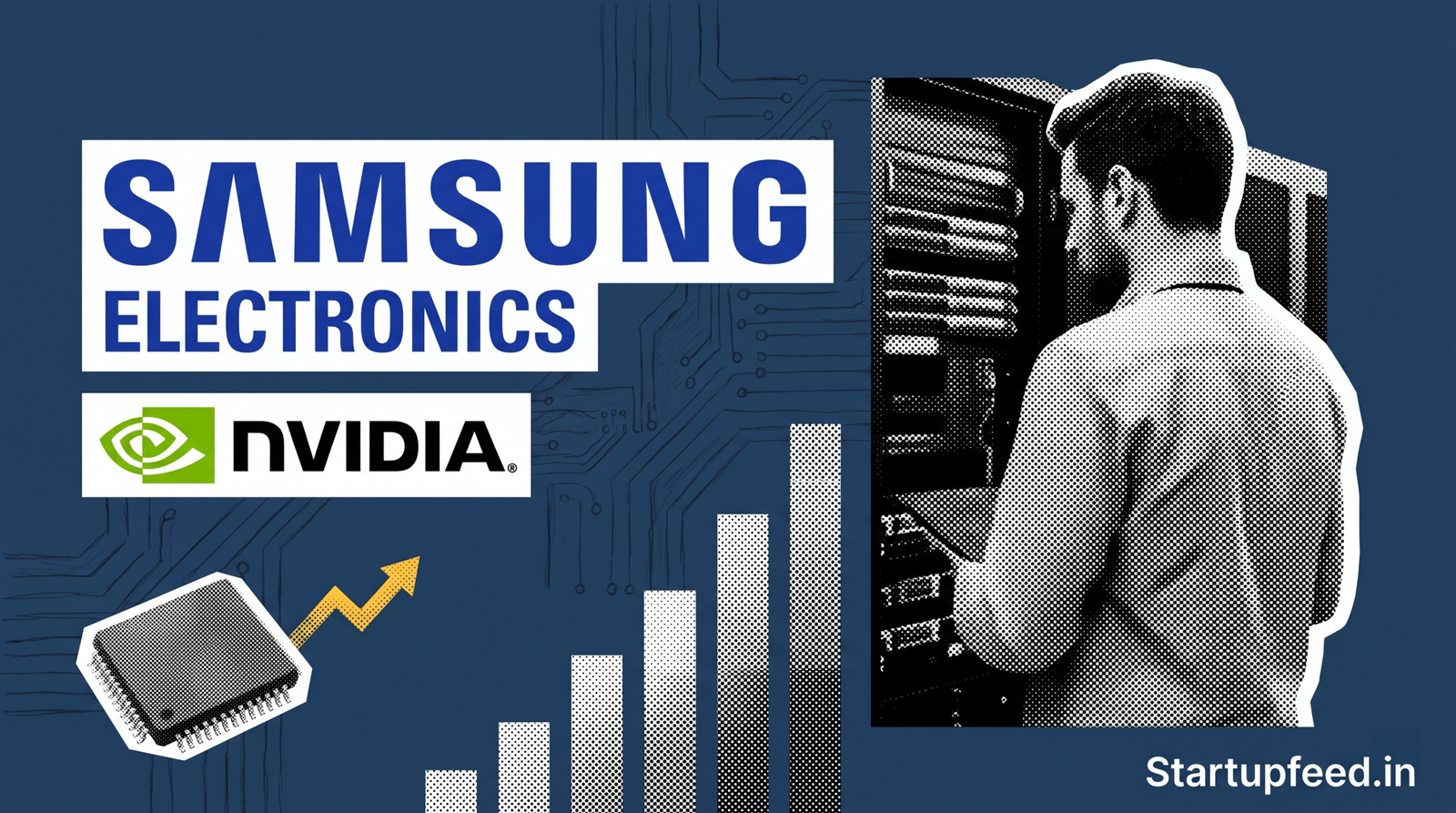
Samsung hits $1 trillion in market capitalisation on May 6, 2026, making it only the second Asian company after TSMC to cross that threshold, as surging global demand for high-bandwidth AI memory chips drove its stock up 15% in a single trading session.
The milestone did not arrive in isolation. It followed Samsung’s best quarter on record — Q1 2026 revenue of KRW 133.9 trillion (approximately $90 Bn, or Rs 7,56,000 Cr) and operating profit of KRW 57.2 trillion (approximately $38.6 Bn), up 753% year on year. More than 90% of that operating profit came from the semiconductor division alone. For Indian AI founders, investors, and chip-procurement teams, this tells one unmistakable story: the global supply chain for advanced AI memory is tightening fast, and the companies controlling it are getting very large, very fast.
StartupFeed Insight
The $1 trillion figure conceals a structural warning that every Indian AI infrastructure startup should read carefully. Samsung’s semiconductor division contributed over 90% of Q1 2026 operating profit, while its mobile division’s profitability fell 35% year on year. This is not a diversified tech company anymore — it is effectively a memory chipmaker that also sells phones. That concentration means Samsung will continue prioritising its largest AI customers (NVIDIA, Google, hyperscalers) over smaller buyers. Indian AI startups dependent on commodity DRAM or HBM3 allocation should expect tighter supply and higher prices through at least H2 2026. Expect Samsung to announce a dedicated hyperscaler co-investment partnership — possibly with a Gulf sovereign fund or a US cloud major — before the end of 2026. — StartupFeed Desk
Deal Breakdown
| Metric | Detail | Notes |
|---|---|---|
| Market Capitalisation | $1 Trillion (Rs 84,00,000 Cr) | Reached May 6, 2026 |
| Q1 2026 Revenue | KRW 133.9 Tn (~$90 Bn) | +70% YoY; all-time quarterly record |
| Q1 2026 Operating Profit | KRW 57.2 Tn (~$38.6 Bn) | +753% YoY; 8x full-year 2025 profit |
| Q1 2026 Net Profit | KRW 47.22 Tn (~$31.8 Bn) | Up from $5.5 Bn in Q1 2025 |
| Share Price Rally (Single Day) | +15% | Triggered the $1 Tn crossing |
| Stock Performance (Past Year) | ~4x (nearly quadrupled) | Year-to-date gain: ~90% |
| HBM Revenue Growth Target (2026) | More than 3x vs 2025 | Samsung guidance, Q1 2026 earnings call |
The most striking figure is operating profit of $38.6 Bn in a single quarter — that is nearly equal to Samsung’s entire operating profit for the full year of 2025 ($29.2 Bn), delivered in just 90 days.
About Samsung Electronics
Samsung Electronics Co., Ltd. is a South Korean multinational headquartered in Suwon, South Korea, founded in 1969. It is the world’s largest memory chip manufacturer and second-largest semiconductor company by revenue. Its core divisions are Device Solutions (semiconductors), Mobile Experience (Galaxy phones), and Consumer Electronics (TVs, appliances). Samsung operates one of the largest consumer electronics businesses in India, with manufacturing in Noida and a top-three smartphone market share. Key institutional investors include the National Pension Service of South Korea and global index funds tracking the Kospi.
Why Samsung Hits $1 Trillion: The HBM4 Advantage
The proximate cause of the $1 trillion crossing is Samsung’s dominant position in high-bandwidth memory (HBM), the specialised chip architecture that sits inside every major AI accelerator. Samsung announced in February 2026 that it became the world’s first company to mass-produce HBM4 — the sixth-generation and most advanced version of the technology. It began shipping these chips to NVIDIA for the Vera Rubin AI accelerator platform, which is scheduled for commercial rollout in the second half of 2026.

Ray Wang, analyst at SemiAnalysis, noted that Samsung narrowed the performance gap with rival SK Hynix in HBM4 versus previous generations. That matters because SK Hynix had held roughly two-thirds of NVIDIA’s HBM supply for the Blackwell generation. Samsung’s HBM4 win signals a meaningful share recapture.
“Memory is firmly establishing its independent position as the deciding factor in the success or failure of AI infrastructure,” said Jeongku Choi, research analyst at Counterpoint Research.
Samsung also guided that HBM revenue for full-year 2026 will more than triple versus 2025, and plans to ship its first HBM4E samples in Q2 2026 to maintain its technology lead heading into 2027.
How Does Samsung Compare to Its Closest Rivals?
| Company | Q1 2026 Revenue | Market Cap (May 2026) | HBM Generation |
|---|---|---|---|
| Samsung Electronics | ~$90 Bn | $1 Tn | HBM4 (mass production) |
| SK Hynix | Not disclosed (Q1 2026 margin: 72%) | ~$130 Bn | HBM4 (samples; mass production imminent) |
| TSMC | ~$25 Bn (Q1 2026) | ~$1.1 Tn | Logic foundry (CoWoS packaging for HBM) |
Samsung’s advantage is vertical integration: it designs, manufactures, and packages its own HBM stacks without depending on external foundries for the memory itself. That self-sufficiency is now worth $1 trillion.
What’s Next
Watch for Samsung’s Q2 2026 earnings in late July, which will show whether HBM4E shipments add another margin step-up or whether supply loosens and pricing resets. The bigger test arrives in H2 2026, when NVIDIA’s Vera Rubin platform launches commercially: Samsung’s ability to meet Vera Rubin allocation demand will determine whether it can sustain or grow its HBM market share against SK Hynix. For Indian semiconductor and AI infrastructure startups, the more immediate question is: will tightening HBM supply cascade down to commodity DRAM pricing in your server stack?
Frequently Asked Questions
How did Samsung hits $1 trillion in market cap, and what drove it?
Samsung hits $1 trillion in market capitalisation on May 6, 2026, after its stock rose 15% in a single session on the Seoul exchange. The primary driver was record Q1 2026 earnings: $90 Bn in revenue and $38.6 Bn in operating profit, both all-time highs, powered by AI chip demand for its HBM4 high-bandwidth memory products supplied to NVIDIA and major cloud hyperscalers.
What is HBM4, and why does it matter for AI?


HBM4 is the sixth-generation high-bandwidth memory chip, purpose-built for AI accelerators that need to move massive amounts of data between memory and processors at extreme speeds. Samsung became the world’s first company to mass-produce HBM4, shipping it to NVIDIA for the Vera Rubin AI platform. Without HBM, large language models and AI training clusters cannot operate at scale — making HBM one of the most strategically valuable chips in the world right now.
What does Samsung’s $1 trillion milestone mean for Indian AI startups?
It signals that advanced AI memory is becoming scarcer and more expensive as Samsung and SK Hynix prioritise their largest hyperscaler customers. Indian AI startups that rely on cloud computing infrastructure — which in turn depends on servers loaded with HBM — will face indirect cost pressure. Founders building AI infrastructure or data centre plays in India should monitor HBM supply allocation and DRAM spot prices closely through H2 2026.
Disclaimer: This article is for informational purposes only and does not constitute investment advice. StartupFeed and its authors are not SEBI-registered investment advisors. The analysis above is based on publicly available information and should not be the sole basis for any investment decision. Please consult a SEBI-registered financial advisor before making investment decisions.
Written by Dr. Mayank Raj. Published: May 6, 2026. Updated: May 6, 2026. Have a tip? Write to us at editorial@startupfeed.in.