
Quick Take
|
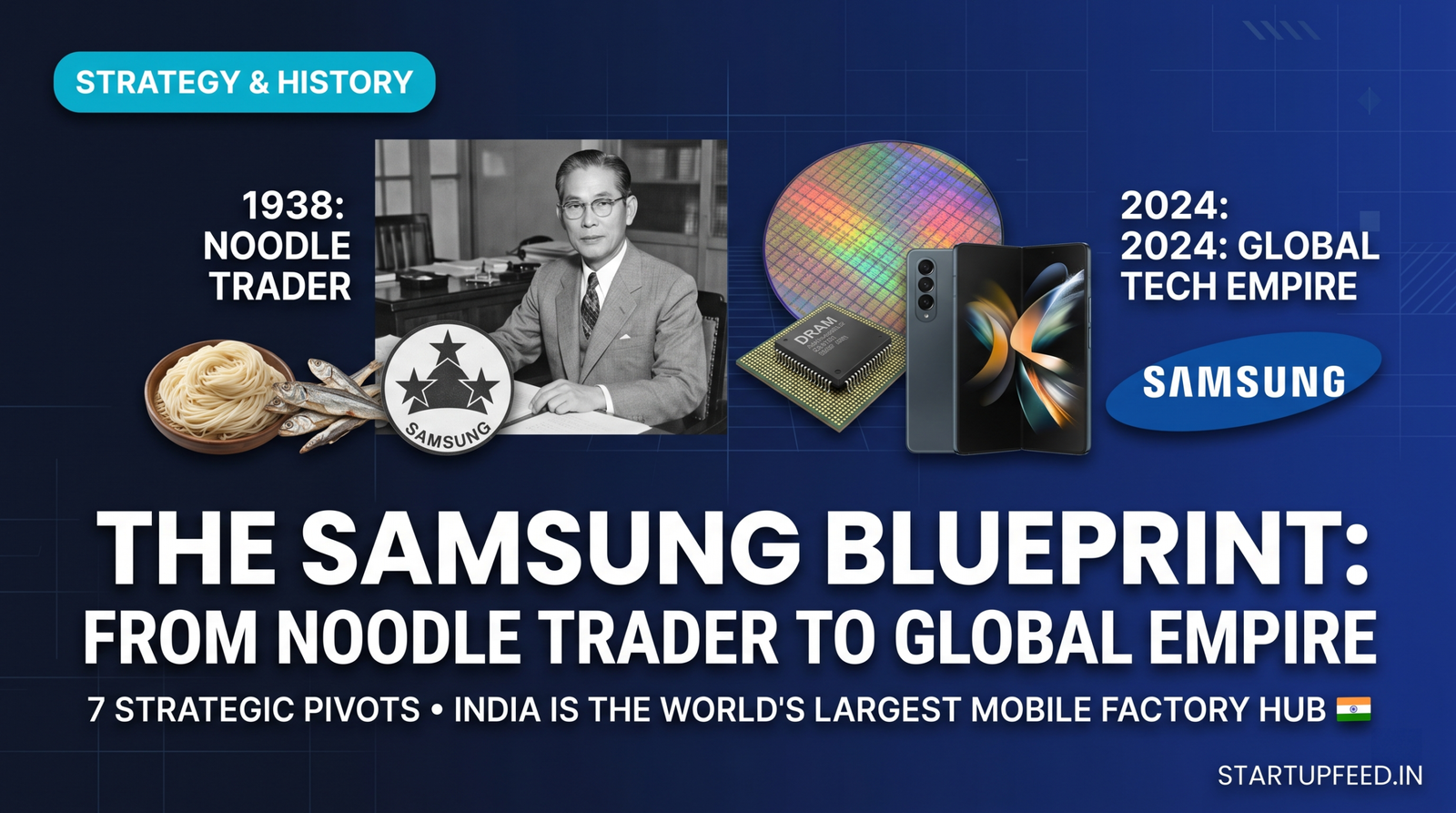
In 1938, a 28-year-old Korean entrepreneur named Lee Byung-chul started a small trading company in the city of Suwon, selling noodles, dried fish, and local produce to buyers in Manchuria and Beijing. He named it Samsung — which means ‘three stars’ in Korean, a name chosen to represent something ‘big, numerous and powerful.’ Eight decades later, Samsung Group’s annual revenues exceed the GDP of countries like Finland and Portugal. Its semiconductors are inside virtually every computing device on earth. Its smartphones are carried by 20%+ of all mobile phone users globally.
This did not happen by accident. Samsung’s ascent from noodle trader to global technology giant is one of the most deliberate, disciplined, and at times ruthless cases of corporate reinvention in industrial history. It survived the Korean War, a military junta’s forced restructuring, the 1997 Asian financial crisis, and a chairman’s jail sentence — and came out of each crisis larger than it entered. The story of how Samsung built its empire is, at its core, the story of seven strategic decisions that rewrote the rules of what a company can become.
| StartupFeed Insight — What Samsung Teaches Indian Founders The key pattern: Every time Samsung became comfortable in a business, it deliberately entered a harder, higher-margin adjacent industry. Noodles → textiles. Textiles → insurance and construction. Construction → electronics. Electronics → semiconductors. Each pivot looked insane from the outside and inevitable in hindsight. This is Samsung’s real competitive strategy: not to optimize the existing business, but to continuously cannibalize it with something harder and more defensible. What this means for Indian founders:
Our prediction: Samsung’s next decade will be defined by the foundry business — manufacturing chips for Apple, Qualcomm, NVIDIA, and others. If Samsung Foundry closes the gap with TSMC by 2028, Samsung becomes the most strategically important company on earth. India’s PLI semiconductor scheme is the first opportunity for Samsung to build a foundry presence in South Asia. That decision — whether Samsung bets on India for chip manufacturing — will shape the Indian tech ecosystem for 20 years. |
Chapter 1: The First Pivot — From Noodles to Nation-Building (1938–1969)
Samsung’s founding story carries a lesson that most startup founders overlook: the original product does not matter. The original discipline does.
Lee Byung-chul started with noodles because he understood trade — the fundamentals of buying low, moving goods efficiently, and selling at the right price. By 1948, he had pivoted the company to sugar refining under the name Cheil Sugar. By the early 1950s, he was making textiles under Cheil Woolen Mill. By the late 1950s, Samsung had entered insurance, retail, and construction through a series of acquisitions.
The Korean War (1950–1953) devastated the country but accelerated Samsung’s diversification. Lee recognized that a war-rebuilding economy needed capital, materials, and consumer goods — and Samsung was positioned in all three. Each new business was not a gamble; it was a calculated response to a specific national demand.
The first strategic lesson: Start where there is demand. Build operational discipline. Pivot into adjacent opportunities before competitors see them coming. By 1969, Samsung entered electronics — not because Lee had predicted the digital revolution, but because he saw Japanese companies printing money from consumer electronics and recognized that South Korea’s low labour costs and Lee’s manufacturing discipline gave him a structural advantage in a new industry.
| Period | Business | Why It Worked | Revenue (Est.) |
| 1938–1948 | Noodles, dried fish, dried vegetables | Trade fundamentals; Manchuria export demand | Negligible |
| 1948–1953 | Sugar refining (Cheil Sugar) | Post-war food demand; import substitution | ~$1 Mn |
| 1953–1960 | Textiles (Cheil Woolen Mill) | Rebuilding economy needs fabric; low labour cost | ~$10 Mn |
| 1960–1969 | Insurance, retail, construction | Capital accumulation; national infrastructure boom | ~$100 Mn |
| 1969 | Electronics (Samsung-Sanyo) | Japanese TV boom; cheap Korean manufacturing | First electronics revenue |
Chapter 2: The Electronics Gamble — Copying Japan to Beat Japan (1969–1983)
Samsung’s entry into electronics was not exactly original — it was shameless. The company’s first TV factory (established in partnership with Sanyo in 1969) was essentially a licensed copy of Japanese technology. Samsung assembled televisions, refrigerators, and washing machines using Japanese components and Japanese designs, learning the manufacturing process from the inside.
This was not embarrassing. It was the strategy.
Lee Byung-chul understood something that few founders grasp: the way to defeat entrenched competitors is to first become an expert imitator, then use that expertise to out-execute them in the next wave. Samsung did not try to invent a new kind of television. It mastered the art of making televisions cheaper, faster, and more reliably than anyone else. Then, once the manufacturing discipline was embedded in the company’s culture, it moved to the next wave.
The 1977 inflection: Samsung launched its first colour television with entirely domestic components — no more Japanese licensing. It had used a decade of forced knowledge transfer to build genuine in-house capability. By 1981, Samsung was exporting televisions to the United States. By 1983, it was competing directly with Sony and Panasonic in American consumer electronics stores.
“The imitation phase is not the end of the journey. It is the classroom. The exam is what you build next.”
The Samsung lesson: Do not be ashamed of learning from the best. Being a fast, disciplined follower in an established market is often cheaper and less risky than being a first mover in an untested one. The goal is to use that follower phase to build the manufacturing excellence, supply chain relationships, and quality culture that will power your next leap.
Chapter 3: The Bet That Defined Everything — Semiconductors in a Recession (1983)
In 1983, Lee Byung-chul announced that Samsung would enter the DRAM memory chip business. This was considered insane by virtually everyone who heard it:
- The global semiconductor market was in the middle of a severe recession
- Japanese companies (Hitachi, NEC, Toshiba) completely dominated the DRAM market
- Samsung had zero experience in semiconductor manufacturing
- The capital requirements were enormous — Samsung needed to build fabrication plants that cost hundreds of millions of dollars each
- American companies were retreating from the DRAM market because margins had collapsed
Lee made the bet anyway. He reasoned that the very moment when everyone else is retreating from a capital-intensive market is exactly when a well-capitalized, disciplined player should enter — because the barriers to entry have never been lower and the remaining competitors have never been weaker.
Samsung hired engineers who had worked at American semiconductor companies. It acquired technology licenses. It built its first chip fab. And then it did something that permanently changed the economics of the global memory chip market: it kept investing during every downturn, building capacity that it would need when the cycle turned. When the DRAM market recovered in 1986–87, Samsung had more capacity than any other player. It could supply chips at lower cost. And it had the quality to serve the most demanding customers — IBM and Apple.
By 1992, Samsung was the world’s largest producer of DRAM memory chips. A decade after entering an industry with no experience, against entrenched Japanese giants, during a recession, Samsung had achieved complete market leadership.
The Semiconductor Playbook — Why It Worked:
|
Chapter 4: The 1997 Fire — Crisis as Accelerant
The 1997 Asian Financial Crisis nearly destroyed Samsung. The Korean won collapsed. Credit froze. Samsung’s revenue fell by half. The company was forced to sell businesses, lay off 30,000 employees, and restructure its balance sheet under pressure from the IMF and Korean government.
What makes Samsung’s response to 1997 remarkable is not that it survived — many Korean chaebols did. What is remarkable is what it sacrificed and what it protected. Samsung sold its car manufacturing business (Samsung Motors, later acquired by Renault). It sold its satellite business. It exited financial services. It cut every business that was not at the technological frontier of its core electronics and semiconductor capabilities.
The crisis created clarity. When Samsung emerged from 1997, it was no longer a sprawling conglomerate with one foot in everything. It was a focused technology company with three core pillars: semiconductors, displays, and consumer electronics — each of which Samsung was either already leading or had a credible path to leading.
The first Lee Kun-hee move: Samsung Chairman Lee Kun-hee (who had taken over from his father Lee Byung-chul after the latter’s death in 1987) used the post-crisis restructuring to push a quality agenda that would define the next decade. His famous instruction to his engineers: “Change everything except your wife and children.” He allegedly had Rs 50+ crore worth of Samsung mobile phones and other products burned in a bonfire in front of employees — because they had quality defects. The message was permanent: Samsung would compete on quality, or not at all.
| Samsung Market Position | 1993 | 2000 | 2010 | 2023 |
| DRAM Memory | #1 globally | #1 globally | #1 globally (45%+ share) | #1 globally (43%+ share) |
| NAND Flash | — | Early entry | #1 globally | #1 globally (31% share) |
| Smartphone | Not relevant | Early mobile phones | Top 5 globally | #1 globally (~20% share) |
| Displays (OLED/LCD) | — | LCD entry | #1 globally | #1 globally |
| Semiconductor Foundry | — | — | Early stage | #2 globally (behind TSMC) |
| Television | Regional | Top 10 globally | #1 globally | #1 globally (18+ years) |
Chapter 5: The Galaxy Moment — How Samsung Became the World’s Largest Smartphone Maker
In 2007, Apple launched the iPhone and disrupted the global mobile phone market. Nokia, Motorola, and Blackberry — the dominant players — failed to respond adequately and lost their leadership positions within five years. Samsung looked like it might face the same fate: its feature phone business was enormous, and the transition to smartphones required a completely different software stack, chip architecture, and user interface philosophy.
Samsung’s response was characteristically bold. Rather than defending the feature phone business, it accelerated its pivot to smartphones, licensing Google’s Android operating system as the foundation for an entire product portfolio. The first Galaxy S launched in 2010. By 2012, Samsung had overtaken Apple as the world’s largest smartphone maker by units — a position it has held, with brief interruptions, ever since.
The strategic insight: Samsung did not need to build the operating system from scratch — Google did that. What Samsung needed to do was what it had always done: manufacture at massive scale, at the best quality, at the lowest cost per unit. By using Android as the software platform, Samsung freed itself to compete on the dimensions where it had structural advantages: hardware quality, display technology, processor design, and supply chain depth.
The vertical integration advantage: When Apple launched the iPhone, it needed suppliers for screens, memory chips, and processors. Many of those suppliers were Samsung — because Samsung was the only company on earth with the scale and quality to supply Apple’s volumes. Samsung was simultaneously Apple’s biggest competitor and biggest supplier — a remarkable position that generated billions in revenue from Apple while Samsung’s own phones competed directly with the iPhone.
Chapter 6: The 7 Strategic Decisions That Built the Empire
| Decision | Year | Context | Why It Was Brave | Outcome |
| Pivot to electronics | 1969 | Korean economy rebuilding; electronics a Japanese monopoly | Entering a foreign-dominated industry with zero IP | Became Asia’s first electronics export powerhouse |
| Bet on DRAM chips | 1983 | Global semiconductor recession; Japanese dominance | Invested billions in a market everyone else was exiting | Became #1 DRAM maker by 1992; still leads today |
| Quality purge post-crisis | 1998 | Emerging from 1997 Asian financial crisis | Burned defective products; fired 30,000; exited non-core businesses | Created a quality culture that enabled premium positioning |
| Android-first smartphone strategy | 2009 | iPhone launched 2007; Samsung had no smartphone OS | Chose Android (unproven) over building own OS | Galaxy S launched 2010; #1 smartphone maker by 2012 |
| OLED display bet | 2010s | LCD was the dominant display technology; OLED unproven at scale | Built OLED fabs at a time when yields were low and costs high | OLED is now the premium standard; Samsung supplies Apple’s iPhone screens |
| Foundry business (make chips for others) | 2017 | TSMC dominated contract chip manufacturing | Competing with your own chip customer (TSMC) is the hardest market to enter | Now #2 foundry globally; makes chips for Qualcomm, NVIDIA, Google |
| Foldable phones bet | 2019 | Flat slab form factor dominated; foldables seemed like a gimmick | First foldable (Galaxy Fold) had catastrophic screen failures at launch | By 2024, foldable market leader; proving new form factor is viable |
Chapter 7: Samsung and India — The Rs 1 Lakh Crore Bet
India is one of Samsung’s most strategically important markets — and one of its most revealing case studies in localisation strategy. Samsung entered India in 1995 with a manufacturing facility in Noida, Uttar Pradesh. What it built there over the next three decades is the world’s largest mobile phone factory — a single plant that produces more than 120 million smartphones per year.
| Samsung in India | Details |
| Market entry | 1995 — manufacturing plant in Noida, Uttar Pradesh |
| Noida factory capacity | 120 Mn+ smartphones per year — world’s largest mobile factory (inaugurated 2018, expanded since) |
| India market position | #1 smartphone brand by value; top 3 by volume (competition from Xiaomi and Vivo intense) |
| R&D presence | Samsung R&D Institute India (SRI-B, Bengaluru) — one of Samsung’s largest R&D centres globally; 5,000+ engineers; works on 5G, AI, and core Android platform |
| PLI scheme benefit | Samsung is India’s largest PLI beneficiary for mobile phones; committed to producing $40 Bn+ in India over 5 years |
| Made in India exports | Samsung India exports Made-in-India phones to 60+ countries; India has become a manufacturing hub, not just a sales market |
| Display manufacturing | Samsung is investing in display manufacturing in India under PLI for IT hardware |
What India means for Samsung’s global strategy: The Noida factory is not just a cost-efficiency play — it is Samsung’s hedge against geopolitical risk in its Korean and Vietnamese supply chains. As the US-China tech war intensifies and companies seek non-Chinese manufacturing alternatives, India’s Samsung factory is positioned as the world’s most credible alternative to Chinese contract manufacturing at scale. Samsung is not just India’s largest electronics manufacturer — it is arguably India’s most important link to the global technology supply chain.
Chapter 8: The Lessons — What Every Builder Can Take From Samsung’s Playbook
| Lesson | Samsung Example | Application for Founders |
| Enter hard markets at the bottom of cycles | Entered DRAM during the 1983 recession when everyone was exiting | The best time to enter a capital-intensive market is when capital is unavailable — competitors cannot respond |
| Copy first, then innovate | Copied Japanese electronics to learn, then beat Japan | Use the imitation phase as a learning accelerator — do not be embarrassed by it |
| Sell to your competitors | Supplied screens and chips to Apple while competing with the iPhone | Becoming a critical supplier to your rival creates cash flow, technical intelligence, and a strategic hostage |
| Never exit a core business permanently | Always maintained chip manufacturing even when consumer products struggled | Capital-intensive infrastructure is a moat that compounds — do not divest it in downturns |
| Use crisis to cut complexity | 1997 forced Samsung to exit cars, satellites, financial services | Every company needs a crisis to force the clarity that strategy cannot. Samsung’s crisis made it a technology company, not a conglomerate |
| Invest in quality as a cultural value, not a process | Lee Kun-hee’s bonfire of defective products | Quality must be embedded in identity, not enforced by checklists. Samsung’s quality culture was built by destruction, not inspection |
| Vertical integration creates asymmetric advantages | Samsung makes chips, displays, components, and final products | Owning multiple layers of the value chain gives you cost advantages, speed advantages, and intelligence advantages that vertically disintegrated competitors cannot match |
Samsung by the Numbers — The Empire’s Scale
| Metric | Value (2023-24) |
| Annual Revenue | ~$224 Bn (2023); ~$300 Bn target (2024+) |
| Market Capitalisation | ~$350-400 Bn USD |
| Global Employees | 270,000+ across 80+ countries |
| Countries of Operation | 80+ |
| DRAM Market Share | 43%+ (#1 globally) |
| NAND Flash Market Share | 31%+ (#1 globally) |
| Smartphone Market Share | ~20% globally (#1 by units) |
| Television Market Share | 18+ consecutive years as #1 globally |
| OLED Supply | Primary supplier for Apple iPhone screens; also supplies Google, Samsung own devices |
| India Factory Capacity | 120 Mn+ phones/year (Noida) — world’s largest mobile factory |
| R&D Investment | ~$20 Bn per year (consistently top 5 globally) |
| Total Funding Raised | Zero — Samsung has been entirely self-funded since founding |
What’s Next — Samsung’s 2025–2030 Empire
Samsung’s next decade is defined by three battlegrounds:
- Foundry — closing the TSMC gap: Samsung Foundry has spent $40+ Bn building advanced chip manufacturing capacity (3nm, 2nm processes). If it successfully manufactures chips for Apple (currently TSMC-only) and NVIDIA at the 2nm node, it becomes the second indispensable chip maker on earth. This is the most important business decision Samsung will make in the 2020s.
- AI chips and edge AI: Samsung’s Exynos processor division and its HBM (High Bandwidth Memory) business are central to the AI infrastructure boom. HBM chips — which sit next to AI processors in data centers and provide ultra-fast memory access — are a market Samsung and SK Hynix dominate. The AI chip demand cycle is the best market tailwind Samsung has seen since the smartphone explosion in 2010.
- Foldables and new form factors: The Galaxy Z Fold and Z Flip have proven that consumers will pay premium prices for new form factors. Samsung is betting that the next smartphone cycle — from 2025 to 2030 — will be defined by devices that fold, roll, or combine with AR glasses. If Samsung is right, it will own the premium segment of the next hardware cycle the same way it owned the transition from feature phones to touchscreen smartphones.
The 86-year verdict: Samsung started selling noodles. Today it makes the chips inside your AI assistant, the screen you read this article on, and the phone you carry everywhere. The company did not get there by being smarter, better-funded, or luckier than its rivals. It got there by being willing to do the hardest thing in business: to keep reinventing itself before reinvention was forced upon it — again, and again, and again across eight decades and seven fundamental business transformations.
What do you think? Is Samsung’s playbook replicable for Indian tech companies? Or is the chaebol model unique to Korea’s development context? Tell us on X @StartupFeednews
Liked this story? Follow StartupFeed on Google so our reporting reaches you first.