
Quick Take
- Goa’s Draft AI Policy 2026 was released on April 29, 2026 — delivered in 50 days, half the 100-day window promised to the state assembly in March.
- Core proposals include a Konkani LLM, AI labs in schools, startup grants with a women-led bonus, and an AI Centre of Excellence.
- Public feedback opens May 4 for 15 days via the state portal — founders, researchers, and citizens can submit inputs before the policy is finalised.
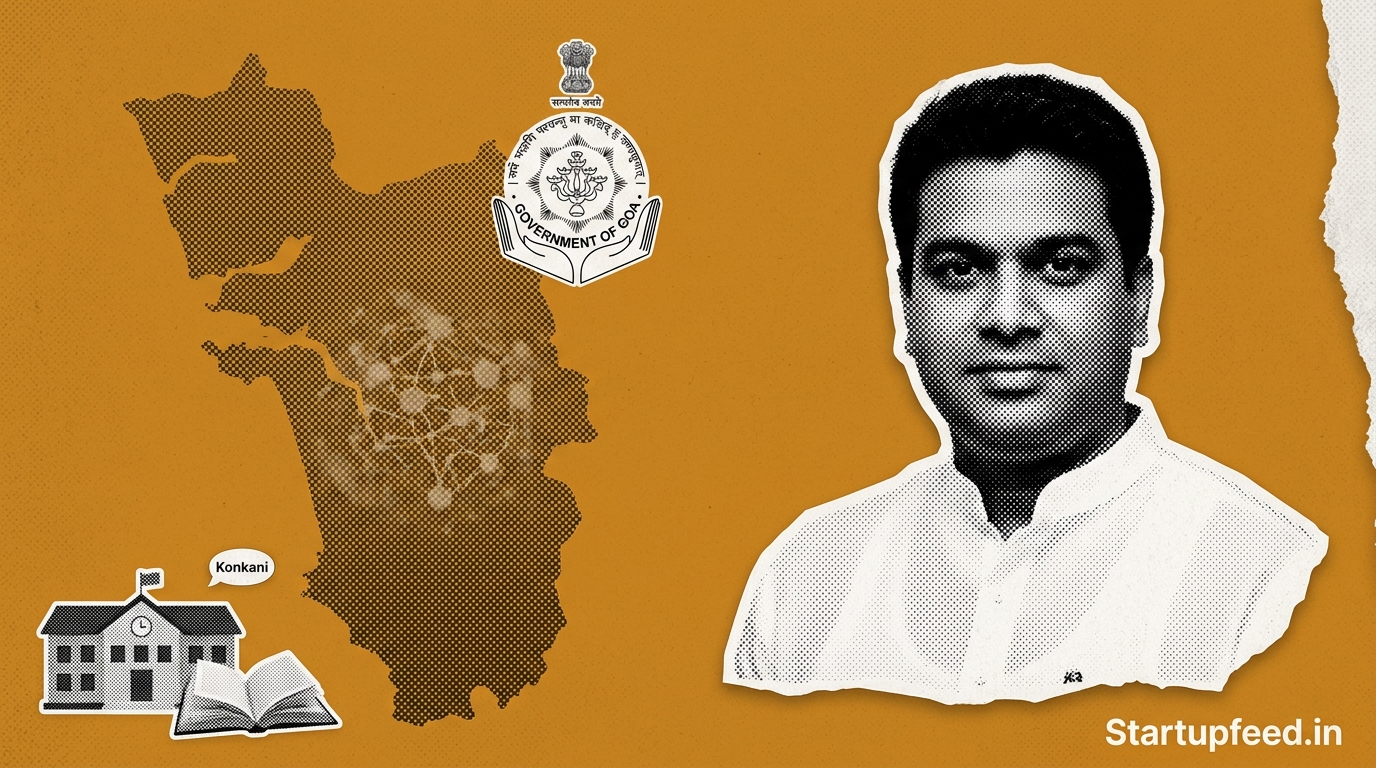
The Goa Draft AI Policy 2026was released for public consultation on April 29, 2026, by IT Minister Rohan Khaunte at Paryatan Bhavan, Panaji — completing in 50 days a commitment that had been given a 100-day window when it was announced at the Goa Legislative Assembly Budget Session on March 13. The draft is now open for public feedback from May 4 for 15 days on the state portal, the Goa Online portal, and the DITE&C website.
Structured around the four pillars of the Goa AI Mission 2027 — Skilling, Startups & Companies, Capital, and Governance & Infrastructure — the draft positions Goa as a destination for AI and deep-tech development, not a passive adopter. For a state with a population of 1.6 million and a tourism-dominant economy, the ambition is pointed: use AI to diversify economic identity and build home-grown talent pipelines that compete nationally.
StartupFeed Insight
Three things stand out in Goa’s draft AI policy that most state-level AI frameworks miss entirely. First, the Konkani LLM via Bhashini — India has 22 scheduled languages and fewer than a dozen have functional LLMs. A Konkani LLM is not just a cultural gesture; it is a genuine data moat. Any AI company building citizen-facing applications for Goa’s 9.1-lakh-user digital platform will need it, which means whoever builds it first owns a meaningful infrastructure layer. Second, the AI Kosh initiative — making government data assets available responsibly for AI research is one of the highest-leverage moves a state government can make.
If implemented well, it gives Goa-based AI startups access to proprietary datasets that private companies simply cannot replicate. Third, the AI Readiness Index for government departments this is governance innovation, not just tech deployment. It creates accountability infrastructure that most state AI policies skip entirely. The 50-day turnaround also sends a signal that this is not a shelf document. Our view: Goa’s size is its advantage, not its constraint.
A state small enough to implement fast, with IIT, NIT, and BITS Pilani already operating campuses, has a genuine shot at becoming India’s AI policy laboratory — the state that proves what works before larger states scale it. — StartupFeed Desk
What Does Goa Draft AI Policy 2026 Actually Propose?
| Pillar | Key Initiatives | Institutions / Partners |
|---|---|---|
| Skilling & Education | AI as a subject in schools and colleges; AI learning laboratories; teacher training; multilingual study material in Konkani, Marathi, Hindi and English; every technical graduate AI-ready by 2028 | IIT Goa, NIT Goa, BITS Pilani Goa Campus, Goa Engineering College, Goa Institute of Management |
| Startups & Companies | Grants and structured support for AI startups; additional provisions for women-led startups; AI startup development as a core policy focus | Startup & IT Promotion Cell (DITE&C); Goa Technology Association (GTA) |
| Governance & Infrastructure | AI chatbot for citizen services (GoaOnline — 280 services, 41 departments, 9.1 lakh users); AI for Governance & Social Impact workshops; Goa AI Hackathon; AI Centre of Excellence; AI Readiness Index for all government departments | DITE&C; ASSOCHAM Goa; GCCI; GEL; Education Department; IndiaAI |
| Vernacular & Data AI | Konkani LLM (in partnership with Bhashini); AI Kosh — responsible release of government data assets for AI research and innovation | Bhashini (Digital India language mission) |
| Deep Tech & Research | Chips-to-Startup (C2S) programme for semiconductor design; 5G Use Case Labs at BITS Pilani Goa Campus and NIT Goa; planned AI Centre of Excellence for research and startup collaboration | BITS Pilani Goa; NIT Goa; IIT Goa |
| Child Safety (proposed) | Social media access restriction under deliberation for children below 16 years; AI-driven educational tools as a replacement alternative | Proposal being referred to Chief Minister and Centre |
The draft incorporates 57 suggestions received from an earlier stakeholder round that included GTA, ASSOCHAM Goa, GEL, GCCI, the Education Department, and IndiaAI. The policy’s declared target sectors for AI deployment are healthcare, agriculture, tourism, finance, and public service delivery.
About the Goa AI Mission 2027 and Draft Policy Process
The Goa AI Mission 2027 was launched by DITE&C in 2025 under IT Minister Rohan Khaunte and operates as the implementing framework for the state’s broader AI ambitions. The mission has already delivered an AI-for-Governance workshop, a Goa AI Hackathon, and an AI chatbot rollout on the GoaOnline platform before the draft policy was even released.
The draft policy, released April 29, 2026, was finalised following two rounds of stakeholder consultationsincluding a meeting on April 7 at Paryatan Bhavan, Panaji, chaired by DITE&C Director Kabir Shirgaonkar. The policy is open for public feedback from May 4 to May 19, 2026 on the state portal, Goa Online, and the DITE&C website. Citizens, students, entrepreneurs, and researchers are invited to submit inputs before finalisation.
Why Is the Konkani LLM Initiative Significant?
The Konkani LLM — built in partnership with Bhashini, the Digital India language translation mission — is designed to enable AI systems to understand and respond in Konkani, allowing citizens to access government services in their native language. Konkani is the official language of Goa and is spoken by roughly 2.5 million people across Goa, Maharashtra, and Karnataka. It is one of India’s smaller scheduled languages, meaning existing commercial LLMs have minimal Konkani training data — which gives a purpose-built Konkani LLM a structural advantage for citizen-facing AI deployments in the state.
The initiative also connects to the AI Kosh project: by making government data assets responsibly available for AI research, Goa can generate the Konkani-language training data that no private company has the access or incentive to collect at scale. The two initiatives are architecturally linked, even if the policy presents them separately.
What Does the Social Media Proposal Mean for Goa’s AI Strategy?
The deliberation on restricting social media access for children below 16 — targeting platforms like Instagram and Facebook — is positioned by the state as a complement to its AI education push. The stated logic: replace passive consumption of social media with active AI skill-building through educational tools. Khaunte confirmed the proposal is still under stakeholder review and will be shared with Chief Minister Pramod Sawant for referral to the central government before any formal move.
The proposal mirrors actions taken internationally — Australia passed a similar under-16 social media ban in November 2024 — and signals that Goa’s AI policy is thinking about the demand side (youth attention and skill formation) and not just the supply side (infrastructure and investment).
How Does Goa’s AI Policy Compare to Other Indian States?
| State | Policy Status | Differentiating Feature | Startup Fund |
|---|---|---|---|
| Maharashtra | Approved — April 29, 2026 | Rs 500 Cr startup fund; 6 AI Excellence Centres; 2,000 GPUs; India’s first ethical AI framework | Rs 500 Cr (50-50 public-private) |
| Goa | Draft released — April 29, 2026; feedback open May 4–19 | Konkani LLM; AI Kosh data initiative; AI Readiness Index; 50-day turnaround; BITS Pilani + IIT Goa + NIT Goa research axis | Startup grants with women-led provisions (quantum not yet disclosed) |
| Telangana | AI Framework (2023) | NVIDIA partnership; AI City at Hyderabad | Not separately disclosed |
| Karnataka | Karnataka Digital Economy Mission | Bengaluru’s existing VC density; startup ecosystem depth | No dedicated state AI fund announced |
| Tamil Nadu | Safe & Ethical AI Policy (2023) | AI governance focus; TIDCO-backed compute access | Limited direct startup fund |
Maharashtra and Goa released their AI policies on the same day — April 29, 2026 — making it the most concentrated day of state AI policy activity in India’s history. Maharashtra is playing a capital-deployment game; Goa is playing an institutional and vernacular-infrastructure game. Both bets are legitimate, and both reflect the same underlying realisation: state-level AI policy is no longer aspirational — it is competitive.
What’s Next
The 15-day public comment window (May 4–19, 2026) is the most actionable near-term event. Founders building AI products in healthcare, tourism, agritech, or governance — especially those targeting Konkani-speaking users or Goa’s government digitisation stack — should submit inputs and, more importantly, make themselves known to DITE&C before the policy is finalised. The finalised policy, expected within the original 100-day window from March 13, should arrive before mid-June 2026. Watch for the quantum of the startup grant fund, the specific mandate of the AI Centre of Excellence, and whether the Chips-to-Startup semiconductor programme gets a dedicated budget line — three details conspicuously absent from the draft release.
Frequently Asked Questions
What is Goa’s Draft AI Policy 2026?
Goa’s Draft AI Policy 2026 is a state government framework released on April 29, 2026, by IT Minister Rohan Khaunte under the Goa AI Mission 2027. It covers four pillars: skilling, startups and companies, capital, and governance and infrastructure. Key proposals include a Konkani LLM built with Bhashini, AI labs in schools, grants for AI startups with additional support for women-led ventures, an AI Centre of Excellence, and an AI Readiness Index for governments departments. The draft is open for public feedback from May 4 to May 19, 2026.
How can I give feedback on the Goa AI Policy 2026?
The Goa Draft AI Policy 2026 is available for public comment from May 4, 2026 for 15 days on three platforms: the Goa state portal, the Goa Online portal, and the DITE&C (Department of Information Technology, Electronics and Communications) website. Citizens, students, entrepreneurs, researchers, and industry stakeholders are all invited to submit their suggestions before the policy is finalised.
What is the Konkani LLM and why does Goa’s AI policy include it?
The Konkani LLM is a large language model being developed in partnership with Bhashini — the Digital India language translation mission — that will enable AI systems to understand and communicate in Konkani, the official language of Goa. The initiative is designed to allow Goan citizens to access government services in their native language through AI-powered interfaces. It is architecturally connected to the AI Kosh project, which will make government data assets responsibly available for AI research, helping build the Konkani-language training data needed to make the LLM functional.
Written by Harshvardhan jain. Published: May 1, 2026. Updated: May 1, 2026. Have a tip? Write to us at editorial@startupfeed.in.
Liked this story? Follow StartupFeed on Google so our reporting reaches you first.